
Not only does Singapore have an airport that is voted among the world’s best, but the trains and buses run regularly, and the taxis are (usually) plentiful. The public transport system is carefully integrated, so train stations usually have a taxi stand or bus stop nearby. Plus, there are lots of easy payment options – more details below.
# Air
Unless you’ve driven in from Malaysia or you’re coming on a slow boat from somewhere, you’ll be landing at Changi when you arrive. And what an airport it is – in fact, up to 2026, Skytrax has named it the World’s Best Airport a total of 14 times!

Over 100 airlines fly to Changi from 400 cities around the world. Passenger numbers for 2024 were around 67.7 million, a 13 percent increase over the previous year.
In addition to four terminals (and a fifth, T5, set to open in the 2030s), the airport is also home to Jewel Changi Airport, an enormous lifestyle and retail complex that’s worth visiting even if you’re not flying anywhere.
Changi reclaims its crown!
Over the past five or so years, Changi has been in a tussle with Qatar’s Hamad International Airport for best airport honours, with Changi winning in 2020, 2023, 2025 and 2026, but Qatar coming first in 2021, 2022 and 2024. This year, Changi rose to the top again, claiming the award for the 14th time.
Changi Trivia Test!
- How old is the airport: 25 years, 45 years or 65 years?
- Changi opened with just two restaurants – McDonalds was one of them, true or false?
- The HSBC Rain Vortex at Jewel is the “World’s Highest Indoor Waterfall”. What country was home to the previous highest?
- How frequently does someone lose a smart phone at Changi: every 3.5 hours; 30 seconds; or 52 minutes?
- What airline that served as the regional arm of Singapore Airlines, flying five million passengers around Southeast Asia, ceased in 2021?
Answers: 1. 45 years. 2. True! The other restaurant was Swensen’s. 3. Also Singapore! The indoor waterfall in the Cloud Forest at Gardens by the Bay previously held the mark. 4. 52 minutes (approximately 10,000 mobile phones per year). 5. SilkAir (the airline was absorbed by Singapore Airlines).
Also… Did you know that Changi has its own distinctive fragrance diffused in various areas throughout the airport. It has notes of ylang-ylang, damask rose and orchid tea, and is designed “to leave you invigorated for your journey ahead”.
# Rail
The MRT and LRT (Light Rail Transit) system is the island’s train network, offering reliable, air-conditioned and cost-effective transport. These are the MRT lines that are currently in operation:
- North-South Line – red
- East-West Line – green
- Circle Line – orange*
- North East Line – purple
- Downtown Line – blue
- Thomson-East Coast Line – brown
And these are the LRT lines as of 2026 (they are all coloured grey on the Land Transport Authority map of Singapore’s rail networks):
- Bukit Panjang (BPLRT)
- Sengkang (SKLRT)
- Punggol (PGLRT)
Did you know? In 2020, around three-quarters of respondents in a Twitter survey said that they believed the Circle Line was yellow in colour, while a quarter claimed that it was orange. The official answer? It’s orange. The LTA posted a tweet to clarify, before adding: “’Orange’ you glad we cleared that up.”
What’s new?
- Singapore’s newest MRT station is Hume, which opened in February 2025, on the blue Downtown Line.
- The Jurong Region Line (teal coloured) will fully open from 2029 as an aboveground line using smaller trains to accommodate 150 to 200 commuters.
- The average number of daily passenger trips on the MRT in 2024 was 3.41 million, a record for Singapore.

# Road
Buses
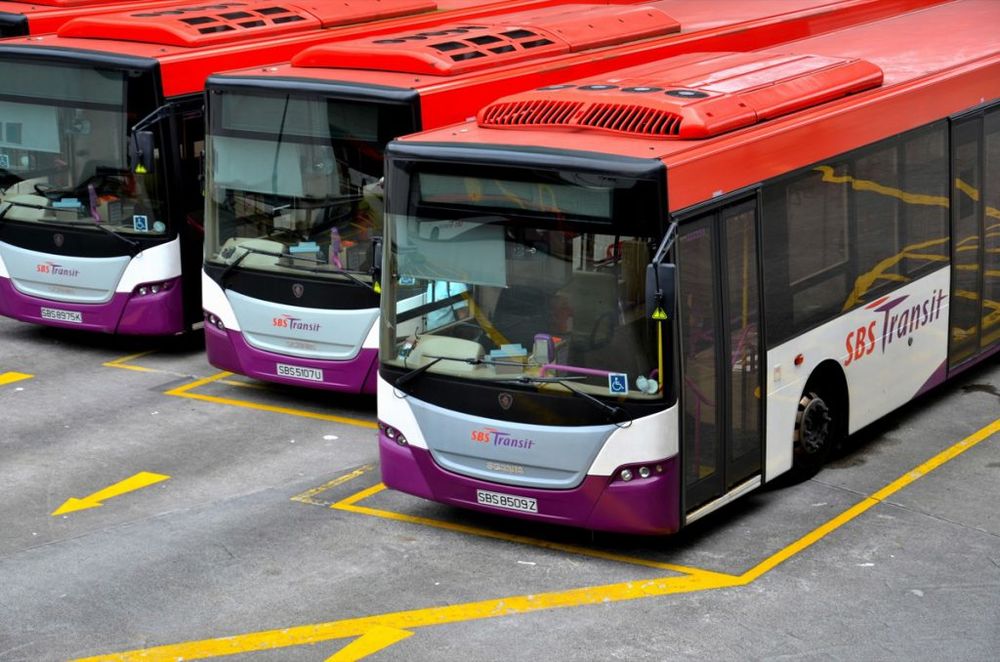
It might be a small island, but Singapore is home to more than 5,000 bus stops! The bus service is an affordable and reliable way of travelling that reinvents the clunky, dusty systems found in many major cities. Dozens of electric buses have been added in recent years – the LTA aims to have its whole fleet electric by 2040. Singapore continues to trial driverless buses, too.
Editors’ tips: EZ-Link or smartphone
Fares for trains and buses run on the EZ- Link card system, which can consist of a physical card that you tap when getting on and off transport including debit or credit cards, or an app (EZ-Link / SimplyGo). You can also pay by bank card if you have it linked up to your phone or smart watch – for example, Apple Pay, Google Pay or Samsung Pay. This is an increasingly popular way to pay for MRT and bus fares in Singapore.
For tourists, there’s a Singapore Tourist Pass that can be purchased from money changers at Changi Airport. It provides unlimited travel on buses and trains for one to three days. You can also tap a foreign-issued bank card to pay for a fare, but these may be subject to a $0.60 administrative fee per day of use.
Readers’ thoughts
“It’s brilliant! My typical MRT routes are Dakota to Botanic Gardens or Eunos to Orchard.” – Mangla
“Although I rarely use it, I recognise that the public transport system here is efficient and clean compared to other countries we’ve lived in and back home in London.” – Charlotte
“These days, I’m more of a bus person – less crowded and a better view. However, I find both modes of public transport clean, highly efficient and cost-effective. I use the 970 bus to collect my daughter from nursery school and my son from mandarin tuition sessions. The journey is always filled with anticipation as he loves to press the ‘stop’ bell before we alight!” – Eve
“It’s really very good. I take the MRT to work from Novena to Telok Ayer Street daily – 30 minutes all in. It’s also clean and cheap.” – Alexander
“I love long bus rides when I’m not in a rush – it’s peaceful watching the world go by through the window. On busier days, I use trains for speed and convenience. The ‘gothere.sg lite’ app is helpful for planning your route, giving you options for bus, train, taxi or even driving, including estimated travel times. Another favourite is BusLeh, which tells you exactly when the next bus will arrive.” – Exther
“I use public transport a lot – commuting to work, taking the kids to and from school and going to enrichment classes.” – Soumita
“I have memories of taking buses in the UK – rainy days when the bus was late or just didn’t turn up, while standing under a little bus flag that signalled a stop. Here in Singapore, most stops have a shelter to shade you from the sun or rain. The buses run on time and the MRT is so frequent it makes it easy to get around. It’s also a reasonable price.” – Millie
Taxis & Share Rides
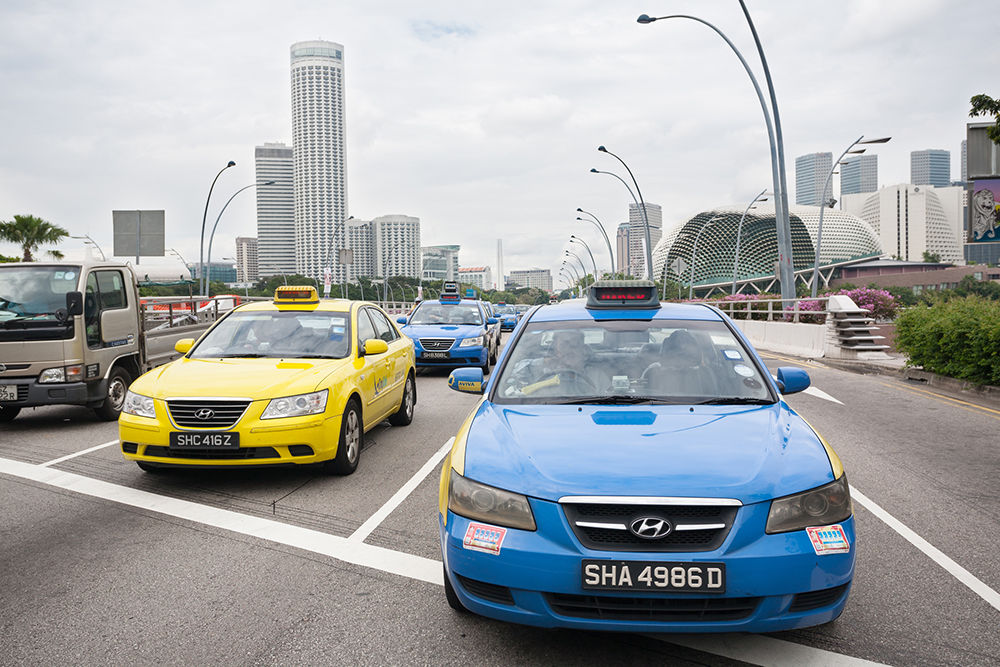
If you prefer to get a car across the city, you can hail a cab from Singapore’s well-established taxi system, or use one of the rapidly-growing private companies, including Grab (which took over Uber’s Southeast Asian operations in 2018), Gojek and Tada.
The base fare for travelling in a standard taxi is around $4, with additions made during peak hours (6am to 9.30am, and 6pm to midnight), and a CBD surcharge of $3. You can pay for taxis and private hire cars with cash (smaller denominations preferred), credit card, NETS, EZ-Link cards, or via the company’s appt.

Top tips from our panel of Expat Living readers:
“If you’re trying to get a taxi or Grab from an area you’re unfamiliar with, there’s usually an option to send a photo/description of your location to the driver through the app’s chat function. This greatly assists the driver in locating you – and, as a perennially geographicallychallenged individual, it has served me many times!” – Eve
“Plan your travel a little in advance. For instance, if you’re heading out around 7.30am, try booking a Grab Hitch for 7.15am. It gives you a buffer if there’s no Grab Hitch available so you can use other options, and it can save you a few dollars compared to a Grab car option. You can then treat yourself later with a cuppa!” – Exther
“When we need a taxi, we try several companies as we’ve found there can be quite a difference in cost. Also, if you see the rain coming, it’s going to cost a bit more, so book one earlier. Try to avoid peak times, too – travel a little earlier or a little later.” – Millie
“They’re all pretty reliable – Grab, Tada and Gojek all have variable pricing. We get the kids a cab to school in the morning and it costs around $18 from Novena to Yishun; more if it’s raining – but usually not extortionate. We don’t bother with street-hail cabs anymore.” – Alexander
“Install all the taxi apps; you may have to look for a ride from multiple sources at the one time – also, taxi prices can be like the stock market, and at times drivers aren’t in the mood to pick you up, so backups help!” – Soumita
For more helpful tips, head to our Living in Singapore section.
This article first appeared in the Expat Living City Guide.
Don't miss out on the latest events, news and
competitions by signing up to our newsletter!
"*" indicates required fields