“The Singapore Pages” is a monthly feature in Expat Living magazine where we look at fun, quirky and interesting Singapore news and trivia – on food, culture, art, history, nature and more. Here are some snippets from recent instalments!
Red Light, Green Light
The world’s first traffic signal was installed in Parliament Square in London in 1868; it was a manually operated system using a gas lamp. The first electric traffic light was introduced on a street corner in Cleveland, Ohio, in 1914; and the first four-way, three-colour light (including amber for caution) was used in Detroit, Michigan in 1920.
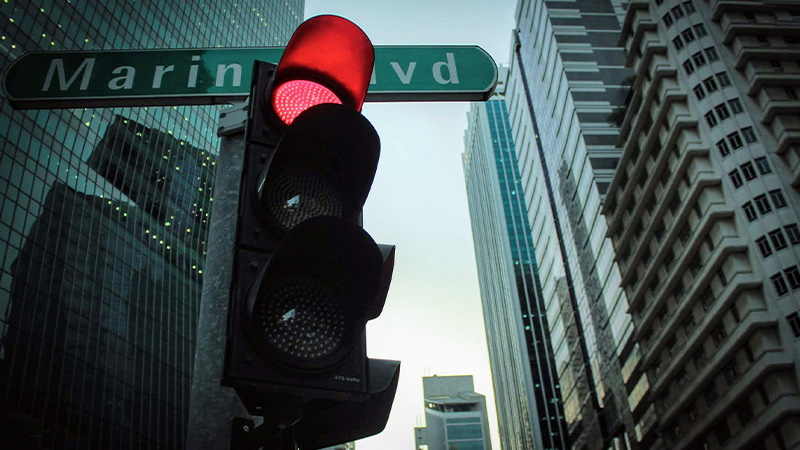
Singapore wasn’t too far behind: the island’s first electric traffic light – also one of the earliest such lights in Asia – flickered on in Empress Place (near today’s drop-off area for the Asian Civilisations Museum) in 1930. It was said to be different to Western models, with a pagoda-style canopy to protect it from heat and rain.
First traffic lights in other places in the region:
Indonesia – 1934 (Bandung)
Malaysia – 1937 (Ipoh)
Thailand – 1963 (Bangkok)
The first appearance of the “Green Man” style of pedestrian traffic light came in the late 1970s, with an audible version installed on Paya Lebar Road in 1978 to assist visually impaired pedestrians. One online commenter says they remember loudspeakers set up next to the lights with instructions in different languages about how to use them.
In 2009, the LTA launched “Green Man+”, which allows seniors and people with disabilities to tap a concession card at a traffic light to extend the green man timing by between 3 and 13 seconds.
In another innovation, the LTA last year began replacing 11,500 push buttons at traffic junctions across Singapore with touchless sensors, so you can just wave your hand to activate the signal.
Did you know? There are currently around 2,700 intersections in Singapore with traffic lights. Green lights used to be fixed at 85 seconds; today, the timing depends on the traffic flow.
Sentosa reimagined
When you cross over to the island of Sentosa, you first pass a smaller island on your left – noticeable for its multi-coloured shipping containers, cranes and other port activity. That’s Pulau Brani. And in the coming years, it will start to look very different.
The Sentosa Development Corporation (SDC) unveiled the next chapter of its Greater Sentosa Master Plan, a long-term transformation that will integrate Sentosa with Brani, greatly expanding the “island playground” off the south coast of the Singapore mainland.
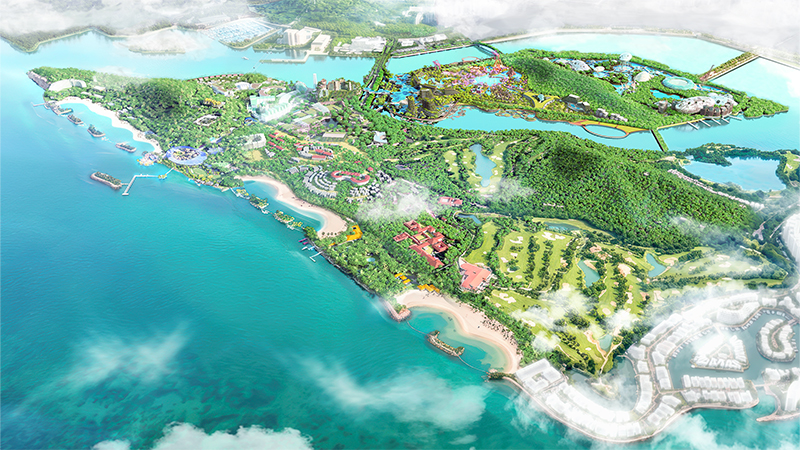
Here’s what to expect:
- New spaces for next-generation experiences, attractions and hotels
- New iconic landmarks on Sentosa including Imbiah Canopy and Imbiah Lookout Walk, plus an events centre, Sensorium
- New beach club concepts and a unique islet-hopping experience
- Enhanced land, air, sea and waterfront links, including a new people mover system to replace the current monorail. The artist’s impression pictured here shows Sentosa in the foreground with Pulau Brani at back right.
Obviously, these things won’t happen overnight – it’s a 20-year master plan, with the first wave of projects set to open by the early 2030s. The aim, though, is for Greater Sentosa to see twice the number of annual visitors as the area does today. Find out more at sentosa.com.sg/greatersentosa.
5 things about Pulau Brani
- The island is about a quarter the size of Sentosa (120 hectares compared to 500).
- With a name meaning “island of the brave”, Brani was home to a small Orang Laut community who lived in stilt houses on the water until around 50 years ago.
- Brani also served as a centre for tin smelting from the late 1800s to the 1960s, while the British army simultaneously maintained a maritime base there, with family quarters and even a school.
- In the 2000s, the island was developed into the Brani Container Terminal.
- To facilitate the transition to a lifestyle destination, port operations on Brani are relocating to Tuas Megaport.
Champion orchids named!
We think all orchids are kind of special, but what makes a particular orchid an award-winner? If you’re a judge with the Orchid Society of South East Asia (OSSEA), the factors you’ll weigh up include shape, colour, presentation, size and substance, along with miscellaneous considerations such as difficulty of cultivation or noteworthy botanical attributes.
Recently in Singapore news, OSSEA’s judges convened at the 10th edition of the Singapore Garden Festival, where they assessed 366 entries of orchids from Asia and the Americas to determine the Grand Champion in the Singapore Orchid Show.
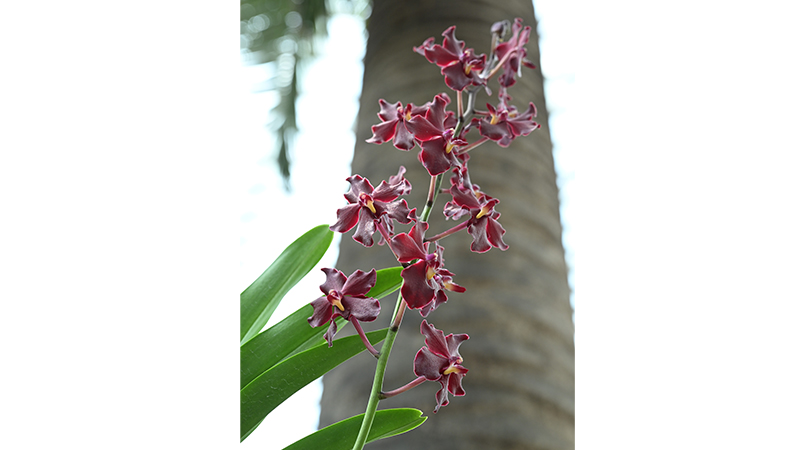
The winner was Renantanda Singapore Gardening Society x Vanda Alice Motes – and while the flower’s name doesn’t roll off the tongue, it’s certainly a fine-looking specimen!
The “Motes” part of the name comes from Dr Martin Motes, a world-renowned orchid breeder and author. He’s known for his work with the Vanda genus, which produces showy, fragrant, longlasting and intensely colourful flowers. One of its varieties, Vanda Miss Joaquim, is Singapore’s national flower.
About the Kallang River
The photo below shows the Kallang River, taken from the viewing deck at the Kallang Basin. The Kallang is the longest river in Singapore, flowing for 10km from Peirce Reservoir to the coast at Nicoll Highway. One nice spot to see its course is in Bishan-Ang Mo Kio Park, where it flows west to east through the middle of the green space.
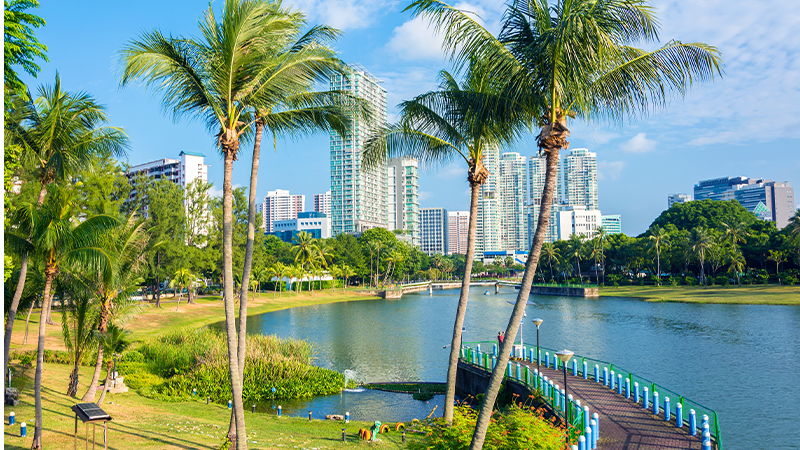
As for the name, it almost certainly comes from the community of Orang Kallang boat-dwellers who occupied this area until the 1820s. The word “kallang” is believed to be a Malay term describing a “shipbuilding place”.
Did you know? Ten kilometres is obviously quite modest by “longest river” standards, but there are in fact 19 countries and 22 territories around the world that have zero natural flowing rivers; they include Saudi Arabia, Bahrain, Malta and Tonga.
Discovering the durian
The peak season for durians in Singapore runs from June to September – always an exciting time for fans of “the King of Fruit”. Here are a few things you may or may not know about these unique spiky spheres.
#1 They’re available in many varieties
If you’ve tried one durian, you’ve tried them all, right? Wrong! Turns out, there are dozens of named varieties of durian. Some are sweet, some are bitter. Some have white flesh while others sport pale yellow, orange or even red fruit. Each has a very distinct flavour and smell. Prominent varieties for 2026 include the ever-popular Mao Shan Wang (or “MSW”), D24 and Red Prawn.

#2 They’re native to several countries
Durians come from Malaysia, Borneo and Sumatra, but Thailand is now the biggest exporter, shipping over a million tons in 2025; Vietnam is a close second. Most durians in Singapore come from Malaysia and are picked daily. In fact, the name “durian” is derived from the Malay word “duri”, which means thorn.
#3 They’re heavy, fleshy and seasonal
Durians typically weigh between one and three kilograms, depending on the variety, and the copious volume of flesh inside can be found in five different compartments. Durian trees are evergreens, and there are several seasons for durian, but high season is mid-year.
#4 They’re enjoyed at various stages of ripeness
A ripe durian will begin to crack, but some people also hit them with a knife and listen to test the ripeness – kind of like thumping a watermelon. In some parts of Asia, people like the fruit a little crisper; here in Singapore, durian lovers generally prefer it gooey.
#5 They’re full of nutrients
While an average 1kg durian has a whopping 1,350 calories, the good news is that they’re naturally rich in vitamins A, B complex and C, and minerals such as magnesium, potassium, manganese and copper; they’re also an excellent source of dietary fibre.
#6 They’re stinky
Yup, durians smell. When a team of German scientists tried to figure out why the fruit is so whiffy, they identified 50 distinct odorous compounds, including four that were previously unknown to science! Animals can smell them from about half a mile away. The strong odour is why they’re banned from public transport in Singapore.
What else?
- Durian flowers are mostly pollinated by bats rather than bees.
- Alcohol and durian are considered a bad mix, perhaps on account of the sulphur compounds in the fruit, which are thought to interfere with the body’s ability to break down alcohol.
- Aside from its natural fruit form, durian is found in ice cream, cakes and other foods in Singapore. It’s used in other ways, too – including the disused husks being made into antibacterial bandages that can speed up wound healing!
- Singapore’s MRT durian ban began in 1988; some hotels also impose a fine for guests who leave durian odours in their rooms. (A woman was fined $200 by a hotel in May last year.)
About JY Pillay
We recently spotted a social media post that was doing the rounds about veteran civil servant JY Pillay and his astonishing contributions to the Singapore economic and political landscape over his long career. Pillay, born in 1934 in Klang, British Malaya, obtained a first-class honours degree in engineering, working for a time in Kuala Lumpur, before joining the Ministry of Finance in Singapore, and later becoming its acting permanent secretary.
Perhaps his best-known accomplishment was helping to transform Singapore Airlines during his role as founding chairman from 1972 to 1996. His tenure at SIA included the largest single purchase of aircraft by any airline, when in 1978 he ordered almost US$1 billion worth of Boeing 747 jumbo jets and other planes. By the time he stepped down, SIA was a powerhouse – ranked the world’s third best airline.
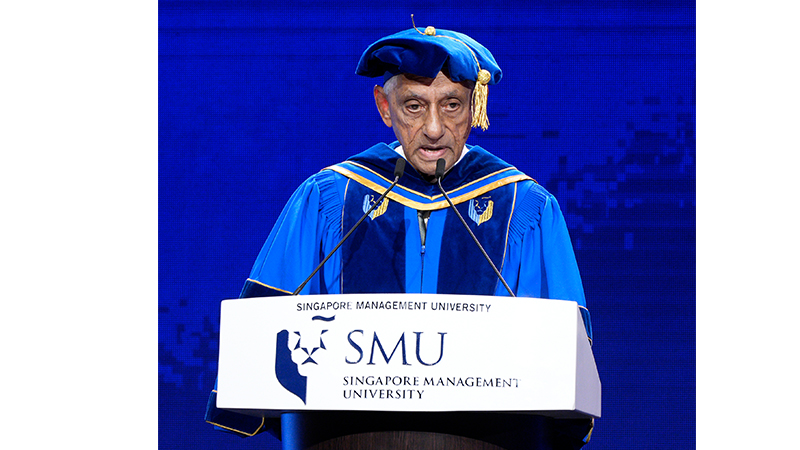
Elsewhere on Pillay’s very stacked CV are the following: managing director of the Monetary Authority of Singapore, first chairman of the Singapore Stock Exchange, permanent secretary in the defence and national development ministries, Singaporean High Commissioner to the United Kingdom, Ambassador to Ireland, Chancellor of Singapore Management University (SMU), director of the Singapore Symphony Orchestra… the list goes on!
JY Pillay even had a stint as the nation’s acting head of state. In 2017, when President Tony Tan’s term expired, it would be two weeks before the next president, Halimah Yacob, was sworn in. Pillay, who at the time was Chairman of the Council of Presidential Advisors, was elevated to Acting President of Singapore for 13 days.
Amazing. We need a cup of tea and a lie down just from reading it all!
A rainbow of rail lines
The MRT continues to grow, along with the palette of colours you can find on the system map:
- Red: North-South Line
- Green: East-West Line
- Orange: Circle Line
- Purple: North East Line
- Blue: Downtown Line
- Brown: Thomson-East Coast Line
- Teal: Jurong Region Line (est. 2029)
- Lime green: Cross Island Line (est. 2030)
For the first 14 years of operation (1987-2001), the MRT used a dual-colour system for each line, with different colours designating the direction of travel. So, the North-South Line was red for southbound travel and yellow for northbound travel. When authorities realised there would soon be too many colours on the quickly expanding MRT map, they changed to the current single-colour system. Speaking of colours, since its launch in 2009, the Circle Line has been known colloquially to many as the “yellow line” – despite the fact that the official colour is orange. As recently as April 2026, the LTA were reminding people of this fact on social media, saying: “For the record, it’s orange, not yellow. We’ve checked.”
By the way, if you’re wondering why “North-South” and “East-West” have hyphens, and “North East” doesn’t, it’s because the first two refer to directions of travel, while the latter refers to an area, as most of its stations are in the island’s northeast
Singlish in the dictionary
March of 2026 saw the release of the latest update of the Oxford English Dictionary (OED), with around 500 new words and phrases – including “doomscrolling” and “jelly” (short for “jealous”) – making the cut.
The fresh batch of words included a handful of new Singlish words, adding to the likes of “shiok” and “lepak” that have previously found their way into the official OED.

The March 2026 entries – which aren’t described as Singlish but rather as “having a Singaporean or Malaysian English etymology” – include the following:
- “kaypoh” – a noun, adjective or verb that refers to a busybody, gossip or someone who sticks their nose in other people’s business
- “play play” – often used in the negative sense, “don’t play play”, meaning something like “don’t mess around” or “don’t take things lightly”
- “BTO” – a property-related term (from a “Build-to-Order” housing scheme) that has taken on a second meaning referring to a couple’s relationship status; applying for a BTO together means things are getting serious, or that an engagement might be imminent
- “jialat” – this is derived from Hokkien and literally means “to eat away the strength”; it’s a negative word referring to some kind of trouble or predicament
- “ice kacang” – no double meaning here; this is literally just the treat of shaved ice covered in syrup and toppings that you find at most hawker centres!
Speaking of hawker centres, it’s another phrase that’s already been in the OED for some time. Other very common Singlish terms in the dictionary that even newcomers to the island are likely to have heard include “blur”, “alamak”, “ulu”, “kiasu” and “chope”. There are around 30 in total that have been recognised in this way.
Did you know?
AA Milne’s Winnie-the-Pooh has its own Singlish translation, released in 2023 by Singaporean author Gwee Li Sui – it’s called Winnie-da-Pooh, and follows on from Gwee’s earlier Singlish version of Beatrix Potter’s classic children’s book, which he named The Tale of Peter Labbit.

Wildlife spotting
It doesn’t happen very often, but a rare Malayan tapir was spotted in Singapore recently. A midnight cyclist saw the animal in March 2026, in the Lorong Halus area (in the northeast of the island, near Pasir Ris and Coney Island). He was able to slow down and document his find, before the beast – which he described as “the size of half a car” – moved on from grazing on grass and returned to the jungle.
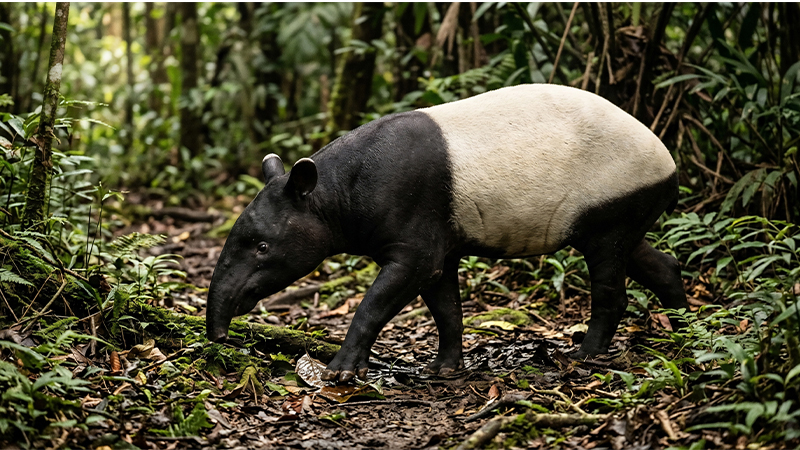
There are thought to be around 3,000 of these animals in existence, almost all in the Malay peninsula, but seeing them in Singapore is a rarity. In the 2020s, there have been four or five documented sightings. Authorities believe they use their strong swimming skills to get across from Johor using nearby islands as resting points.
The animal is classified as endangered (at high risk of becoming extinct in the wild).
What to expect from Wetlands by the Bay
Three things to know about an upcoming expansion of Gardens by the Bay, slated to open in 2028.
#1 Announced in early 2026, Wetlands by the Bay will add an area around the size of seven football fields to the current Kingfisher Wetlands, with 600 additional mangroves and coastal plants – including species from Costa Rica, Sri Lanka and Timor-Leste.
#2 A canopy boardwalk will provide an elevated, over-water encounter with nature, and also link to the Gardens by the Bay MRT station, while international art collective teamLab will be launching a flagship museum, including a “multi-sensory pedal kayak experience”.
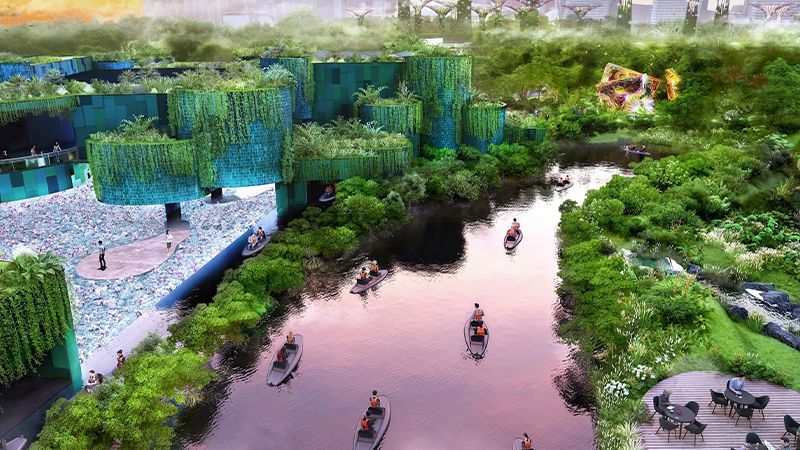
#3 A new, larger waterfront dining block will replace Satay by the Bay and include an upper deck for a wider range of eating options. There will also be a new event space, Glade Lawn.
Construction starts in the first quarter of 2027, with staged openings up to the end of 2028. Meanwhile, Bay East Garden will be linked to the main Gardens by the Bay area via a new bridge across Marina Bay that is set to offer a “walking-on-water experience”.
Why Dakota?
Along with an MRT station, the word “Dakota” appears in the names of two roads in Singapore – Dakota Close and Dakota Crescent.
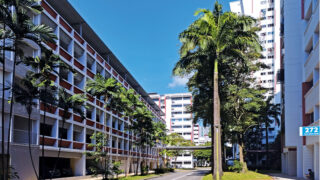
The latter is also the name of a building, which is one of Singapore’s oldest housing estates. Dakota Crescent was built in the 1950s, just prior to the establishment of the Housing and Development Board (HDB). Several blocks of the original 17 from the estate are still occupied today. It’s located just east of the former Kallang Airport, which was operational from 1937 to 1955; this is also why you’ll find Old Airport Road (and the popular hawker centre of the same name) in the vicinity.
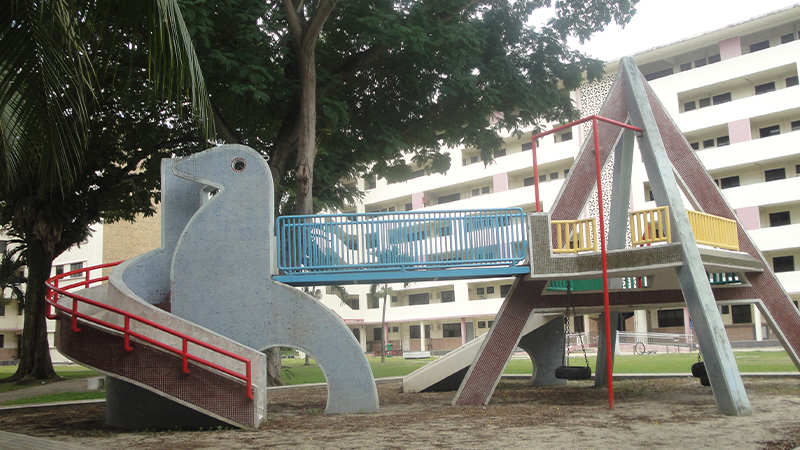
As for the Dakota name, while it sounds like it might relate to the US states of North and South Dakota (“dakota” is a Sioux word for “friends”), it actually derives from the Douglas DC-3 aircraft, which could frequently be seen taking off and landing at the airport in the 1940s and 50s. The plane was nicknamed “Dakota” after the acronym DACoTA, from “Douglas Aircraft Company Transport Aircraft”.
Did you know? Today, the remaining blocks of Dakota Crescent are clustered around the Dove Playground (above), one of Singapore’s best-known heritage playgrounds. (Another of these that many people are familiar with is the Dragon Playground in Toa Payoh.) Several of these structures were the vision of Khor Ean Ghee (b.1934); he was a former HDB interior designer and watercolour painter, and he also served as the president of the Singapore Art Society.
The story behind the names of six Singapore islands
St John’s Island
The current name of this island off Singapore’s south coast seems a world away from what it was called historically: Pulau Sekijang Bendera, Malay for “Island of One Barking Deer and a Flag”. In fact, the two may be connected. It’s thought that when early European sailors heard the word “Sekijang” in the island’s name, they corrupted it to “Saint John” – and it stuck.
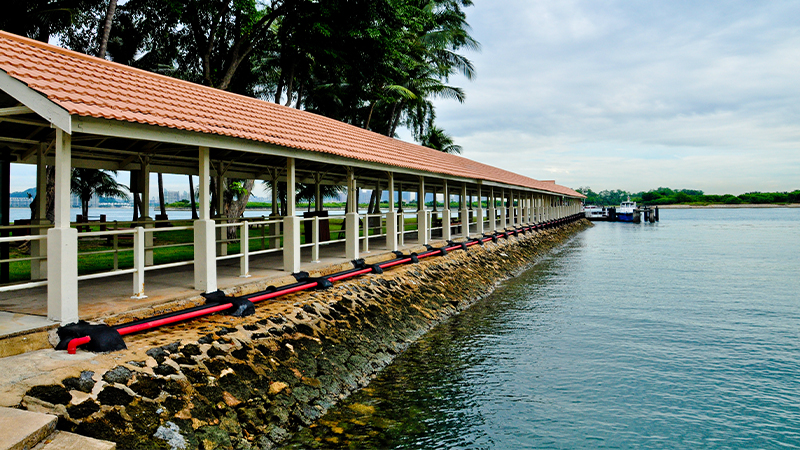
The barking deer (or muntjac) referred to in the Malay name was once found in Singapore but has been extinct here for about a century.
Lazarus Island
Lazarus is joined to St John’s, and it shares a similar historic name: Pulau Sekijang Pelepah: “Island of One Barking Deer and Palm Trees”. The modern name may relate to a cholera epidemic in the 1870s, when the islands were transformed into a quarantine centre, or lazaretto – an isolation hospital for people with infectious diseases. The word derives from the biblical character of Lazarus the beggar (different from the one who was raised from the dead!).
Kusu Island
“Kusu” means “turtle” or “tortoise” in the Hokkien dialect. Two species of sea turtle are commonly encountered in Singapore’s Southern Islands: the green turtle and the hawksbill. However, the name is more likely a reference to the legend of a giant tortoise that transformed into the island to provide a safe haven for shipwrecked sailors.
Sentosa
It might have a pleasant name today – “Sentosa” comes from the Malay word for “tranquillity” – but this popular resort island was once called Pulau Blakang Mati, or “island of death from behind”. This may refer to a period when piracy was rife, or to a huge malaria outbreak in the 1840s, which nearly decimated the population of original settlers. At the time, the deaths were blamed on the island’s swampy water and decaying leaves; only later were mosquitos found to be responsible.
The island was renamed Sentosa in 1972 after a contest held by the Singapore Tourist Promotion Board.
Coney Island
Formerly known as Pulau Serangoon, this island once belonged to the Burmese-Chinese entrepreneurial brothers Aw Boon Haw and Aw Boon Park (of Haw Park Villa and Tiger Balm fame). They sold it in the 1950s to an Indian businessman who intended to create an amusement park in the style of New York’s Coney Island – hence the name.
Sisters’ Islands
This island pair is separated by a narrow but dangerous channel that gave rise to the legend behind the name. Minah and Linah, two pretty daughters of a poor widow, vowed to marry two brothers so they could always live together. When Linah was snatched away by a pirate chief, Minah swam after the boat but was swept away by a wave. Seeing this, Linah broke free and hurled herself overboard. A huge storm ensued, and when it cleared, two islands stood in the waters where the girls had drowned.
Some others:
Pulau Hantu – Ghost Island
Pulau Tekukor – Spotted Dove Island
Pulau Ubin – Granite Island
Pulau Biola – Violin Island
Pulau Jong – Junk Island
Pulau Satumu – One Tree Island
Tourism updates
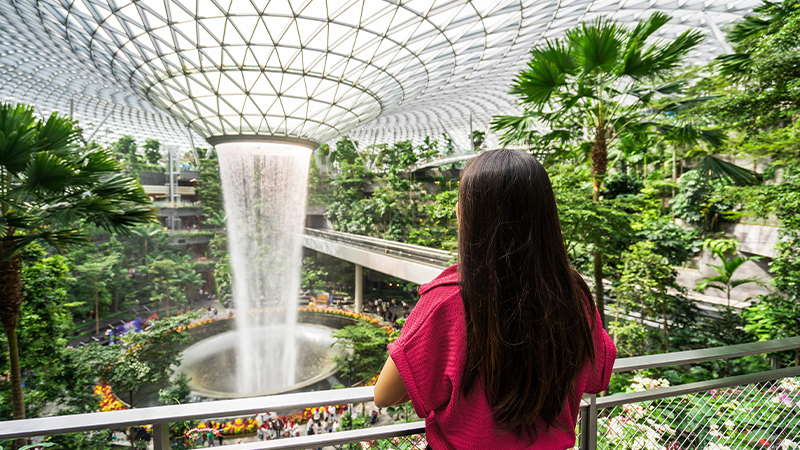
In figures released in February 2026, Singapore’s tourism numbers for 2025 smashed previous records, with the country posting a record $23.9 billion in tourism receipts for the first three quarters – the highest ever. International arrivals jumped 2.3 percent from the previous year to 16.9 million. One big growth area was cruise arrivals, up 10 percent, with 375 boats and 2 million passengers docking here during the year.
About Thaipusam
Thaipusam is a major Hindu festival (being held next on 22 January 2027), which sees devotees conduct a 4.5-kilometre “Walk of Faith” early in the morning. On this walk, they carry brightly decorated kavadis – burdensome metal frames up to 40kg in weight – which are attached with sharp skewers piercing their tongues, cheeks and bodies. The procession goes from Sri Srinivasa Perumal Temple at Serangoon Road to Sri Thendayuthapani Temple at Tank Road.
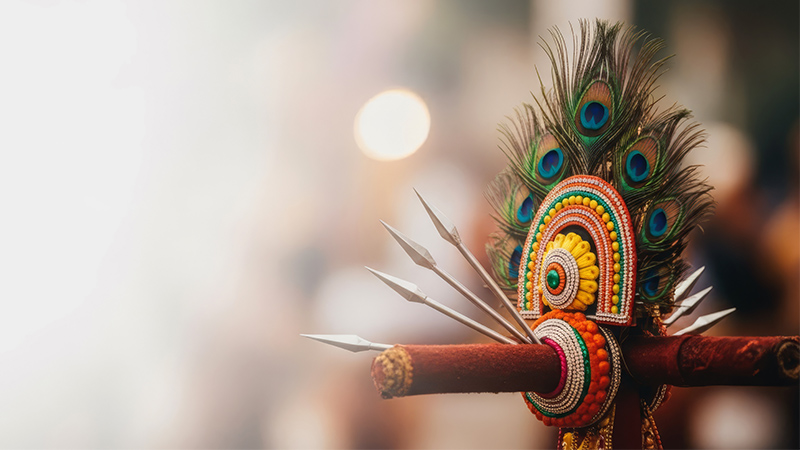
Did you know?
- Thaipusam is no longer a public holiday in Singapore, but it was until 1968; in that year, the Holidays Amendment Act was passed to reduce the number of public holidays in order to improve economic competitiveness.
- The biggest Thaipusam procession in the region takes place at the Batu Caves, just outside Kuala Lumpur.
Cycling – past, present & future
Singapore’s current network of more than 700km of cycling paths and park connectors has grown recently, with the addition of 51km of new cycling paths in Geylang, Kaki Bukit, Serangoon and Senkang. The paths were constructed with low-carbon concrete as part of the sustainability efforts of the LTA (Land Transport Authority).
The LTA has plans to bring the island’s total cycling network up to around 1,300km in length by 2030, helping connect people’s homes to MRT stations, bus interchanges, shopping malls, schools and more.
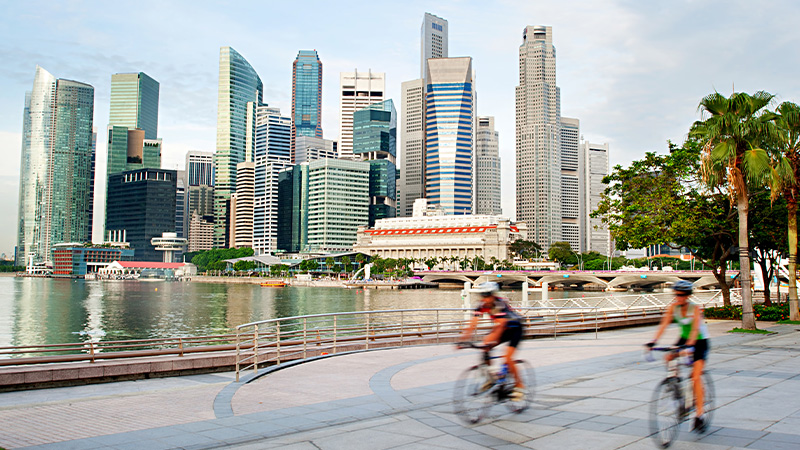
There might be some nice new trails in Singapore, but the sport of cycling has been here since the 1860s. Back then, the contraption used for riding was referred to in English as a “two-wheel velocipede”. The word “bicycle”, coined in France, arrived a little later.
By the end of the 19th century, cycling was ubiquitous. Here’s a passage taken from Harper’s Weekly magazine from the 1890s: “The bicycle is more popular in Singapore than in any other Eastern port; and naturally, since the roads thereabouts are not only very picturesque, but literally the best in the world. The only drawback is the rain!” This growth continued in the first half of the 20th century, and by 1960 Singapore was home to over a quarter of a million bicycles.

But cycling’s popularity would soon be challenged. Car ownership boomed from the 1970s (at which time, 50 percent of cars in Singapore were Japanese). Cars became so popular, in fact, that the growth rate of ownership was around 12 percent per annum in the 1980s and 1990s. This led to the introduction of the COE (Certificate of Entitlement) in an effort to control numbers on the road.
The good news (from both a health and environment perspective) is that cycling has had a resurgence – and the growth of cycling infrastructure in Singapore, including the paths mentioned above, has surely played a big part.
See an interactive map of all current cycling paths and park connectors on the island at lta.gov.sg/content/ltagov/en/map/cycle.
5 things about gambier
You don’t have to do too much reading about Singapore’s history before coming across a reference to gambier, and the vast plantations of the stuff that were once found here. But what is it? And where did it all go?
#1 Gambier – scientific name Uncaria gambir – is a climbing shrub native to Southeast Asia. It’s also the name of the extract derived from the leaves of the plant.
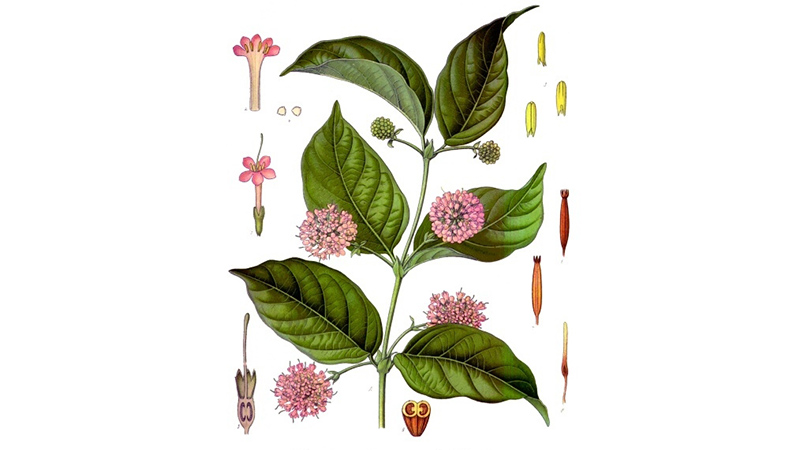
#2 This extract became a very prominent trade item in this part of the world in the 19th century, chiefly for its use as an agent for tanning leather. It was sold as cubes of a semi-solid paste that was derived from boiling the leaves and pressing them to get the liquid out, then leaving the liquid to set in the sun. Gambier was also used as a brown dye, a herbal medicine, and for chewing with betel leaf and areca nut.
#3 The peak of Singapore’s gambier trade ran from the 1830s to the 1850s, when there was a huge demand from the British dyeing and tanning industry. In the 1840s, there were around 600 gambier and pepper plantations, being run by 6,000 Chinese labourers. Many were located in Upper Thompson, Sembawang and Mandai. Gambier was almost always grown in conjunction with pepper plantations. This is because the byproducts of gambier production were used as fertiliser for pepper plants; also, pepper vines wrapped around gambier plants and supported their growth.
#4 The person with the most plantations was Seah Eu Chin (1805- 1883) – the “King of Gambier”. This Teochew merchant arrived in Singapore in 1823 and would become one of the wealthiest Chinese on the island. He has given his name to Seah Street, which runs along the northeast side of Raffles Hotel.
#5 Two things hastened the demise of gambier in Singapore: first, the soil they were grown in became infertile – sometimes in as little as 15 years. As a result, many plantations were moved to Johor. Then, the likes of pineapple and rubber became favoured because demand for them had grown enormously. By around 1905, the gambier industry had largely disappeared.
Gambier Islands: There are several islands or island chains in the world with this name – including in South Australia, French Polynesia and British Columbia. They’re not named after the plant, however, but after the Royal Navy officer and colonial administrator James Gambier (1756-1833).
Singapore on the world stage
Big events in sport in 2026 included the Winter Olympics and Paralympics (February), the FIFA World Cup (June/July) and the Commonwealth Games (July/August). Considering how hot it is, you might expect Singapore not to have any Winter Olympics representation. This year, however, Faiz Basha became the country’s first ever alpine skier, following in the footsteps of speedskater Cheyenne Goh who competed in the 2018 Games.
But how well is SG doing in other sports? Here’s a checklist of team rankings (at the time of writing) and some of the best performers.
- Football: Singapore is currently ranked 151st (one spot below Guyana, two above Hong Kong). That’s a decent step up from the country’s lowest rank of 173 back in 2018.
- Netball: With four Asian Netball Championships under its belt, the Singapore team is currently 24th in the world rankings.
- Sailing: Singapore has produced world-class sailors, including reigning Formula Kite World Champion Maximilian Maeder. Golf Shannon Tan is easily Singapore’s highest ranked golfer, currently sitting 103rd in the women’s world rankings.
- Running: The highest rank for a marathon runner in Singapore is 1209th, achieved by Soh Rui Yong. He has a PB of 2:22:59. Basketball The Singapore team is ranked 136th in basketball, just below Somalia, the Maldives and Vietnam.
- Table Tennis: Zeng Jian is Singapore’s best table tennis performer to date, reaching a world ranking of 17th in 2017. The Singapore women’s team currently ranks 20th in the world, and the men’s team is 25th.
- Cricket: Singapore is currently 37th in the world T20 rankings, just below Nigeria; Hong Kong is 24th.
- Swimming: Joseph Schooling won a famous Olympic gold for Singapore, beating Michael Phelps, and Yip Pin Xiu is a seven-time Paralympic champion. Singapore also does very well in artistic (synchronised) swimming, with Rachel Thean currently ranked 25th in the world.
- Rugby Union: Singapore’s men’s rugby team is ranked 62nd in the world (its highest ever), while the women’s team is 48th.
- Badminton: Loh Kean Yew is a former world champion in the sport, with a high ranking of 3rd in the world and a current ranking of 10th.
Also…
Singapore has reached the pinnacle of some less common sports than those listed on this page; Vincent Ng is a former world champion in the martial art of wushu, for example, winning the Men’s Broadsword category in 1995, while a Singaporean team of indoor skydivers won the Dynamic 4-Way Open event at the 2025 FAI World Championships in Belgium (they train at AltitudeX, formerly iFly, on Sentosa).

Singapore’s latest National Monument
A 76th item has been added to the list of National Monuments, with the Former Kandang Kerbau Hospital (KKH) being gazetted in October 2025. It’s the first announcement of a new National Monument in over three years, since the Padang was added in 2022.
The building at 1 Hampshire Road opened in 1924 and served as the only government hospital in Singapore specialising in obstetrics and gynaecology at the time. It witnessed some groundbreaking medical firsts and the birth of over 1.2 million babies!
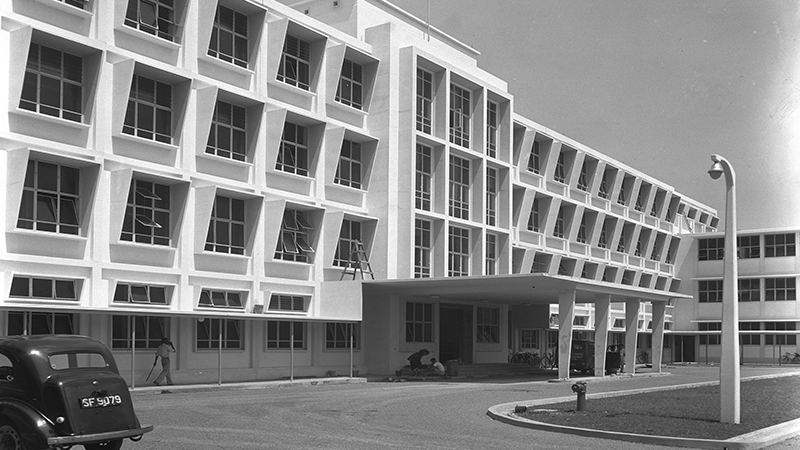
While the hospital relocated in 1997, the three blocks of the Former KKH will be preserved and accorded the highest level of protection in Singapore under the Preservation of Monuments Act. One of the pioneering doctors to work at KKH was Dr Benjamin Henry Sheares, a Singaporean of Eurasian descent who would later become the second president of Singapore from 1971 to 1981.
Dr Sheares joined KKH in 1937 as the first local obstetrician. He contributed significantly at the hospital, especially in the fields of gynaecology and obstetrics. In World War II, he performed the first lower-segment caesarean section operation in Singapore. He also pioneered the “Sheares Procedure” in 1960, a surgery that created an artificial vagina for women born without one. He even contributed to the design of new additions to KKH in the early 1950s, including the outpatient building and the hospital’s front block.
Did you know?
The term kandang kerbau means “buffalo enclosure” in Malay; the hospital’s name recalls the site’s past when buffalo pens belonging to the colonial department of transport were found in the area.
About the National Monuments
Singapore’s National Monuments are sites, buildings and structures designated by the National Heritage Board as having exceptional cultural and historical significance. They are legally protected from demolition. The first eight National Monuments to be installed, on 28 June 1973, were:
- Sri Mariamman Temple
- Former Telok Ayer Market, now Lau Pa Sat
- Former Thong Chai Medical Institution
- Armenian Church of St Gregory the Illuminator
- St Andrew’s Cathedral
- Thian Hock Keng
- Hajjah Fatimah Mosque
- Cathedral of the Good Shepherd
A magnificent mansion
The House of Tan Yeok Nee is Singapore’s last-surviving traditional Chinese courtyard mansion (and another gazetted National Monument, while we’re on the topic!). It was built by the Teochew towkay (businessman) Tan Yeok Nee in the 1880s.
A restoration project that began in 2022, under the stewardship of the Karim Family Foundation, was completed late in 2025. The house has been restored and reimagined as a living heritage destination for the arts, culture, architecture and community. Located at 101 Penang Street, it’s now home to a gallery, finedining restaurant (Loca Niru) and event spaces for private and public functions.
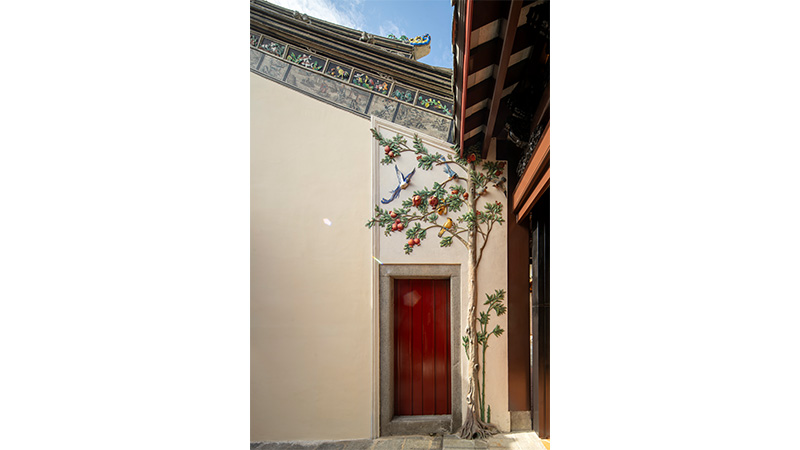
The restoration features some beautiful architectural elements, including this ornate downpipe on an outside wall.
Hawker Taste Test!
Consider yourself a foodie? Test your skills by identifying the following 10 popular dishes found in countless hawker centres across Singapore.

- A spring roll (fresh not fried) with a crepe wrapper, filled with turnip, bean sprouts, egg, crushed peanuts and other fillings.
- Stir-fried cubes of steamed radish cake served in two varieties: black and white.
- Pork ribs simmered for a long time in a medicinal broth and served with rice and other sides.
- A do-it-yourself dish where you select different vegetables, tofu, meat or seafood items, which are then boiled and served in a soup or sauce.
- A dessert of shaved ice in a tall pile, drizzled with different syrups and topped with red beans, jellies and more.
- Stir-fried yellow noodles and vermicelli, with prawns, squid, eggs, pork, sambal and a calamansi lime for squeezing over the top.
- More noodles: this time flat, wide, rice noodles stir-fried in a dark sauce with Chinese sausage, cockles and other ingredient.
- Barbecued dried meat (often pork) with a salty-sweet taste, a bit like soft, sweet jerky.
- A mixed salad of fruit, vegetables, youtiao and tofu puffs, tossed in a sweet-savoury dressing and often eaten with toothpicks.
- Fragrant coconut rice served with sambal, ikan bilis, sliced cucumber and often fried chicken or otak-otak.
Did you know? The dishes above might be widespread in Singapore, but there are some very rare hawker foods too. One is wah kueh – “bowl cake” in Hokkien – which apparently is almost impossible to find these days. It’s a savoury steamed cake served in a bowl with a brown sauce and other ingredients as toppings. (It looks a bit like a rice pudding.)
Answers to our Hawker Taste Test:
1. Popiah 2. Carrot Cake (Chai Tow Kway) 3. Bak Kut Teh 4. Yong Tau Foo 5. Ice Kachang 6. Hokkien Mee 7. Char Kway Teow 8. Bak Kwa 9. Rojak 10. Nasi Lemak
Bus shelter gets a glow-up
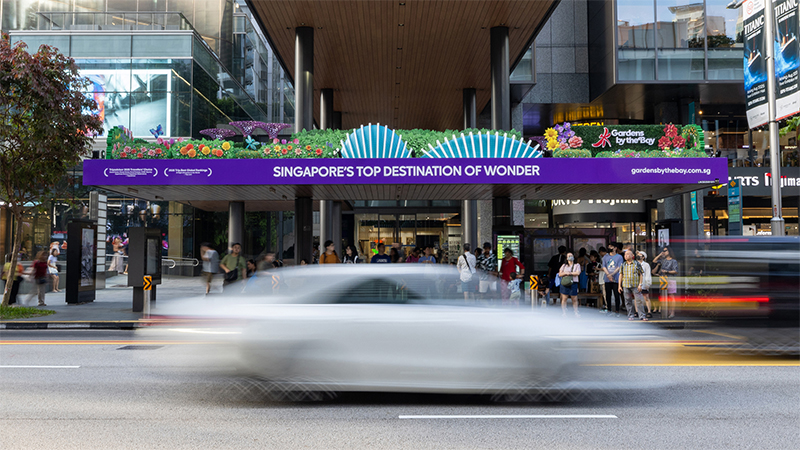
Next time you’re doing a spot of shopping at The Heeren on Orchard Road, take a glance at the bus shelter just outside the main entrance: the roof of it has been adorned with a 3D model of Gardens by the Bay. The special installation by media company Stellar Ace features the Supertrees, Flower Dome and other iconic aspects of the Gardens. It’s one of a series of new out-of-home (OOH) advertising formats that the company is rolling out, including digital walls and pillars in MRT stations.
8 things you might not know about Pulau Ubin
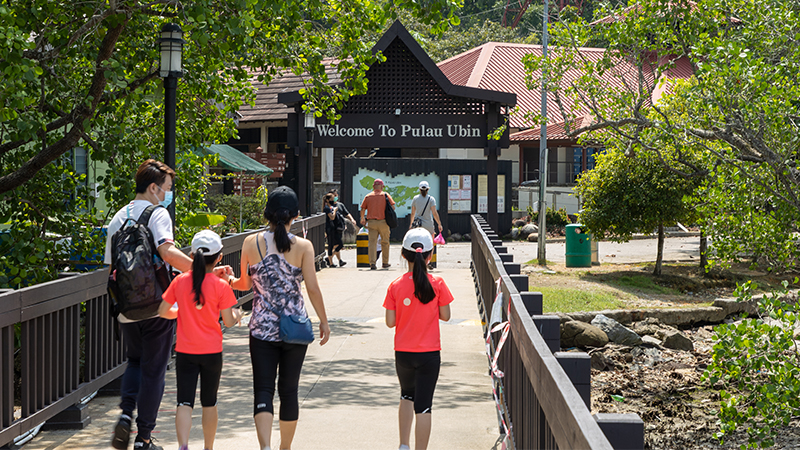
Pulau Ubin was in the news recently, though not for anything important happening on this 10-square-kilometre island off Singapore’s northeast coast – just a trivial story of a fellow who was forced to charter a whole bumboat for himself (for $48) after refusing to pay $5 rather than $4 to ride with a group!
A day on Ubin is always an adventure, whether it’s having a bit of a haggle about the boat price, or discovering a cool corner of nature away from the pier and the small town. Here are some facts about it.
#1 You could fit approximately 70 Pulau Ubins onto the Singapore mainland.
#2 The population of Ubin peaked at around 2,000 in the 1950s. Bin Kiang School, which operated on the island from 1952, had as many as 400 students at one point; it was demolished 25 years ago. Today, there are around 30 or so residents.
#3 The German Girl Shrine on Ubin commemorates the teenage daughter of German plantation owners who lived there. The girl is said to have died while attempting to flee British soldiers during WWI.
#4 According to legend, a frog, a pig and an elephant raced each other to be first to reach Johor. When the elephant and pig failed to finish, they were turned to stone, forming Pulau Ubin in the process.
#5 Granite from the island’s quarries (Pulau Ubin means “granite island”) was used to build the Singapore-Johor causeway.
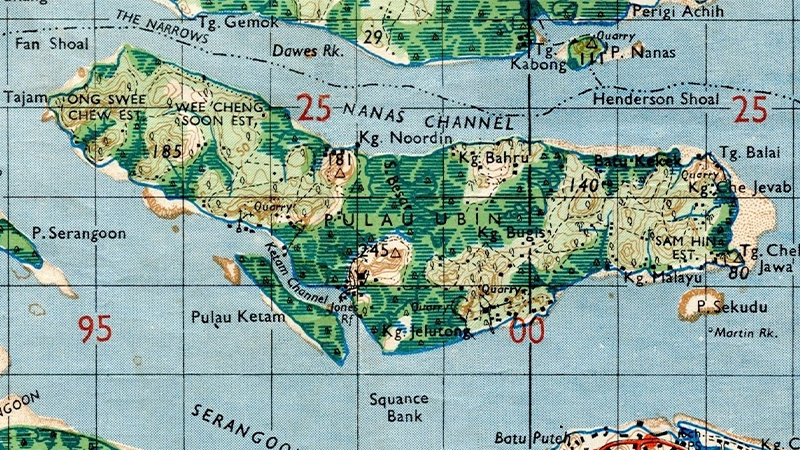
#6 The wetland area of Chek Jawa consists of seven separate independent ecosystems, and is home to a huge range of sea creatures, rare plants, migratory birds and more.
#7 In the 25th season of TV show Amazing Race, contestants flew from Malta to Singapore, where they took a bumboat across to Pulau Ubin. Once there, they had to find a coconut stand and drink a full coconut to get their next clue, before flying on to Manila.
#8 The highest point on Ubin is Bukit Puaka (“Haunted Hill”), 75 metres above sea level. You can hike up to the top for a view of the island’s old quarry
Did you know? The pictured map of Ubin above dates back to 1945 and includes a reference to “Squance Bank” in the water between the island and the mainland. This bank remains today and is a popular fishing shoal for catching orangespotted grouper, barramundi and Spanish flag snapper.
If you’re strolling the Changi Boardwalk, you can also spot a rocky outcrop rising from the bank; this is Squance Rock, better known as Loyang Rock. For decades, it has been a nesting site for the black-naped tern, which used to feature on Singapore’s old $1 note.
Two stinky flowers!
Rafflesia
Despite being native to Southeast Asia, and also being named after Sir Stamford Raffles, founder of the British colony of Singapore, the Rafflesia – the world’s largest flower – doesn’t grow here.
Also known as the stinking corpse lily for its distinctive smell of rotting flesh (to attract pollinating insects), the flower first came to the attention of Europeans in the late 1700s and early 1800s. The British naturalist Joseph Arnold spotted one in Sumatra in 1818, and he wrote: “Had I been alone, and had there been no witnesses, I should, I think, have been fearful of mentioning the dimensions of this flower, so much does it exceed every flower I have seen or heard of.”
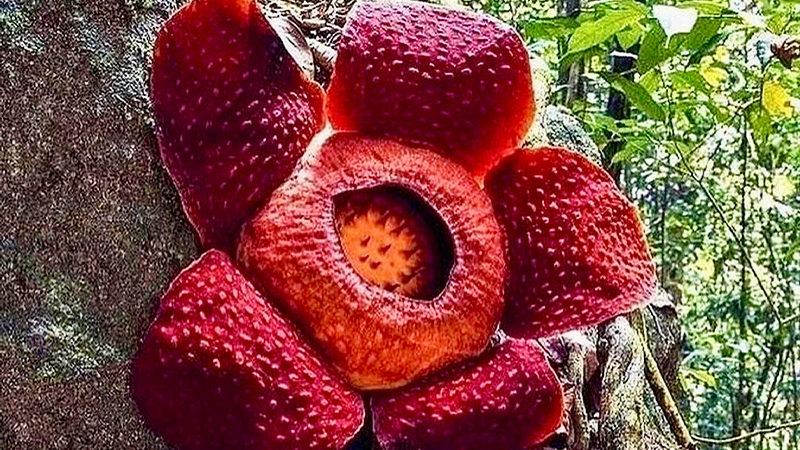
How big? Well, one species of Rafflesia has a flower that grows up to 1.2 metres in diameter and weighs over 10kg!
The Singapore Botanic Gardens apparently tried to grow a Rafflesia in 1985, by adding seeds into a host vine (the flower has no stems, leaves or roots of its own, so it needs a host to propagate). The attempt was unsuccessful.
Elephant Foot Yam
Probably the closest flower Singapore has to the Rafflesia is the elephant foot yam (which comes from the same family, Araceae), with an aroma described as “similar to a decomposing animal”. Like the Rafflesia, it’s not native to the island and won’t grow here spontaneously, but the Botanic Gardens did successfully plant the species in 2014.
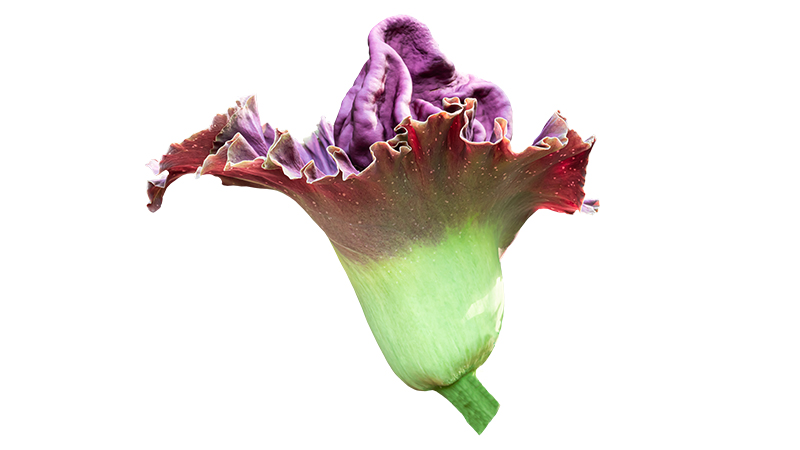
The flower only blooms once every few years, lasting for around two or three days before it starts to wilt. The most recent record of a bloom was in early 2023, in the Healing Garden of the Botanic Gardens. The wildlife photographer who discovered the flower was said to be extremely excited about his find, despite “feeling the urge to vomit”.
A couple of years earlier, in 2021, a single elephant foot yam was found next to an HDB block in Sembawang. It’s thought to have been grown there deliberately, as it was mysteriously harvested with a knife before any investigation could take place.
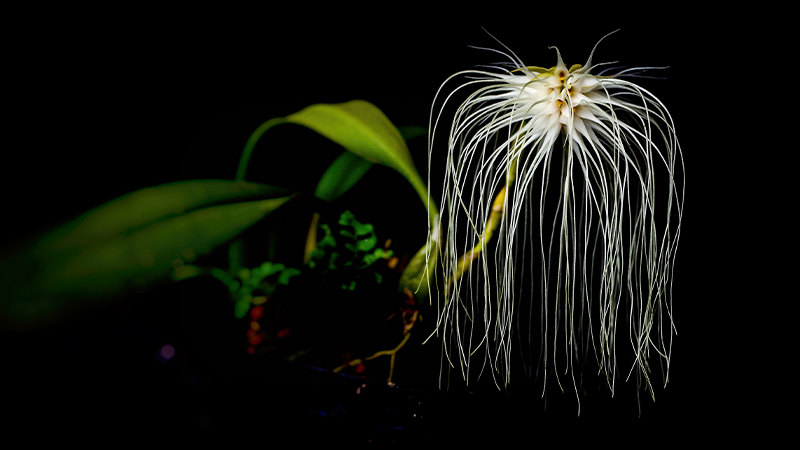
Other flowers in Singapore with a reputation for an offensive smell:
• Voodoo lily
• Medusa orchid
• Konjac
Things to do in and around Changi Village
Changi is synonymous with the airport, but it’s worth taking time to explore the namesake neighbourhood too (rather than just look down at it from 26A!)
#1 Eat at Changi Village Hawker Centre
Changi Village was a buzzing place in the postwar decades, but things slowed with the mass departure of British servicemen and their families in the early 1970s. A hawker centre was built here in 1975 in part to revitalise the area as a leisure destination. Today, it’s a popular destination, especially for its nasi lemak stalls (including the highly rated stall #01-03!). On the eastern side of the centre is Little Island Brewing Co for craft beer lovers, and The Bus Collective, which offers overnight stays in – you guessed it – a bus!
#2 Visit a quirky sculpture
Beside the sea on the western edge of Changi Beach Park is a sculpture known as “Inscription of the Island” – or colloquially “The Finger”. It’s inspired by the Colossus of Rhodes, the gigantic bronze that was one of the Seven Wonders of the Ancient World. Apparently, artist Lim Soo Ngee imagined that the Singapore version of the Colossus had been lost to time, except for its giant left hand.
#3 Get a ferry to Ubin
Keen to escape Singapore for a bit? Head to Changi Point Ferry Terminal, where you can take the $4 bumboat ride to Pulau Ubin. Boats run from dawn to dusk and the trip takes 10 minutes; they only leave when they have enough passengers (around 10 or so). Things to do on Ubin include cycling, hiking, taking nature photos, spotting marine life and eating in the town’s handful of stalls.
#4 Try plane spotting
In 2024, over 360,000 flights took off or landed at Changi International Airport (a thousand a day!). Needless to say, it attracts plenty of plane spotters, many of whom head to Car Park 5 of Changi Beach Park, for a close-up look at departures and arrivals on runways 20R and 20C.
#5 Learn about Singapore’s military history
Changi is well known for the namesake prisoner-of-war camp that operated here in WWII. You can learn about this period at the Changi Chapel & Museum, which reopened in 2021 after a refurb. It’s a few kilometres back along the road into the city. A monument plaque in Changi Beach Park highlights the infamous Sook Ching massacre of 20 February 1942.
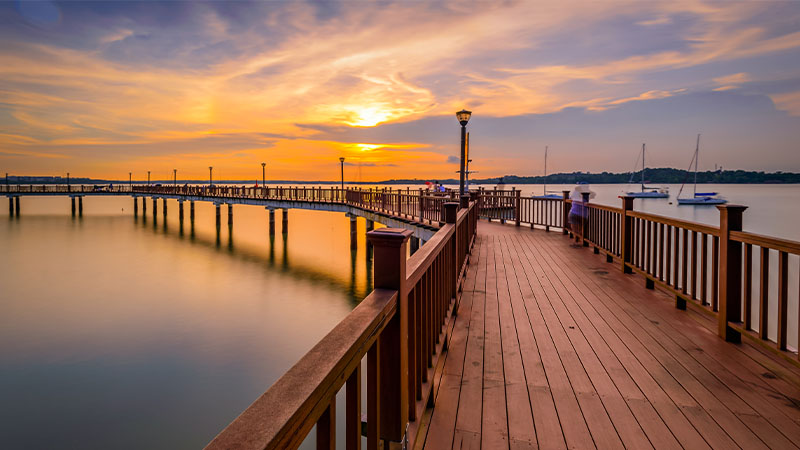
#6 Enjoy sunset from Changi Coastal Boardwalk
This 2.2km boardwalk is a nice place for taking in a coastal breeze or snapping sunset photos. Ongoing repair works (until Q3 2026) mean that you can’t walk or jog the full length just now, but it’s still worth a visit for some crab spotting or ocean gazing.
What’s in a name? The word “Changi” maybe comes from the chengal tree (Neobalanocarpus), a tropical hardwood endemic to the Malay Peninsula
Rooster bowls
Have you ever come across this iconic piece of homeware while eating at a hawker centre in Singapore?
Rooster-design bowls and plates are used to serve noodles and other dishes not only here but in Malaysia, Indonesia, Thailand and Hong Kong. You don’t come across them too often today, and if you do it’s usually a plastic version rather than the traditional hand-painted ceramic variety. Most of the original bowls were manufactured by the Hakka community in Thailand – in particular, Lampang Province – though the design is likely older, from China’s Guangdong Province.
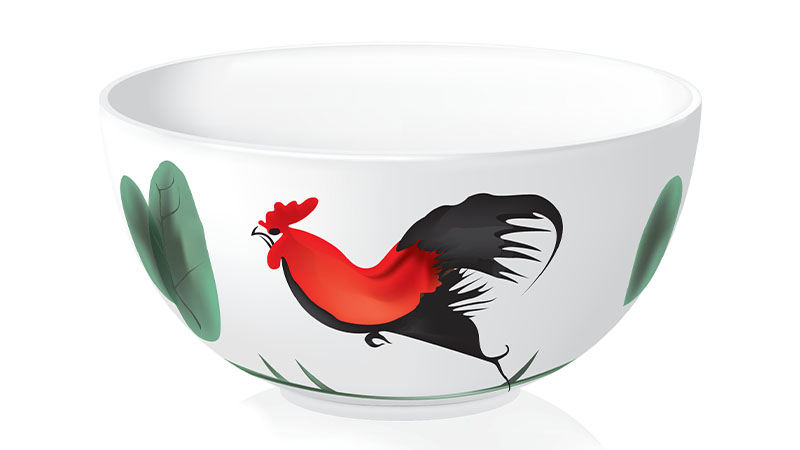
The rooster is depicted alongside peonies and banana leaves. Together, these images represent prosperity and happiness for the home (in Hokkien, the word “rooster” sounds similar to “family” or “home”).
Birdwatching in Singapore
Ex-Singapore expat LINDSAY SHERMAN returns to the little red dot and captures some wonderful photos of its rich and varied birdlife on a day out with a guide.
Twenty years ago, when I lived in Singapore, I loved the vibrant bougainvillea and rain trees that lined and covered the roads. On a recent return visit, I discovered that as well as being attractive, Singapore’s greenery teems with wildlife. There are over 400 bird species that call the island home, many of them stunningly beautiful. I spent a day with local bird guide Kenneth Kee to seek them out. We started at Bukit Timah Nature Reserve and walked up to Hindhede Quarry; the disused quarry is part of the nature reserve and now full of water.
We saw two types of kingfishers – stork-billed and whitethroated. There were also two types of woodpecker and a lineated barbet hiding in the foliage. An oriental darter was drying his wings on a tree stump.
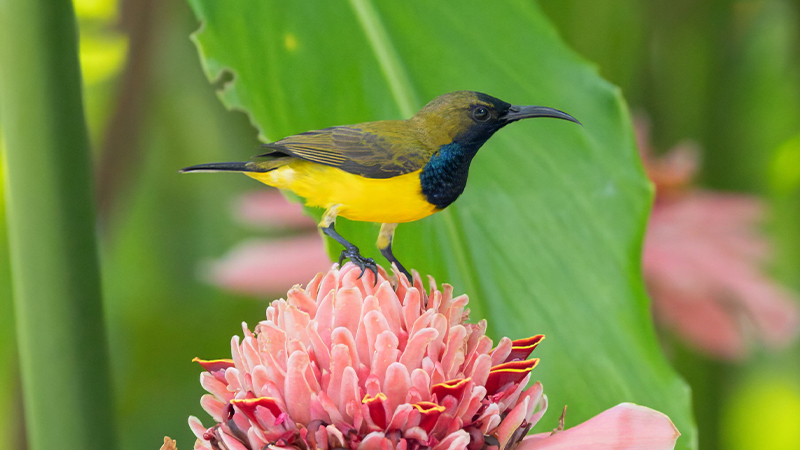
Our next stop was a small area of public garden close to the Rail Corridor at Bukit Timah. A large pink shrub was alive with feeding birds. We saw a gorgeous blue-crowned hanging parrot, some sunbirds and a yellow-vented bulbul. Another local photographer showed us stunning photos he had taken on prior visits to the same spot.
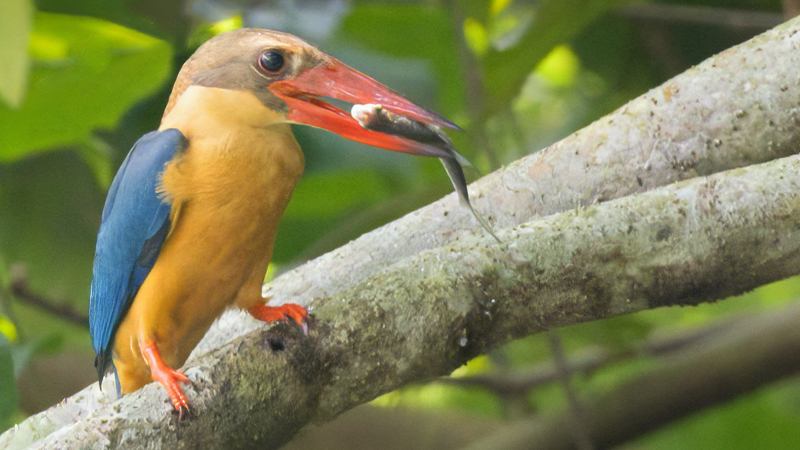
We then headed northwest to Sungei Buloh Wetland Reserve. We made two stops in the wetlands. At the first one, we found a pair of nesting white-bellied sea-eagles circling the car park. We also saw olive-backed and brown-throated sunbirds plus a stork-billed kingfisher with a catch.
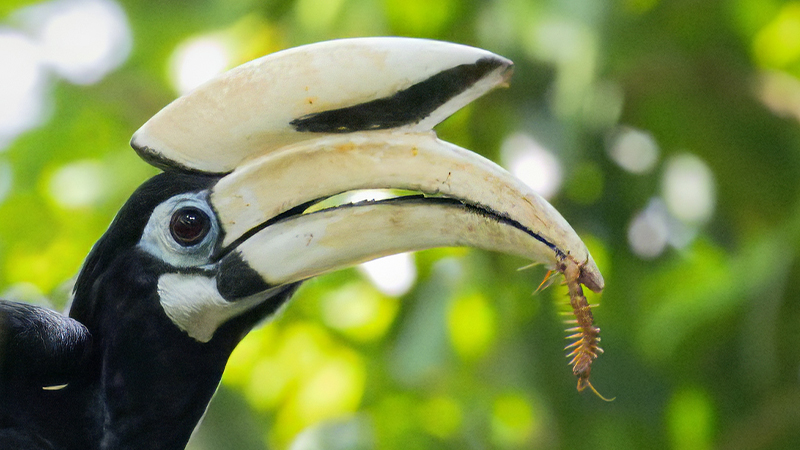
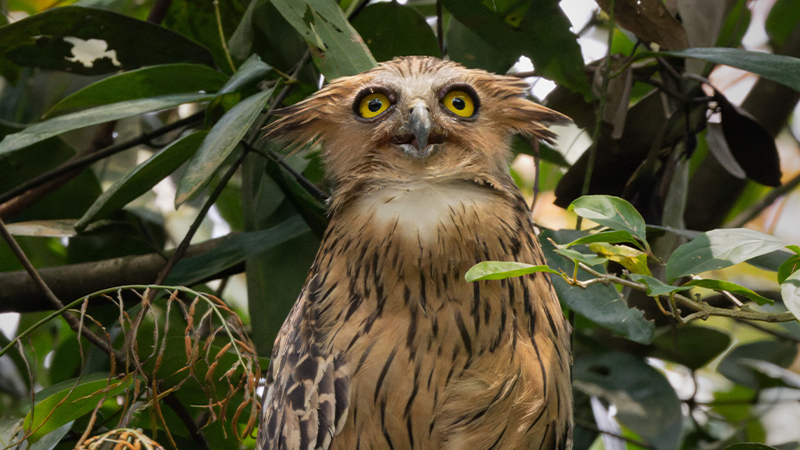
The second stop at Sungei wetlands was a real treat. A pair of buffy fish owls are regularly seen there and, luckily, one of them was perched in full view. We also had a lovely sighting of an oriental pied hornbill. Copper-throated sunbirds, a scarletbacked flowerpecker and a rufous woodpecker were other great finds.
Our final stop was the Singapore Botanic Gardens. We were looking for bee-eaters. Sadly, they were not around, but Kenneth located a nightjar perched underneath some shrubs. Then we headed to the Heliconia Garden to try to get a good photo of the sunbirds that regularly feed there.
Kenneth’s local knowledge and familiarity with the names and calls of each species were invaluable. He told me that Singapore plans to plant a million trees over the course of the 2020s. It’s great to know that the habitat for its wonderful birdlife is secure!
8 things to know about the Henderson Waves
#1 The distinct wave-shaped bridge opened in 2008 and crosses over Henderson Road, connecting two forested areas of the Southern Ridges.
#2 The Henderson part of the name perhaps comes from George Henderson, a mid19th-century businessman, or from the Henderson Bros. Rubber Factory that operated in this area until the 1920s.
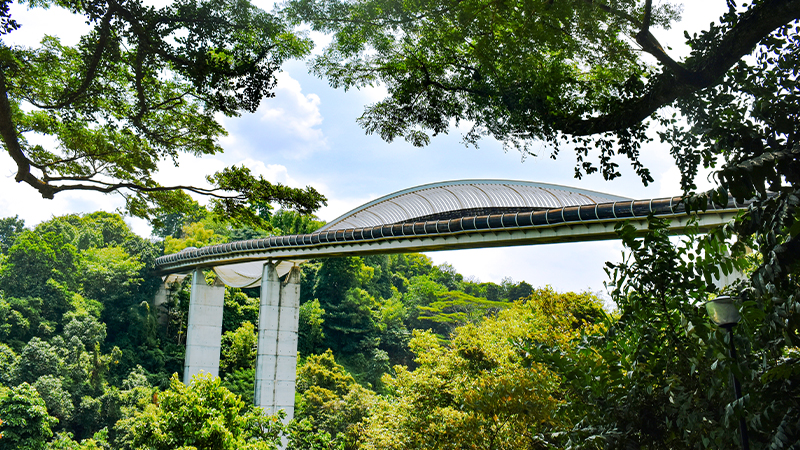
#3 The wave part of the name comes from the distinct curl of the footbridge, created by a series of curved timber ribs made of balau, a dense hardwood native to Southeast Asia.
#4 While it’s not Singapore’s longest pedestrian bridge (the 280m Helix Bridge in Marina Bay is six metres longer), it is the highest, measuring 36 metres above the ground.
#5 The bridge appeared next to a coiled snaked on the 2025 Year of the Snake Almanac coin, a special-edition $2 coin minted in that year as part of an annual series of zodiac-themed coins.
#6 It can also be spotted in the 2016 dystopian film Equals, starring Kristen Stewart and Nicholas Hoult, along with other prominent landmarks in Singapore.
#7 You’ll cross Henderson Waves if you do the 10km Southern Ridges Walk around Kent Ridge, Telok Blangah Hill and Mount Faber; and there are other cool bridges on the same route, including a zigzagging metal structure called the Forest Walk, plus an Earth Trail and Canopy Walk for exploring the rainforest.
#8 A pretty LED light display comes on at 7pm on the bridge, turning off again at 2am.
About the cannonball tree
The photo below shows a cannonball tree, and the large, brown, spherical fruit that give it its nickname. “I saw the tree while walking the Southern Loop of Chestnut Nature Park (2.2km),” says EL’s Judit. “I kicked one of the fruits on the ground out of curiosity and it was hard (yes, like a cannonball!) – impossible to break.” Here’s what else we discovered about it!
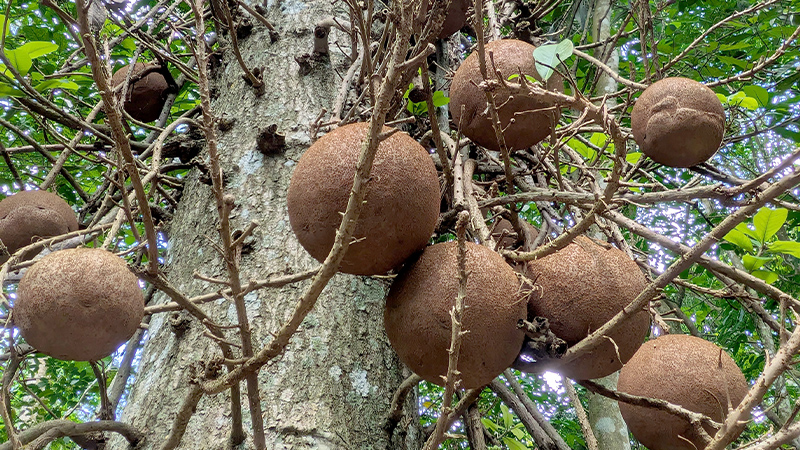
#1 With the scientific name Couroupita guianensis, the cannonball tree grows in abundance in Singapore, yet it’s not native to Southeast Asia. It comes from Central and South America – guianensis refers to the Guianas region that includes Guyana and Suriname.
#2 In a report by the US Department of Agriculture published a century ago, the tree was labelled “one of the strangest freaks of the vegetable kingdom”.
#3 What’s so odd about the cannonball tree? Well, a few things, one being the thin, snaky stems that sprout out of its trunk, up to a metre long. (The tree itself can grow to 35 metres in height.) Flowers emerge along these stems, giving the appearance that the whole trunk is in bloom. One tree can have up to a 1,000 flowers on it per day.
#4 The fruit’s flesh is full of seeds (over 500 in a single bigger specimen!); it’s white when first exposed to air but then turns blue. Apparently, you can eat it, though we don’t recommend it as it can be toxic. Oh, and it has an odour described as “unpleasant” and “rancid”. (One for durian fans, perhaps?)
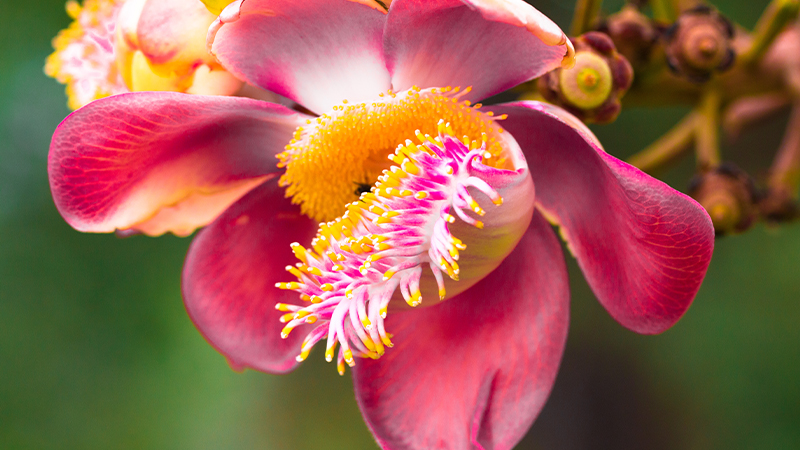
#5 In contrast to the fruit, the large flowers – sometimes described as looking like a mollusc or other sea creature – have a beautiful sweet smell, with hints of hyacinth, petunia and rose, and a green herbal note.
#6 Because of the hardness of the fruit that Judit mentioned, cannonball trees are no longer planted along roadsides on account of how much damage the fruit can cause when it falls. (One piece can weigh up to 7kg…)
#7 Parts of the tree have been used for medicinal purposes in the past, including the treatment of malaria and skin diseases by shamans in the Amazon.
#8 Two cannonball trees feature in Singapore’s list of 263 official Heritage Trees. One of these, in the Botanic Gardens’ Ginger Garden, is grown from a fruit that the Gardens’ Assistant Director, E J H Corner, stole from a famous botanic garden in Sri Lanka! He planted the seed in the tree’s current location in 1934.
The first American film in Singapore?
Fifty years have passed since the theatrical release of The G.I. Executioner, arguably the first American movie to be wholly produced and shot in Singapore. It was originally titled Wit’s End, and completed in 1971. But it took four years and a name change to make it into cinemas.
We don’t know a lot about the film, though with a director like Joel M Reed (Bloodsucking Freaks) and a tagline of “They tried to kill him, drug him, torture and pervert him, but they could not stop the G.I. Executioner”, we doubt that it was the pinnacle of the artform. Put it this way: the final scene has been described as “cinema’s first ever naked shootout”.
If you’re a history buff, though, it might be worth tracking down to see old footage of the filming locations, which included Bugis Street, Clifford Pier and buildings that would later become Raffles City and Clarke Quay.
Iconic ice cream sandwiches
Singapore isn’t the only place to come up with the idea of wrapping ice cream in bread or wafers – Ireland has its “sliders”, for example, and Vietnam does a delicious bahn mi version. But they’re definitely an institution here – in fact, as many as 30 ice cream hawkers once plied their trade on Orchard Road alone, most of them in the vicinity of where ION Orchard is today.
The food trend kicked off in the 1960s, when cut rectangles of ice cream (known as ice potong) were served on wooden sticks, like a regular ice block/popsicle. But they melted too quickly in the heat. Putting the cold slab into a slice of bread made for less mess and easier eating.

Ice cream sandwiches in Singapore are sold by street vendors (“ice cream uncles”) from their mobile bicycle stalls. They’re commonly served in a slice of rainbow bread, with popular flavours including chocolate chip, mint, red bean, durian and corn. You can expect to pay around $1.50 for a serve.
Sadly, the number of stalls is waning – new licences aren’t being issued, as part of a general phasing out of street hawking. So now’s the time to sample this iconic Singapore snack!
Try Uncle Chieng, who sets up outside Takashimaya on Orchard Road (and has his own Facebook page: @unclechieng), or Yellow Ice Cream Uncle, outside Wisma Atria.
Discovering Coney Island Park
Feels like it was only yesterday, but this year marks a decade since Coney Island Park opened to the public. Here are a few things to know about this rustic spot off Singapore’s northeast coast.
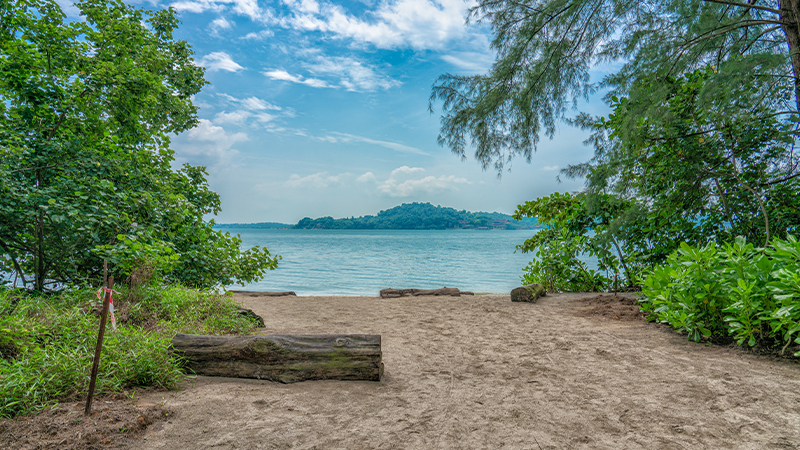
- At 133 hectares, Coney Island is about a third the size of Sentosa. But it has none of the infrastructure – just a few trails and boardwalks that pass by mangroves, woodlands and beaches.
- The best way to explore the park is on foot or by bike; a 2.4km trail passes from one end of the cigar-shaped island to the other, with smaller trails leading off from that.
- Originally known as Pulau Serangoon, in the first half of the 20th century the island was owned by the Haw Par brothers of Tiger Balm fame. They built a large beach mansion there, which fell into disrepair after WWII. Its remains can still be seen today, though the site is hidden away and officially off-limits.
- Indian businessman Ghulam Mahmood bought the island in 1950 and planned to turn it into a “pleasure resort for the people of Singapore”, naming it Coney Island after the New York attraction. But his plans never materialised; three years later, it was put up for auction.
- For a year after the park opened to the public in 2015, it was known as being home to a solitary free-roaming Brahman bull (warning signs proclaimed: “What to do when you encounter the cow”). When it died in 2016, some local commentators suggested changing the island’s name to “Cowney” in its honour…
- The Singapore Scout Association made a bid to hold the 23rd World Scout Jamboree in 2015 on Coney Island. It was beaten by Japan.
Getting there: Punggol Coast MRT station opened a few months ago (North-East Line) and is a 10-minute walk from the western entrance of Coney Island. If you’re driving, park at food centre The Punggol Settlement and walk in from there.
Geraldene Lowe-Ismail, 1938-2025
Expat Living was saddened to hear of the passing of Geraldene Lowe-Ismail, who died in February 2025 at the age of 86. Geraldene was well known as the doyenne of Singapore tours and walks, shining the spotlight on the island’s history and heritage for half a century.
After spending her early years in Singapore, Geraldene and her family found themselves caught up in the Japanese invasion of 1942. They left just a day before Singapore fell, on a boat called the MS Gorgon, one of only a tiny handful of vessels that made it out without being captured or sunk by gunfire. It originally sailed for India but ended up in Fremantle, Western Australia.

She returned here in the 1950s, working initially for an airline and a trading company before starting in tourism – first as a guide taking expats from Singapore to Cambodia, and then exploring the nooks and crannies of the Little Red Dot itself.
Geraldene was co-founder of the Singapore Heritage Society in 1987, which was formed to raise awareness around the need to conserve and promote the island’s heritage. In 2014, she received a Lifetime Achievement Award for outstanding contribution to Singapore tourism, and in 2018 she was inducted into the Singapore Women’s Hall of Fame.
The Expat Living team was lucky enough to join Geraldene on many of her tours and write articles about them for the magazine. Her wonderful outings provided a rare perspective on the often hidden sights and sounds of Singapore, from tours of ethnic Indian, Chinese, Malay or Jewish enclaves to World War II sites, colonial black-and-white houses and other architectural gems.
Our many highlights with Geraldene included an exploration of multicultural Katong, from its Sikh and Hindu temples and old palatial homes to a Peranakan heritage kitchen; and a tour of traditional Chinese businesses that continue to practise their ancient crafts in Singapore today – from joss-stick makers to families who build paper ornaments to use in ancestor worshipping rituals.
Geraldene’s vast wealth of knowledge and bank of fascinating anecdotes and personal insights gave her tours a unique quality. She leaves behind a wonderful legacy.
8 things about Bidadari Park
We explore one of Singapore’s newest green spaces – opened in September 2024.
#1 Bidadari Park is a five-minute walk from Woodleigh MRT station – head through The Woodleigh Mall and across the new link bridge to get there.
#2 The location was once part of the enormous Bidadari Cemetery, which operated between 1907 and 1972, and had almost 150,000 Christian, Muslim, Hindu and Sinhalese burial sites at one point.
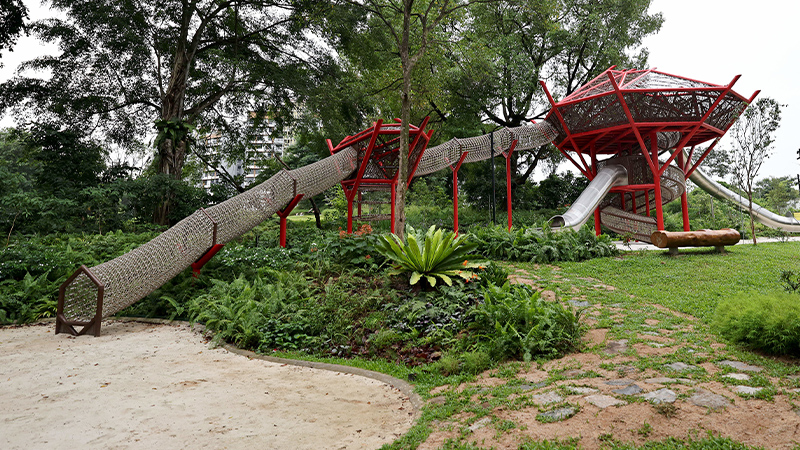
#3 The classic children’s book Winnie-the-Pooh by AA Milne is said to have been the inspiration for the new park – specifically, the Hundred Acre Wood setting of that book. Side note: Did you know that AA Milne’s book is available in a Singlish translation, by Singaporean poet Gwee Li Sui (2023)?
#4 The park sprawls around a central body of water, Alkaff Lake. This 1.8-hectare feature is not only for recreation but also acts as a flood-management tool, collecting stormwater runoff from the surrounding Bidadari estates. There’s scope for the lake to hold up to 16 Olympic-sized swimming pools worth of water in particular heavy rain periods.
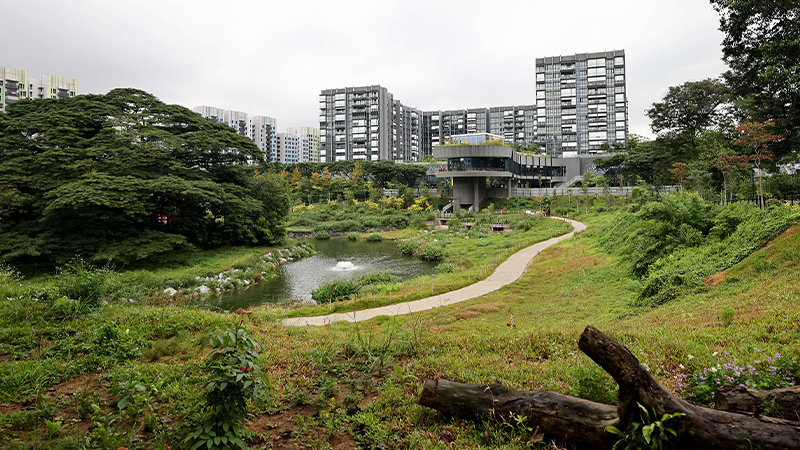
#5 There are 5.2km of trails and boardwalks running through the park, passing by marshlands and trees, as well as two open grassed areas, Tembusu Lawn and Open Lawn, for picnics and events. Investigating the island past and present, with tips, trivia and time travel – and the occasional tricky challenge for readers!
#6 Kids will love the five-metre-tall treehouse playground in the park, Adventure Playwoods; it has climbing nets, a zip line, various slides and an observation pod.
#7 Despite its location in the middle of a busy urban area, Bidadari has long been recognised as a popular place for migrating birds to stop. The new park takes advantage of this, with several birdwatching hides and also a 20-metre-tall raptor nest platform – a first for a Singapore park – that allows the likes of the white-bellied sea eagle to perch high above the ground.
#8 History buffs can find out about the history of this area (see below for a taste) through a series of storyboards along the park’s heritage walk.
The old Alkaff Gardens
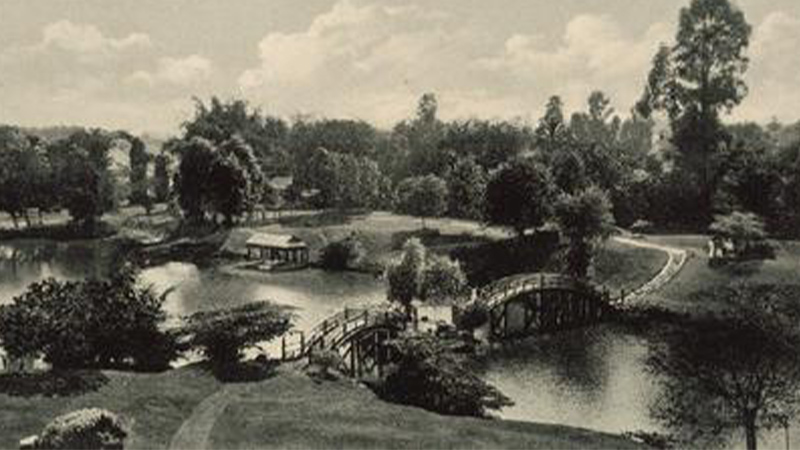
This isn’t the first time this area has been home to a recreational attraction. From 1930 to 1964, a Japanese-style park operated here, centred around the artificial Alkaff Lake. For a short while in the early 1940s, it was called “Happy Garden”. You could try boating or fishing, relax in a teahouse, and even order an imported Japanese Asahi beer. Part of the park was shelled in the Second World War, and the space eventually fell into disrepair, before the lake was drained in 1964.
In 2013, the first ideas were drawn up for a new-look park and lake to be developed here, culminating in the new Bididari Park.
Coldplay’s Marina Bay moment
Coldplay’s six-show run at Singapore’s National Stadium in January 2024 is a long time ago now, but if you want to rekindle the fire from the UK band’s visit, take a look at the music video for their hit song “Man in the Moon” (you can watch it on YouTube).

While most giant touring acts rarely get a moment to do anything beyond sound check, performing and sleeping, the four members of Coldplay found time during their whirlwind stint in Singapore to record a video on a floating stage on Marina Bay. The band flexed their local knowledge of SG’s wildlife, saying: “It was really fun to have a kind of dance party out in the middle of the water, just us and the otters.”
Also featured in the music video are scenes from Fort Canning Park (including a spot of ice-sledding down the park’s grassy slope) and other iconic Singapore spots.
The video was directed by Ben Mor and filmed in partnership with Warner Music Singapore and the Singapore Tourism Board; it premiered with an exclusive Coldplay fan party on the MBS SkyPark deck.
Who else filmed a music video here?
Coldplay isn’t the first big international act to choose Singapore as a backdrop for a song. In August 2022, Billie Eilish brought her “Happier Than Ever, The World Tour” show to Singapore, playing in front of more than 30,000 fans at the National Stadium. (She had earlier performed at Singapore’s final Laneway Festival, in January 2018.) While here, the American singer-songwriter recorded live videos of two tracks, “The 30th” and “TV”. They were filmed in the suitably chilled Cloud Forest dome at Gardens by the Bay.
Other acts to feature SG footage include American pop-rock outfit OneRepublic (2022’s “Runaway”, partly filmed on the MBS SkyPark), Grimes (2015’s “REALiTi”, set in a bunch of Asian cities, including Singapore, with Haw Par Villa and Gardens by the Bay both featuring) and rapper B.o.B, whose 2011 video for “High Life” begins with a spoken word of praise for the view from the MBS swimming pool: “Right now you’re looking at Singapore – breathtaking, there’s nothing to say. As you can see already, this is probably one of the most amazing views that you will see in your lifetime.”
Airborne beasties!
EL’s Judit Gál caught a couple of Singapore’s cute animals on camera recently. One was very easy to spot; the other, not so much!
Fruit bat
Hanging about on this ceiling is the Lesser Dog-faced Fruit Bat (sometimes called the Lesser Short-nosed Fruit Bat – scientific name, Cynopterus brachyotis). Judit mentioned she’d seen them before, including inside her house – one flew out of a cupboard one time, and another was found hiding in among some books!
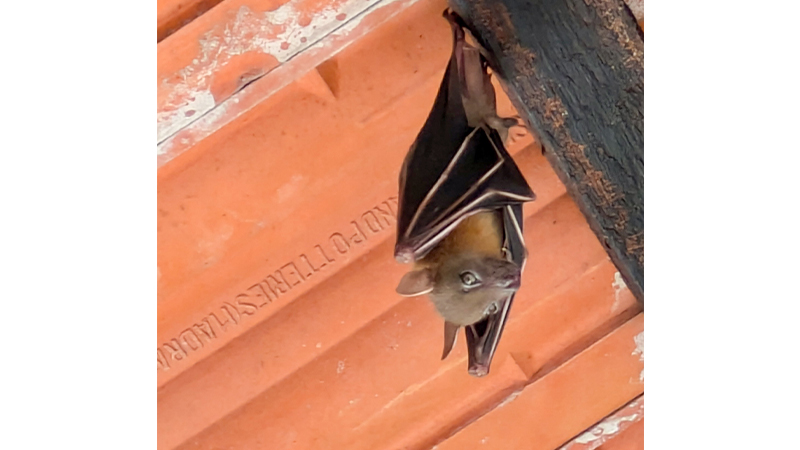
This is a relatively common experience in Singapore, where these bats are prevalent. They’re quite small, averaging around 7cm in forearm length, and weighing just 30 or 40 grams. The one in the photo seems to be female, as it has a yellowish collar (the collar of males is more red/brown).
The Lesser Dog-faced Fruit Bat is frugivorous – that is, it mostly eats fruit. Favourites include mangoes, guavas, bananas and figs, which they mash for the juices, spitting out the pulp.
For shelter, the bats chew on the ribs of palm fronds until the fronds droop down to form a “roof”. Mother bats carry their young for around seven or eight weeks, including while flying.
Malayan colugo
With its coat looking uncannily identical to the tree in this photo from Rifle Range Nature Park, this chap below is the Malayan colugo – also referred to as the Sunda colugo, flying lemur or flying cat, or the cobego or kubong.
But what exactly is it? Well, it’s not a lemur, and it can’t fly – so a few of those names aren’t too accurate! Officially, a colugo is an arboreal (tree-dwelling) gliding mammal that is native to Southeast Asia.
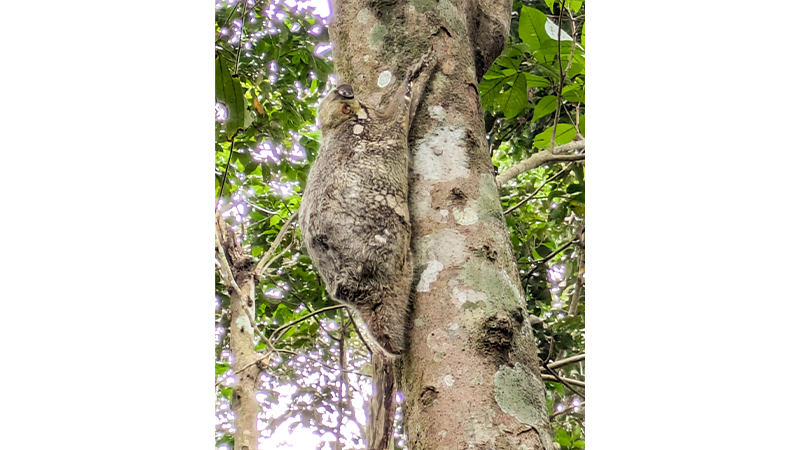
The flying reference comes from the fur-covered membrane that stretches between the colugo’s limbs and fingers, which works like a cape (think Batman…) and allows the creature to glide from tree to tree for up to 150 metres!
While they’re elegant in the air, the Malayan colugo is an awkward-looking tree climber, moving up and down the trunk with a stop-start hopping motion. Judit did well to spot this one as they are almost wholly nocturnal, coming out at night to eat leaves, buds, flowers, shoots, fruit and sap.
Nobody knows exactly how many of these creatures live in Singapore; in 1994, they were listed as being vulnerable (around 200 animals); today, the number is thought to be considerably higher.
Singapore’s snakes
Singapore is home to around 70 different species of snake. They range from small, blind, burrowing snakes you’ll never see to those scarily long snakes that sometimes turn up in city drains or the backyards of black-and-white houses. Some have interesting names – the dog-toothed cat snake, ornate flying snake, white-spotted slug snake and common Malayan racer, for example. And a handful are potentially dangerous. Here are some to avoid stepping on…
King cobra: The largest venomous snake in the world can grow up to six metres. Public sightings are rare in Singapore, though in 2024, a person took an incredible video of a king cobra cannibalising another snake of the same species.
Banded krait: This snake with black-and-white bands and a distinctive triangular cross-section is usually seen in coastal areas – one turned up at the opening of the Chek Jawa boardwalk on Pulau Ubin in 2007. Equatorial spitting cobra: Also referred to as the black spitting cobra, this snake has a highly venomous bite; plus, as it says on the lid, it will spit venom at a perceived attacker’s eyes. Charming.
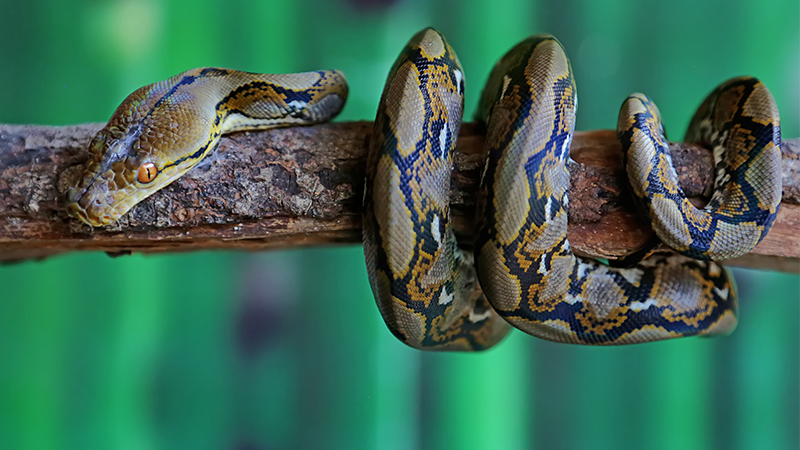
Reticulated python: This is the longest snake in the world – it can grow up to 10 metres but averages a more “modest” 2.3 metres. There are loads in Singapore, but thankfully they’re non-venomous. Public sightings are relatively common – in December 2024, a two-metre-long reticulated python was spotted in Eunos, regurgitating a cat that it had eaten earlier.
The good news? Instances of people getting bitten are rare here – and deaths are even rarer. One five-year study from 2004 to 2008, for example, documented 52 bites – around 10 a year – but no deaths. The last report we’ve found of a lethal bite was an 80-year-old man killed by a cobra in 1995.
If you do find yourself in a sticky situation with a snake, the first rule is: don’t panic. (Easy for us to say, right?) Don’t try to handle a snake yourself. Instead, take a photo on your phone and call the NParks’ 24hr Animal Response Centre at 1800 476 1600. (For a more urgent matter, call 999, and in the unlikely event of a bite, call 995 for emergency services.)
Want to know more about a snake you’ve had an encounter with? Try contacting Wildlife Reserves Singapore (WRS), NParks or ACRES.
Did you know?
- 2025 was the Year of the Snake. In the Chinese zodiac, the Snake is considered an enigmatic animal, variously described as wise, humorous, sophisticated and goal-oriented.
- The next Snake “year” will be 2037.
- Famous Snakes include Pablo Picasso, Mao Zedong and John F Kennedy. Also Slytherin her way onto the list – see what we did there? – is JK Rowling.
- If you’re a Snake, your lucky numbers are 2, 8 and 9, and your lucky colours are black, red and yellow.
- If you have a fear of snakes (ophidiophobia), move to Ireland or Iceland where there are none at all.
For the green thumbs
If the only snake you want to encounter in nature is a snake bean, did you know that Singapore has thousands of neighbourhood gardens? There are different ways you can get involved in these, too.
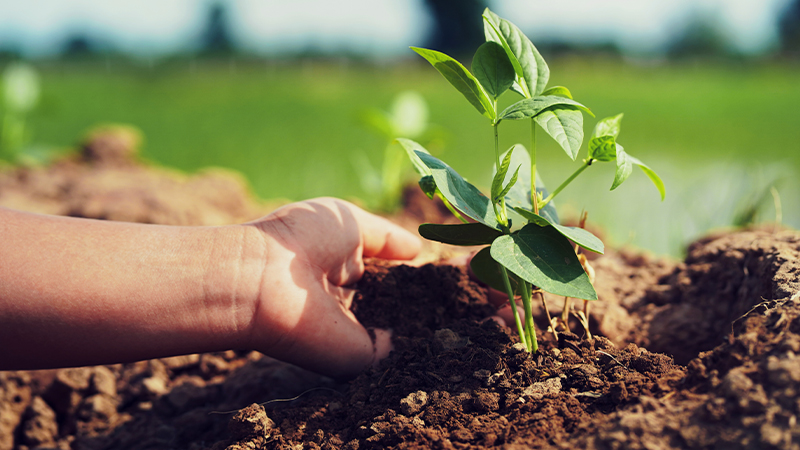
Allotment Gardens
The first type is the allotment gardens – there are currently 2,400 of these located in 28 different parks and green spaces all around Singapore, and managed by NParks. Every household is eligible to ballot for their own garden plot, too; this includes expats, though Singapore citizens and PRs are given priority. All you need to do is apply via the NParks website (gardeningsg.nparks.gov.sg/get-involved/allotment-gardens).
If you’re successful and receive a Letter of Offer, the plot will then be leased to you for three years (there’s a fee of $57 per year for the lease). You’ll then have your own raised planter bed, 2.5 metres by 1 metre in size, with a mini tool storage area. Bring on those beans!
One tip: keep your plot covered with netting – this discourages garden pests, not just of the snail and squirrel variety, but also people who wander past allotment gardens and pluck the best-looking specimens for their own plates. (Unfortunately, it happens.)
Community Gardens
Different from allotment gardens, community gardens are mostly located in community spaces like HDB estates, private housing estates and schools, with support from town councils or residents’ committees.
Examples of these gardens in Singapore include edible gardens, where members of a community grow plant species for self-consumption, and ornamental gardens, which might showcase beautiful orchid species or bonsai trees, for example.
If you’re keen to get involved, this NParks web page has a map showing all the gardens in Singapore: gardeningsg.nparks.gov.sg/get-involved/community-gardens. Then it’s a matter of approaching the group directly to enquire about volunteering at the garden (if you go along in person, you’re bound to find someone there, tending to the bok choy!)
The humble prata
For something that starts as a very plain looking lump of dough, roti prata (“roti” from the word meaning bread, and “prata” from “paratha” meaning flat) can be a ridiculously tasty treat. Indian migrants are thought to have brought this comfort food to the Malay peninsula, and it has since become a ubiquitous feature in hawker centres around the island.
Part of what makes prata special is the dramatic stretching and snapping of the dough; a skilled prata-man will pull, flip and manipulate the oil-brushed dough into a thin veil before folding and frying it on a hot grill (called a kavi) until golden. The resulting disk of tissue-like layers is then “clapped” between hands – this serves to shatter the crispy outer surface and soften the chewy inside.
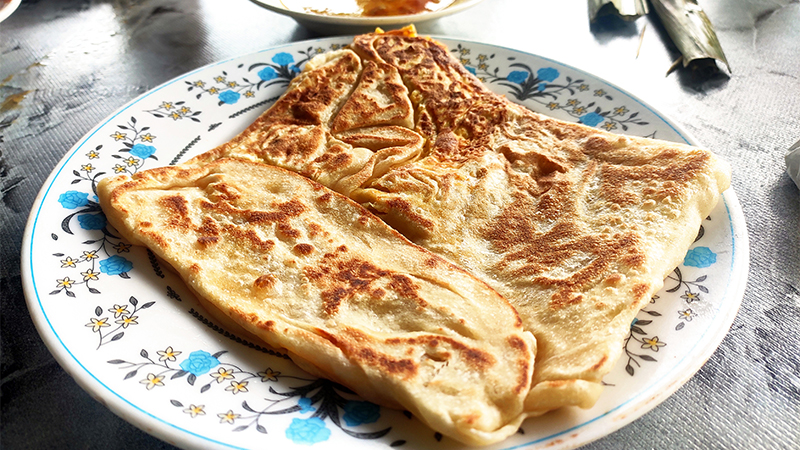
Plain prata is usually served with a side of mutton-based gravy for dipping, but there are countless stuffed prata creations available too: egg, cheese, mushroom or masala, for example, and even fruit, chocolate or ice cream!
Try it at: Al-Azhar (Bukit Timah) | Sin Ming Roti Prata (Bishan) | Mr & Mrs Mohgan Super Crispy Roti Prata (Joo Chiat)
5 things to know about the Sisters’ Islands
#1 The two islands are located around 2.5km south of Sentosa, and 1km west of St John’s Island. Big Sister’s Island (Pulau Subar Laut in Malay) is approximately five or six football fields in area, while Small Sister’s Island (Pulau Subar Darat) is half that size.
#2 Together, they form part of the Sisters’ Islands Marine Park, which is Singapore’s first marine park. It was designated a decade ago in 2014 and covers an area of 40 hectares.
#3 Sisters’ Islands Marine Park closed for three years for rejuvenation works, reopening late in 2024. The bigger island is again accessible to the public, while the smaller island remains closed for conservation and research. One new and notable feature on the bigger island is Singapore’s first floating boardwalk. Designed to rise and fall with the tide, it allows visitors to catch a glimpse of corals and marine life regardless of the tide levels. There’s also a new coastal forest trail on the island, a short 230m route with wildlife-spotting opportunities.
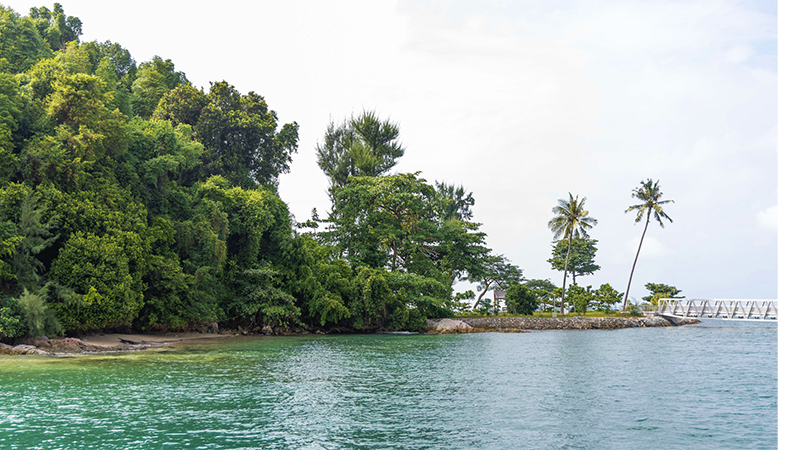
#4 The two islands are separated by a narrow but deep and dangerous channel that gave rise to the legend behind their names. The story goes that Minah and Linah, two pretty daughters of a poor widow, vowed to marry two brothers so they could always live together. When Linah was snatched away by a pirate chief, Minah swam after the boat but was swept away by a wave. Seeing this, Linah broke free and hurled herself overboard. A huge storm ensured, and when it cleared, two islands stood in the waters where the girls had drowned.
#5 Happily, there is safer swimming available on Big Sister’s Island, with two lagoons accessible for families and children for having a splash. Keep an eye out for the likes of sea cucumbers, crabs, starfish and even the occasional (harmless) reef shark.
Did you know? National Parks this year unveiled plans to designate a second marine park in the future, in the waters around Kusu and Lazarus, each home to around 100 coral species. Singapore’s reefs have almost half the number of coral species as Australia’s Great Barrier Reef, despite being 10,000 times smaller in area. Ferries depart daily for the Sisters’ Islands from Marina South Pier, with a return trip via Kusu/St John’s.
Return of the sponge!
Speaking of the islands off the south coast of Singapore, here’s a story about sponges… In 1822, the giant sea sponge Cliona patera was discovered. Thanks to its thick stalk growing out of the seabed, it resembled a wine glass – and it was nicknamed “Neptune’s cup sponge” in reference to the Roman god of the sea. People would harvest these sponges and, because of their size (a metre high and wide), use them as baby baths!
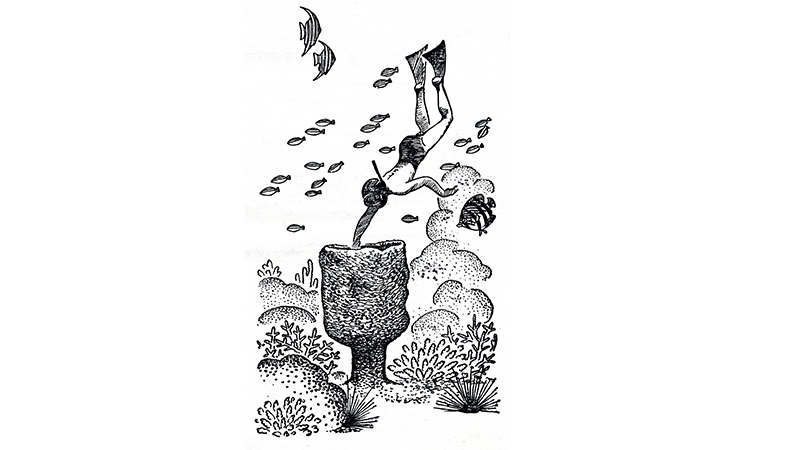
Then they just disappeared. For over a century, they were thought to be extinct, until in 2011, when marine biologists discovered two healthy-sized specimens within 50 metres of each other off the coast of Singapore’s St John’s Island. Today, the battle is on to protect this rare and critically endangered species.
An unwanted wake-up call…
Being woken by an alarm clock in the morning is never a pleasant thing, but at least you can just roll over and switch it off. For about a month recently, one member of the EL team was woken every morning between 4.45 and 5.30am by the “extremely loud and annoying” call of a bird outside her window – and with no “off” switch in sight!
The culprit? An Asian koel (Eudynamys scolopaceus). This large cuckoo bird takes the name “koel” from a Hindi onomatopoeia for its call, which is variously described as a “koo-ooo” or “oo-woo” sound.
The males are blue-black with a crimson eye, while the females have a streaked or spotted body of white and brown. Like other cuckoos, the Asian Koel is what’s known as a “brood parasite” – it lays its eggs in other birds’ nests, then relies on those birds to care for the babies until they’re old enough to fly away. In Singapore, koels usually choose crows’ nests for their purposes. (As terrible as the behaviour sounds, it does help to keep the crow population in check here!)
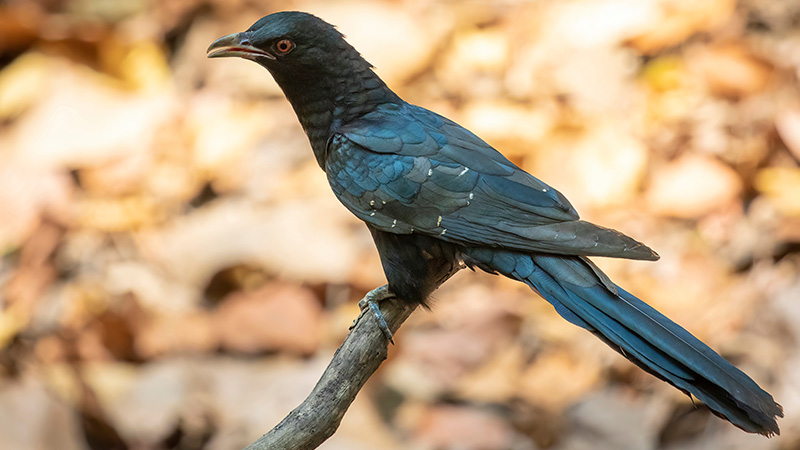
If your mornings are also being disrupted by an Asian koel, sadly the problem is unlikely to just disappear. For one thing, they are listed as a species of “least concern” from a conservation standpoint (i.e., there are loads of them!); and they’re also protected in Singapore under the Wild Animals and Birds Act, with a $1,000 fine for killing, taking or keeping one.
If you’re desperate, there is a “hack” that can apparently help stop the sound. Several online commentators suggest finding a recording of a koel’s call (try YouTube) and then playing it through a speaker out your window at the same time the bird starts its morning ritual. Because of its territorial nature, your feathered friend will more than likely fly away. Repeat the process a few mornings in a row, and there’s a chance it will be gone for good.
Did you know? According to the National Parks Board (NParks), in the period from 2016 to 2020, around 4 percent of all feedback received by the board from members of the public concerned the noisy Asian koel!
Ubin’s elephant
When residents of Pulau Ubin heard suspicious roaring sounds coming from the island’s forests in late February 1991, they thought one of the famed wild tigers of Singapore had made a comeback.
It wasn’t a tiger, though – it was Elephas maximus; an Asian elephant! On 1 March, a villager from Ubin was whacked in the head by the animal’s trunk while praying at a shrine. (He was later admitted to hospital with minor injuries.) Two days later, some French birdwatchers sighted the elephant, which again showed signs of aggression. On 6 March, teams from the Singapore Zoo and the Malaysian Wildlife Department tracked the elephant and tranquilised it. They then used two trained elephants from Malaysia to help coax the escapee onto a barge. It was later released into a national park in northern Johor.
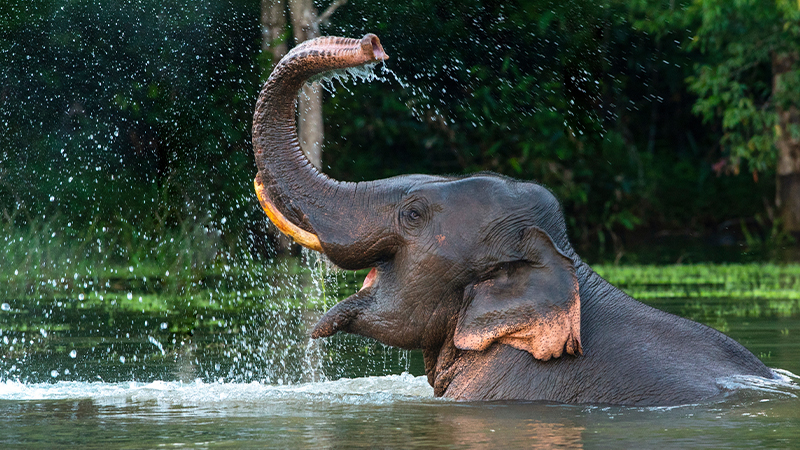
So, how did the elephant get to Ubin? It swam across the Strait of Johor! While it sounds unlikely, elephants are capable swimmers as they’re very buoyant and can employ their trunks like snorkels. Using a dog-paddle-style stroke, they can swim for several hours and even cover distances of up to 20 or 30km.
The Ubin incident followed one from the previous year when three Asian elephants swam to Pulau Tukong, Singapore’s second-largest outlying island. Tukong is used for military training – it was national servicemen who spotted the trio. In all likelihood, the elephants had been displaced by deforestation in eastern Johor and were looking for a fresh habitat.
While members of the public expressed a desire for the animals to be left alone, authorities feared that live firing during training on the island would cause stress; in an agitated state, the elephants could be dangerous to humans.
In June 1990, the three elephants were tracked and tranquilised, and then returned to Malaysia.
Other surprise visitors
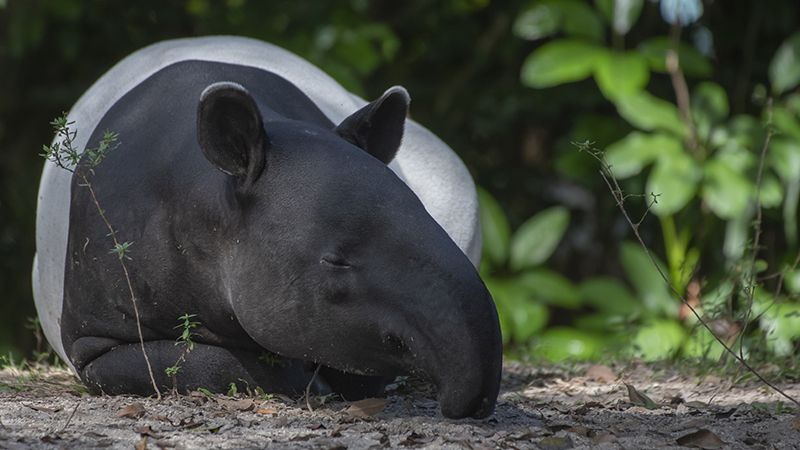
There have been more unusual animal guests in Singapore recently, including a Malayan tapir, which has been filmed running along the Punggol Park Connector at night. Officials from ACRES (Animal Concerns Research and Education Society) believe that, like the elephants, it swam across from Johor. A great slaty woodpecker was spotted on a fleeting visit to the Singapore Botanic Gardens in recent years, too. The grey bird is the world’s largest woodpecker – it can stand over half a metre tall. It had only been seen in Singapore three times previously.
Spooky Sentosa
With Sentosa being a popular place for Halloween festivities – for example, the annual Universal Studios “Halloween Horror Nights” party – it’s worth remembering the island has a scary past. It used to be called Pulau Blakang Mati, which translates roughly as “island of death from behind”.
While some researchers connect this to a period when piracy (and murder!) was rife, others pinpoint a huge malaria outbreak in the 1840s, which nearly decimated the population of original settlers. At the time, the deaths were blamed on “Blakang Mati Fever”, believed to stem from the island’s swampy water and decaying leaves. Only later were mosquitos found to be responsible.
The dark times continued on Sentosa during World War II, when it witnessed executions and was the site of a prisoner-of-war camp for 1,000 allied troops.
Things changed in the post-war period, as the civilian population grew, and fishing and camping enthusiasts from the mainland were drawn to Blakang Mati’s quiet coast. The seeds were being sewn for its complete reinvention as a tourist destination and leisure park in the 1970s and beyond.
Sentosa was given its current moniker in 1972, after the Singapore Tourist Promotion Board held a contest to replace the existing name. The winner was something far removed from its scary past: sentosa is a Malay word that means “peace and tranquillity”.
Tigers in Singapore
The Malay prince Sang Nila Utama is said to have founded Singapore in the 13th century and given it the name Singapura – “Lion City” – after seeing an impressive wild animal on the island. The sighting came during a hunt on a patch of open ground near the river – today’s Padang. The animal was described as having a red body, black head and white breast. When the prince was told by his chief minister that it was a lion, he was pleased, believing it to be a good omen. That’s when he decided to build a new city.

The animal was in all likelihood a Malayan tiger. While lions aren’t believed to have spread further east than India, the tiger population in Singapore was considerable in the past. (They got here by swimming across the Strait of Johor.) In fact, they were something of a menace in the 19th century, with regular reports of attacks on people. The first newspaper story of a civilian death by a tiger was in 1831. A few years later, the Irish architect GD Coleman – he built the Armenian Church that still stands today – was attacked with a group of workers while constructing a new road in the jungle. By the 1850s, it was estimated that 200 people were killed by tigers in Singapore each year. A village in the vicinity of Bukit Timah had to be entirely abandoned because it was too dangerous to live there.
Eventually, the government stepped in and offered a reward for killing tigers. This began at $20 but soon went up to $150 per animal. Hunting tigers became seen not only as a sport but also as a chance to make money. The result, of course, was a rapid decline in tiger numbers – and attacks.
An iconic story says that 1902 saw the last tiger killed in Singapore – in the Bar & Billiard Room of Raffles Hotel, no less. It had escaped from a nearby travelling circus on Beach Road. In fact, wild tigers continued to be found – and hunted – on the island for almost three more decades. The last official report of a big cat shot and killed was in October 1930, in Choa Chu Kang.
Did you know? The Singapore coat of arms honours both the legendary founding of the Lion City, and the prevalence of the Malayan tiger in times gone by, as it shows a shield being held up by a lion on the left and a tiger on the right.
New landmark
In 2024, a groundbreaking ceremony at Bay East Garden marked the start of work on the Founders’ Memorial, which will commemorate Singapore’s founding leaders and the key figures who played a role in the path to independence and nation-building.

Expected to open in 2028, the complex will offer an integrated gallery and gardens experience, including plant species that were planted decades ago as part of the greening of Singapore. As this rendering shows, the viewing gallery will provide some impressive views back over Marina Reservoir and to the city skyline.
Bucking the trend
We recently brought you news of the explosion (metaphorical not literal!) of wild chickens in Singapore, with numbers of the free-ranging birds apparently on the rise. Another animal that is said to be growing in numbers here, albeit at a much slower rate, is the sambar deer.
This large beast – one of the biggest deer species in the world after moose and elk – is native to Singapore and other parts of Southeast Asia but was considered to be extinct here by the 1950s. (The sambar has long been a favoured target of hunters.) However, the species defied the odds and made a comeback – in all likelihood, thanks to a few of them escaping from local public and private zoos and into the Central Catchment Nature Reserve.
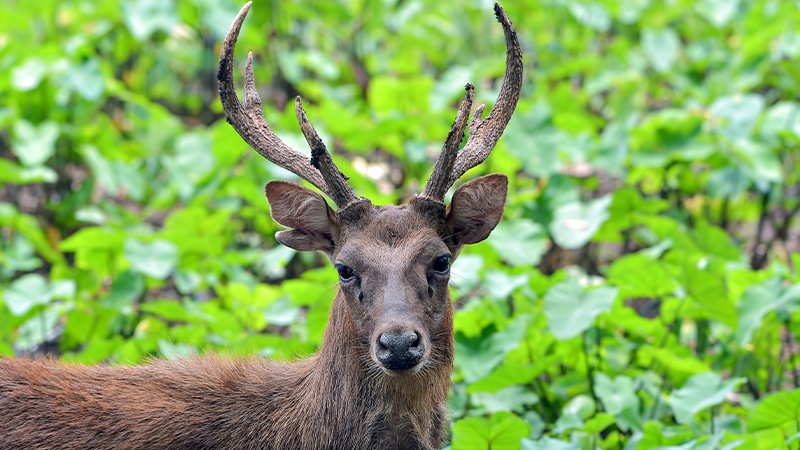
While sightings are rare, in February 2024, a woman filmed a huge sambar stag trotting along a road. Sadly, a sambar deer was killed in that same year in a collision with a taxi on Mandai Road. The fact that the current population of the species in Singapore is thought to be only around 20 makes a loss like this even more devastating. Sambar deer are active mostly at dusk and during the night, staying hidden in small herds in jungle vegetation by day. The animals mark foliage with their scent and stamp their feet to communicate. They live on grass and the fruit and leaves from shrubs and water plants.
Have you seen a deer in Singapore? Share your tale with us at [email protected]!
Feeling clucky?
We’re a long way away from the next Year of the Rooster (2029), but if news reports and personal observation are anything to go by, chickens are having a pretty good time of it in Singapore right now.
There has apparently been a steepish rise in the number of free ranging wild chickens roaming the streets. One of our team even saw a brood of birds walking around in the CBD recently! While it’s hard to quantify the numbers, the NParks board has received more and more feedback about free-range chickens in recent years; in 2017, there were 300 enquiries from the public; in 2021, there were 950; and figures have been rising since then.
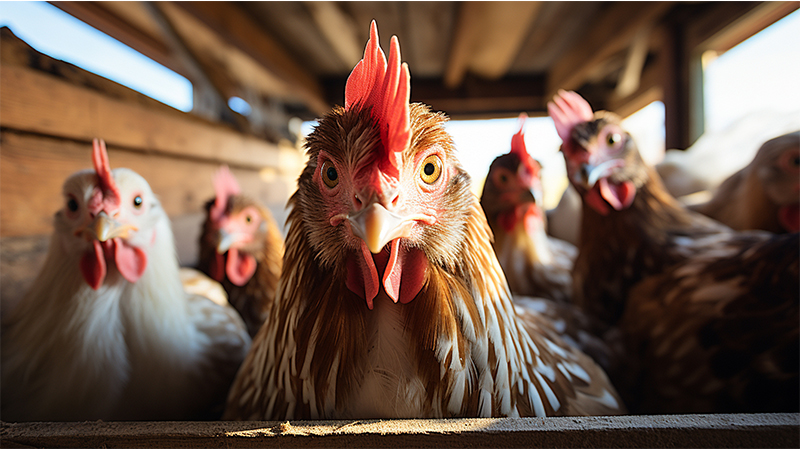
Many of these are complaints, of course: from being woken by cock-a-doodle-dooing in the early hours, to the hygiene issues around widespread chicken droppings, and those pesky birds who hold up traffic as they try to cross the road (to get to the other side). A recent news report described fed-up residents in Tampines being woken by constant crowing from around 4.45am. Some adults told reporters they’d lived in the area their whole lives and never encountered this before.
While the chicken hotspots in Singapore have usually been areas further out, such as Pasir Ris, these days you’re just as likely to find chickens strutting their stuff more centrally in places like Jalan Bukit Merah.
Apparently, the individual town councils of Singapore are responsible for overseeing the issue. Methods of managing the problem include encouraging people not to feed the birds or allow them to settle into roosting sites. Relocation to farms and other hosts elsewhere on the island is another strategy that’s sometimes used. A few resourceful people have been taking the chickens in as pets – in Singapore, you’re legally allowed up to 10 of the birds on your premises, though only if the property manager allows it. HDB residents aren’t allowed to keep chickens, for example.
Filmmaker Jun Chong made an enjoyable short film about this very issue in 2020; it’s called New Resident, and you can watch it on YouTube.
Have you had a recent chicken encounter in your Singapore neighbourhood? Share your tale with us at [email protected]!
5 things about Singapore’s dugongs
#1 Related to the manatee, and also known as a sea cow, the dugong – thought to be a possible source of the mermaid legend – is a marine mammal that can be found in the tropical waters off approximately 40 countries of the Indian and Pacific Oceans, including Singapore.
#2 Dugongs are a threatened species globally and classified as “critically endangered” in Singapore, mostly because of land reclamation and water pollution destroying their main source of food – beds of seagrass. (They can eat up to 30kg of grass a day.) Dugongs were also once hunted for their meat and blubber in Southeast Asia, but this is no longer common.
#3 Making it more vulnerable to extinction is the dugong’s very slow reproduction rate; a female gives birth only every three to seven years, and to a single offspring after a gestation period of over a year.

#4 Around Singapore, they are most commonly found in the east Johor Strait – including off Changi Beach, Pulau Tekong and Pulau Ubin. You’ll be doing well to spot one, though – over the past quarter of a century, there has been an average of two sightings a year. Sometimes at low tide you can see where they’ve been active as they leave “feeding trails” in the grass beds.
#5 An orphaned baby dugong that was found near Pulau Ubin in 1998 was reared at Underwater World on Sentosa. Named Gracie, the animal became one of the aquarium’s star attractions until it died a couple of years before the facility closed in 2016.
Did you know? Although they have to come to the surface to breathe, dugongs are thought to be particularly hard to spot because of their lack of a dorsal fin.
Catching a breeze – kites in Singapore
Kite-flying has ancient origins – it probably dates back 2,500 years to China; but is it still popular in modern Singapore?
While the short answer is yes – in the mid-2010’s, for example, the NTUC Income Kite Festival Singapore attracted 20,000 spectators – many kite enthusiasts will tell you that the hobby’s peak period was in the 1960s.
One reason for the decline is increased regulations. Since 1969, Singapore’s Air Navigation Order has banned kites within 5km of an aerodrome (10km for Paya Lebar) because of the risk they pose to planes taking off and landing. Height restrictions vary from 200 to 500 feet (60 to 150 metres) above sea level, and fines for a first offence can amount to $20,000. To fly a kite within a restricted area, you must apply for a permit from the CAAS (Civil Aviation Authority of Singapore).

Kite-flying is also banned in many of Singapore’s green spaces. The NParks website lists 30 parks and nature areas that are “No-Fly Zones” – from the Botanic Gardens to the Rail Corridor, and all of Pulau Ubin. At East Coast Park, you can fly kites between Area B2 and Area F1/F2.
Another problem that kite lovers face in Singapore is development. Punggol used to be a popular spot in past decades, for instance, but now condominiums fill the open spaces that were once fields of Lalang grass. This change led to an annual celebration called Singapore Kite Day being moved in 2011 from Punggol to Marina Barrage.
Because of the current lack of events in Singapore, many kite enthusiasts head to the likes of Malaysia, India and Bali to fly kites. Some of them will spend thousands of dollars, too – evens tens of thousands – on a well-made and creatively designed kite.

If you’re keen to fly a kite, popular locations include East Coast Park, Marina Barrage, Bishan-Ang Mo Kio Park, Sembawang Park, Punggol Waterway Park, West Coast Park and, a ferry ride away, St John’s and Lazarus Islands.
Did you know? “Fighting kites” were popular in South Asia and Southeast Asia in times gone by, including Singapore; these are kites whose strings are made of nylon combined with powdered glass to help them cut through the kite strings of “opponents”. They are restricted or outlawed in most places now.
Anyone lost a hamster?
Something like 3,000 lost or abandoned items are found at Changi Airport every month. The most commonly reported are mobile phones, wallets, umbrellas, neck pillows and wireless earpieces. But more unusual things turn up, too – here are some that have been reported at the various terminals in recent times:
- A full-size bed frame
- A pet hamster; happily, the little fellow was later reunited with its owner
- A 1kg gold bar valued at approximately $50,000; this was found lying on the ground in Terminal 2 – it was also reunited with its owner
- A bag of adult toys and lubricants (this remained unclaimed)
- Worn dentures; a set of these is apparently found in Changi every couple of months on average
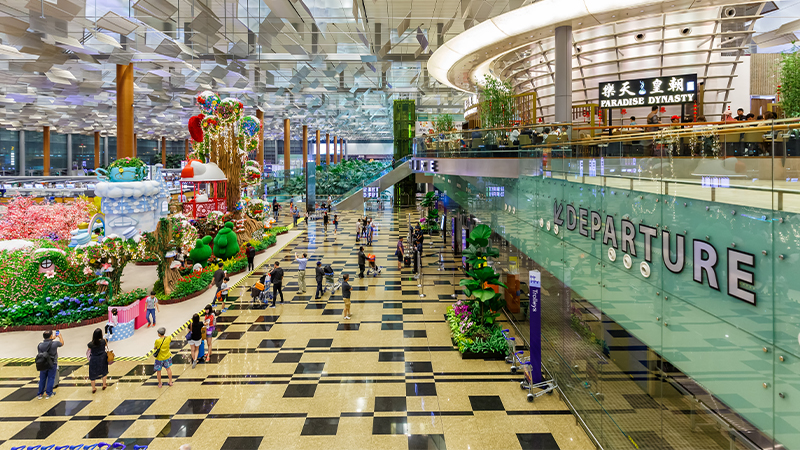
The longest skybridge in the world
Our regular contributor and urban explorer CERI POWELL takes in some more stunning Singapore views, this time from Pinnacle@Duxton.
The iconic shape of the seven towers of Pinnacle@ Duxton dominates the Singapore skyline from Tanjong Pagar to Keong Saik Road. And on the 50th storey of the building is the longest skybridge in the world, accessible to the public! To enter, go to Level 1 at Block G, next to the Yellow Café food stall. You need to register and pay $6 (cash only) at the tiny management booth. Then, take the lift to the 50th storey and tap an MRT/EZ-link/NETS flash-pay card to enter the turnstile onto the skybridge.
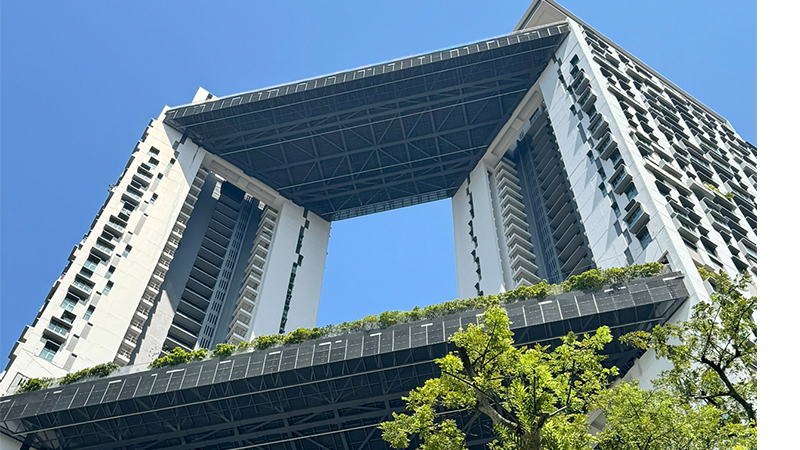
Emerging onto the roof, a spectacular vista of Sentosa, the docks of Pulau Brani, the Singapore Islands and beyond to Bintan and Batam is the first of many expansive views as you walk the 500 metres of the skybridge. Definitely pack binoculars for your visit.
Looking down on the red-roofed shophouse districts of Telok Ayer, Duxton Hill and Blair Road, you realise how precious these enclaves of history are as they nestle between the modern skyscrapers and highways. Pearl Hill remains a leafy oasis and Bukit Timah is instantly recognisable as the highest point in Singapore.
There are shady areas to rest, but the notices do request no food and drink to be consumed. Your MRT/EZ card accesses the exit turnstile on the 50th floor, with the chance to explore Duxton Plain Park once back on the ground. Nearby is Essen @ The Pinnacle in the Park, a modern food court with Asian, Western and fusion cuisine.
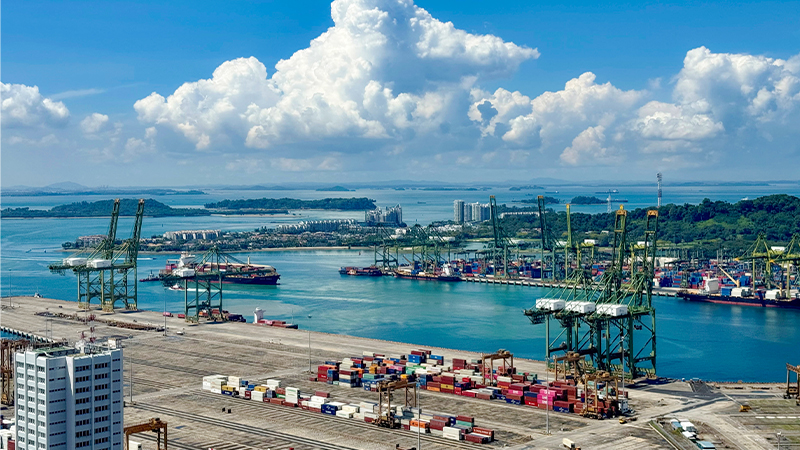
Getting There: MRT to Outram Park Station – take Exit 5 then it’s a 500m walk; or taxi/Grab to Block 1G Pinnacle@Duxton, Cantonment Road.
Opening times: Daily, 9am to 9pm, with a maximum visitor limit of 150 people per day. According to the staff, this limit does get reached, but usually only later on Sundays and public holidays.
Did you know? A Pinnacle@Duxton HDB flat sold for S$1.63 million in 2026, seeting a new Singapore HDB record.
Know your herbs
Sawtooth coriander is commonly grown and used in cooking in Singapore, though you might wonder why, when its Latin name – Eryngium foetidum – translates to “foulsmelling thistle”! In fact, the herb has a very similar flavour profile to regular coriander (cilantro), albeit with a considerably stronger taste. The leaves look very different too – long with serrated saw-like edges.
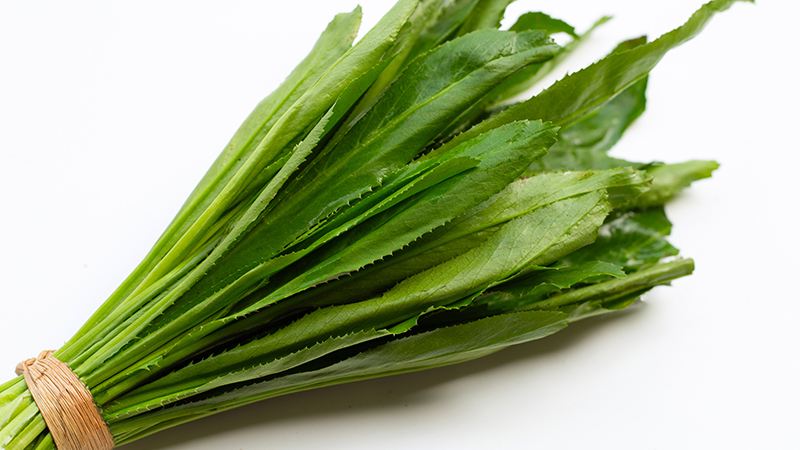
It’s popular in Singapore because it’s far more tolerant of a hot, steamy climate than “true” coriander, which tends to flower very quickly. In fact, it’s a great option for growing in a pot on a windowsill or balcony, as it thrives on four to six hours of direct sunlight a day. It can also withstand high-temperature cooking, which is why you’ll find it being used here in everything from Thunder Tea Rice to curries and stir-fries.
Did you know? Sawtooth coriander is part of the same plant family as carrot, parsley, celery and parsnip
5 things about teh tarik
#1 The name teh tarik comes from the Malay words for “pulled tea”. The pulling reference relates to the preparation of the drink, which is poured back and forth several times between two containers – often from an extended height. This helps give the liquid a frothy head and cool it down to a drinkable temperature.
#2 Teh tarik consists of strongly brewed black tea blended with condensed milk, and sometimes evaporated milk too. (You can say “siew dai” if you want a less sweet version.) There are other variations of the drink, including teh halia (ginger tea).
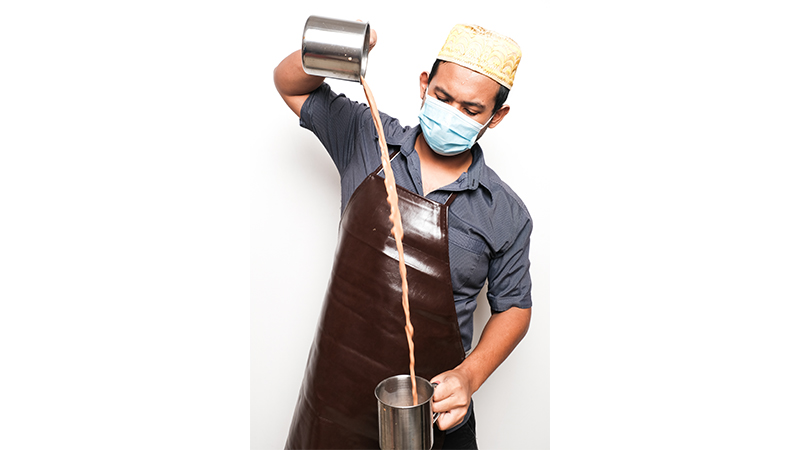
#3 It’s thought to have originated among Indian Muslim immigrants in Southeast Asia after World War II, in particular at drink stands set up for workers on the rubber plantations in the Malay Peninsula.
#4 The pulling process is often quite theatrical, and competitions are held in different parts of
Southeast Asia to find the champion teh tarik server. Contestants use tricks such as pulling the tea while spinning vigorously in a circle, pouring two drinks at the same time, pouring behind their backs and more.
#5 You’ll find teh tarik in just about every hawker centre in Singapore, but one stall that repeatedly features in “best of” lists is Bhai Sarbat, which has been in the same spot in Kampong Glam since 1977.
Streets – a bunch of bananas
Singapore’s roads in certain neighbourhoods have names that follow a particular theme; along Farrer Road you’ll find royal street names – King’s Road, Empress Road and others – while roads close to the Moulmein Flyover have Burmese roots (Rangoon, Irrawaddy and so on).
But did you know there’s a whole set of roads with banana in the title? Around Beauty World in Upper Bukit Timah, six roads feature the Malay word pisang (banana). They are Lorong Pisang Asam (“sour”), Lorong Pisang Udang (“prawn”), Lorong Pisang Emas (“gold”), Lorong Pisang Batu (“stone”), Lorong Pisang Hijau (“green”) and Lorong Pisang Raja (“king”). Each one is a different banana variety – pisang batu, for example, is a cooking banana that’s sold unripened and used in dishes like rojak.
Funnily enough, there’s also a plain old “Banana Street” in Singapore – Jalan Pisang – but it’s located in Kampong Glam.
Not far from Beauty World, in Bukit Panjang, is a neighbourhood of nut-related roads – Almond, Cashew, Chestnut and Hazel.
Singapore at The Oscars
How has Singapore fared in “Hollywood’s night of nights”? Roll out the red carpet and we’ll reveal all…

Best International Film
Singapore has never been nominated in this category at the Academy Awards – nor have Malaysia, Indonesia and Thailand, for the record. (Vietnam has had one nomination – The Scent of Green Papaya in 1993.)
However, Singapore does regularly submit films for consideration – it has done so 15 times. (Indonesia has submitted 23 films and Malaysia eight.) A recent submission was the Anthony Chen-directed drama The Breaking Ice.
Singapore’s 2005 submission – Be With Me, inspired by the true story of a woman known as “the Hellen Keller of Southeast Asia” – was disqualified from the category for having more than 50 percent of the dialogue in English rather than a foreign language.
Best Actor/Actress
Malaysia’s Michelle Yeoh famously became the first Asian to win the Best Actress award at the 2023 Oscars (for Everything Everywhere All At Once). But Singapore hasn’t been so lucky – we’re yet to be nominated for an Actor/Actress award.
No Best Film nods either; Crazy Rich Asians (2018) was set largely in Singapore, but was an American film through and through – in any case, despite a Critics’ Choice win and some Golden Globe nominations, it was snubbed by Academy Award voters.
Individual Awards
Which brings us to Nickson Fong, a computer graphics artist who is currently the only Singaporean with an Oscar to his name. He received the Academy Award for Best Technical Achievement in 2012 for the technique of “Pose Space Deformation”, which makes animated characters appear more lifelike. It’s been used in films such as Spider-Man and Avatar.
Pretty good for a self-confessed “school dropout” whose principal apparently suggested to Nickson’s mother that he find a job at McDonald’s!
A burrowing beastie
It’s easy to get distracted by playful macaques in Singapore’s jungles, but we spotted and photographed a much smaller critter on a recent walk in Bukit Timah Nature Reserve: a mole cricket. Named for its ability to burrow like a mole, thanks to its powerful shovel-like limbs, this insect spends the majority of the time scurrying underground in the long networks of tunnels that it constructs – so this was a rare sighting!
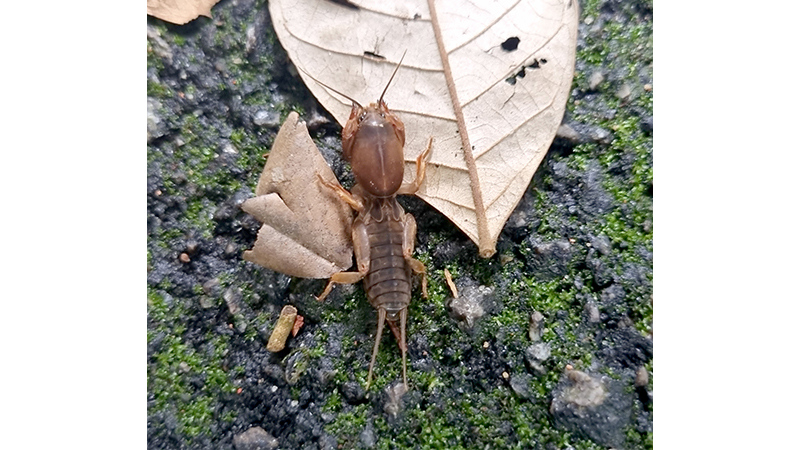
Like other crickets and cicadas, male mole crickets make a very loud noise by stridulating – or rubbing their body parts together. The loudest males are said to attract up to 20 females in a single evening, while quiet ones can miss out altogether. However, there are parts of Southeast Asia – especially Thailand – where making such a racket doesn’t do mole crickets any favours, because they are caught and deep fried as a snack. (YouTube has plenty of videos of this unique delicacy being prepared.)
The Gallop Extension
The beautiful black-and-white colonial building standing on a grassy ridge in the picture below is “Atbara”, one of two bungalows of historical and architectural significance that can be found in the Gallop Extension of the Botanic Gardens.
Atbara – today home to the Forest Discovery Centre – was built in 1898 by the renowned English architect Regent Alfred John (RAJ) Bidwell. He also designed the neighbouring bungalow, “Inverturret” (1906), which is now the Botanical Art Gallery. The two houses are located at 5 and 7 Gallop Road respectively.
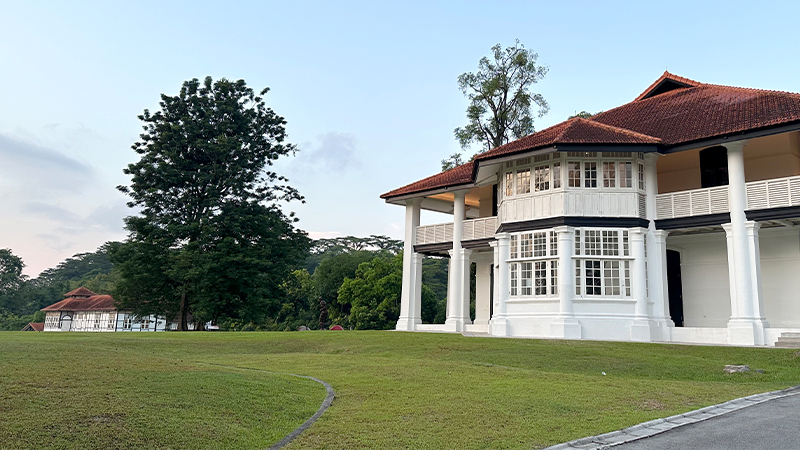
Bidwell came to Singapore in 1895 and worked for 17 years for the architectural firm Swan and Maclaren. In that time, he contributed greatly to the Singaporean landscape, with a string of notable architectural landmarks – among them, the Goodwood Park Hotel, the Victoria Theatre and Concert Hall, Stamford House and, most famously, Raffles Hotel.
Atbara is considered Singapore’s oldest black-and-white house, even if it does feature some striking architectural departures from “regular” black-and-whites (Moorish arches, for example). Before they became part of the extended Botanic Gardens, the two houses were for Architecture many years home to the French Embassy (Atbara) and the French Ambassador’s residence (Inverturret). Atbara is where Singaporeans looking to take a trip to France would go to organise a visa.
About the buildings today:
• Forest Discovery Centre – A showcase of Singapore’s forest ecosystems through interpretive and interactive displays, including a photographic installation of forest trees.
• Botanical Art Gallery – Home to Singapore’s first permanent display of botanical art, including a selection of more than 2,000 paintings, sketches, line drawings and photographs.
Go directly to Changi Prison! Do not pass Go!
Monopoly was first released in 1935, but it wasn’t until 1987 that the first Singapore-specific version of the board game appeared. Newer editions have been released since then, with various changes to the districts and streets portrayed on the board. (And, in a 2005 edition, three special silver playing tokens were introduced: a Merlion, a trishaw and the Singapura breed of cat.)
For a glimpse at these changes, here’s a look at the different colour groupings from the 1987 and 2016 editions, from the “cheapest” to the most expensive:

Brown:
1987: Geylang Road – Serangoon Road
2016: Joo Koon – Bukit Gombak
Light Blue:
1987: Farrer Road – Braddell Road – Thomson Road
2016: Sengkang – Bidadari – Serangoon
Magenta:
1987: Battery Road – Empress Place – Connaught Drive
2016: Woodlands – Ang Mo Kio – Toa Payoh
Orange:
1987: Colombo Court – Havelock Road – St. Andrews Road
2016: Tanjong Katong – East Coast Road – Bayshore Road
Red:
1987: Robinson Road – Shenton Way – Collyer Quay
2016: Queenstown – Tiong Bahru – Tanjong Pagar
Yellow:
1987: Marina Square – Emerald Hill – Raffles City
2016: Novena – Holland Road – Bukit Timah
Green:
1987: Tanglin Road – Orchard Road – Scotts Road
2016: River Valley Road – Orchard Road – Oxley
Dark Blue:
1987: Nassim Road – Queen Astrid Park
2016: Marina Bay – Sentosa Cove
While it would be drawing a long bow to make any conclusions about Singapore real estate prices over the past decades based on a Monopoly board, it’s at least interesting to see the new names that have emerged.
In 2004, a “Uniquely Singapore” edition was released, replacing districts and streets with tourist spots in SG – from Newton Circus and Lau Pa Sat, to the Jurong Bird Park and Asian Civilisations Museum.
Monopoly has been translated into 47 languages and been launched in 114 countries, with nearly 300 million sets of the board game sold to date.
Meet the Milo Dinosaur
In August 2023, McDonald’s outlets in Singapore offered a special-edition Dinosaur McFlurry for a limited time – if you let out a loud roar at the counter when ordering, you got 20 percent off! This wasn’t the dessert’s debut appearance either – it first appeared back in 2016.
The reference in the name is to the more humble Milo Dinosaur. This drink, found in many kopitiams and restaurants in Singapore (and Malaysia), consists of a glass of Milo (the chocolate-malt powder made by Nestlé) mixed with milk and ice, with a big extra spoonful of Milo dumped on top. It began appearing on menus in the mid-1990s, with the dinosaur connection possibly relating to the popularity of Jurassic Park at around that time.
Also known as “ta-chiu”, the Milo Dinosaur can also be ordered with a scoop of ice cream or whipped cream on top: this variation is known as the Milo Godzilla.
And while it might just be a sweet chocolatey treat that kids in particular love, it’s also something of a cultural icon. In fact, in 2019, a Fellow from the ISEAS-Yusof Ishak Institute delivered a lecture at the National Museum on the place of the Milo Dinosaur in Singapore’s heritage landscape!
Blessings in the Business District
Wedged between Raffles Place and Boat Quay (across the road from CapitaSpring, mentioned further down in this feature) is the small Yueh Hai Ching Temple. Set up by Teochew immigrants in the early 19th century, the temple is worth visiting if you’re in the area – or if you work in a nearby office and need a few minutes of peace and quiet! The ceramic decorations on the roof and inside are especially noteworthy.
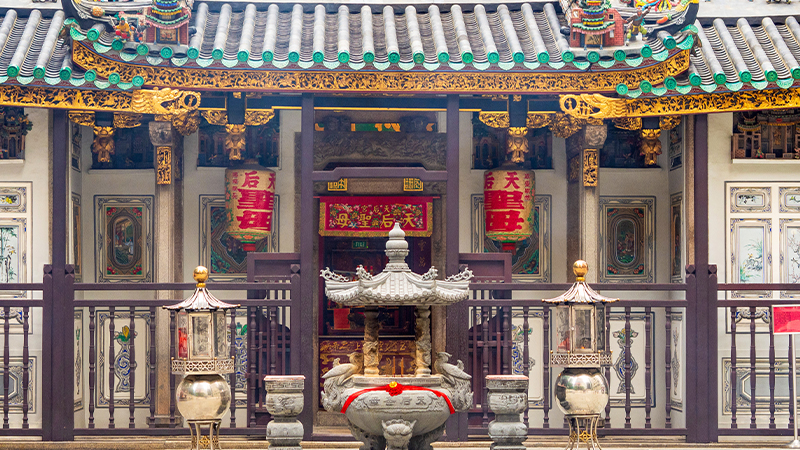
In 1899, the Chinese Emperor Guangxu bestowed on the temple a calligraphy scroll he’d written by hand, with the message: “Moving seas with peaceful clouds above”. It was a personal blessing for a contribution of 6,000 taels of silver the Teochew community had made to help with flood relief in Shandong, China.
Yueh Hai Ching Temple was restored between 2011 and 2014, winning a UNESCO conservation award in the process.
View from the top
Regular EL contributor Ceri Powell finds a sky-high panorama in the CBD.
Did you know that in the heart of Singapore’s financial district you can visit an amazing roof space 280m high above the city? Atop the CapitaSpring building, completed in 2022, is a large sky garden accessible to the public.
Take the dedicated lift in the CapitaSpring ground floor lobby to the Sky Garden on Level 51. There’s an information counter if you need assistance. Emerging onto the roof, a winding path leads through what must be Singapore’s highest urban farm, with dedicated garden areas for tropical fruit and Australian and Japanese plants.
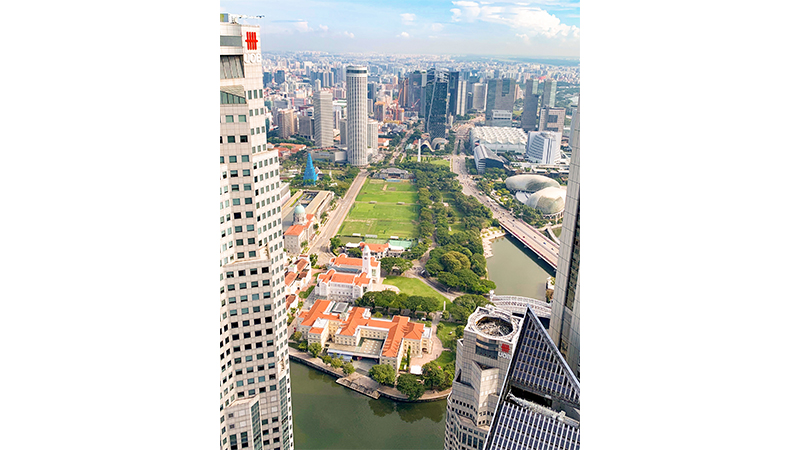
On my last visit, the head gardener shared a unique challenge of the garden. Because it’s at such a high elevation (Singapore’s joint-secondtallest building, in fact), there are no resident birds, so there’s an overabundance of bugs and insects!
The architecture of the CapitaSpring building is Insta-worthy in its own right, but what takes your breath away are the views of the CBD, Chinatown, Tanjong Pagar and – on a clear day – over the Straits of Johor to Malaysia. The most unusual perspective is looking down on Marina Bay Sands! Note that there is no food and drink outlet at the Sky Garden during opening hours, and shade is limited, but there are chairs and tables for a picnic, or you can just sit and take in the incredible vistas.
Upon returning to the ground, explore the cute Yueh Hai Ching Temple nearby (see opposite), or stop for a bite along Telok Ayer Street. I recommend French Fold at number 204 for scrumptious galettes!
Location: 88 Market Street. Take Exit A from Raffles Place MRT Station and walk down Malacca Street to Market Street.
Hours: Monday-Friday, 8.30-10.30am and 2.30- 6pm (last admission 5.30pm). No access on weekends or public holidays.
Singapore’s new Red List
A Red List is a report of the status of species within a country or region – it’s based on the “Red List of Threatened Species”, founded in 1964 by the International Union for Conservation of Nature. The document measures the status of the globe’s biological species, including threats and extinction risks.
Singapore produced its first Red List in 1994, and a second edition in 2008. In June 2023, the third edition was released, following assessments of 7,300 different species by 120 experts between 2019 and 2023, including field samples and lab work.
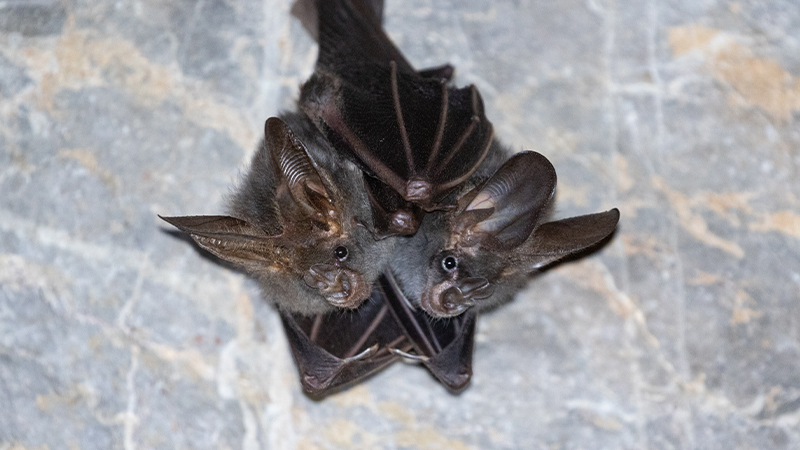
And there was some good news for the island’s critters! More than 560 species had their conservation status downlisted from the earlier edition. They include the oriental pied hornbill, the common onyx (a rare butterfly) and the lesser Asian false-vampire bat! This particular bat is found on Pulau Ubin; it had been classified as Critically Endangered in 2008, but thanks to the construction of bat houses as roosting sites on Ubin by a team from NParks, it’s now Endangered.
Not everything is faring so well. About 300 species were uplisted in the latest edition, including the Malayan horned frog (Endangered to Critically Endangered).
Dragon fruit facts
Here are a few things you may not know about the dragon fruit, a market staple in Singapore.
#1 Dragon fruit flesh is most commonly white or red, but it can also be yellow; the red variety is considered sweeter and is also said to have more antioxidants.
#2 The fruit comes from a cactus plant indigenous to Central America (where it’s referred to as pitaya or pitahaya). Today, it’s cultivated in many countries, including Vietnam, which is the world’s biggest exporter of dragon fruit.
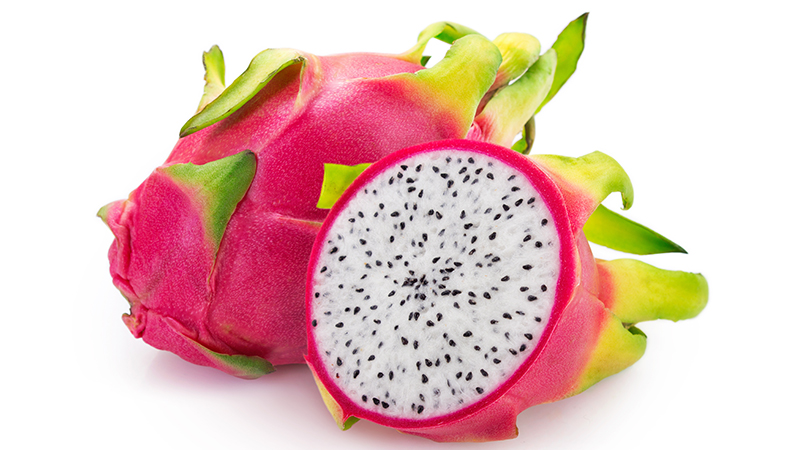
#3 Why “dragon”? Probably because of its leathery skin and scaly spikes.
#4 Keen to see a dragon fruit flower in the wild? You’ll need a torch. Dragon fruit flowers only bloom once, and only at night, opening late in the evening and closing as the sun comes up. For this reason, it’s been nicknamed “Moonflower” and “The Cinderella plant”.
#5 The edible black seeds are high in polyunsaturated fats like omega-3 and omega-6 fatty acids, which can help with heart health.
The unintentional durians
It’s a nice story: architects pick a local icon, in this case the famous durian fruit, and use it as the design inspiration for Singapore’s leading performing arts centre, Esplanade – Theatres on the Bay.
Only, that’s not what happened! In fact, the original design, by DP Architects and Michael Wilford & Partners, looked more like a flower; this then morphed into “concrete blobs” that were initially described as appearing like loaves of bread or marshmallows.
The spikes only came along later – and even then they weren’t added with the idea of making the two buildings look durian-esque. The 7,000 triangular aluminium sun shades were deemed necessary to help block out the tropical heat.
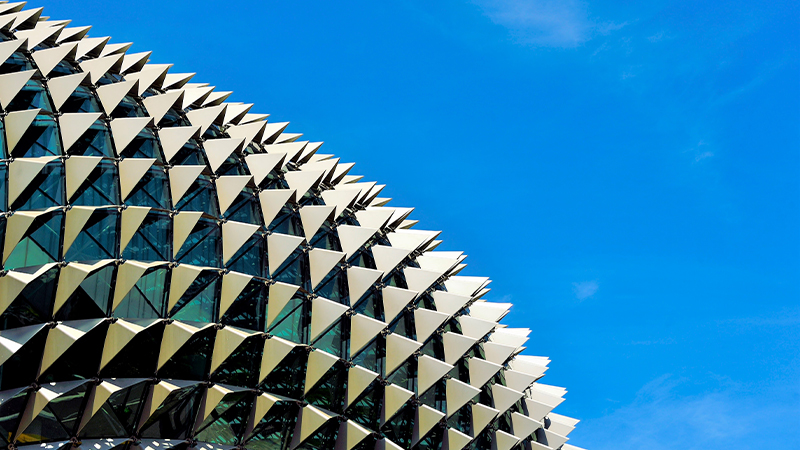
This is why the team at The Esplanade doesn’t refer to them as “spikes”, but rather as “cladding”. And they clean each and every one by hand, with technicians working with safety lines and harnesses – it takes about two months to do both domes.
The Esplanade opened in 2002, and by the end of its opening festival in October and November of that year, had already welcomed a million visitors! It has hosted approximately 50,000 events since then.
For the record, it’s not just durians that people see in the design: others have referred to the two domes as the eyes of a fly, or – perhaps more appropriately – microphones.
Did you know?
The Satay Club, an early incarnation of Satay by the Bay, had been located on the Esplanade site since 1970, but was demolished in 1995 to make way for the construction process. The popular open-air hawker spot served grilled skewers of meat with ketupat rice cakes and spicy peanut sauce – like you can find at Lau Pa Sat’s “Satay Street” today.
A clever drongo
In Australian slang, a “drongo” is an idiot – but that’s not a description that could be levelled at the greater racket-tailed drongo.
This bird, which is found across Asia, including in Singapore, has an amazing array of calls – from a monotonous repeated whistle to complex squawks and metallic noises. It’s also incredibly adept at mimicking the sounds of other birds. In particular, it mimics the alarm calls that other birds make – when those creatures hear that danger is around, they fly off in a panic and the drongo steals their food. Cunning!
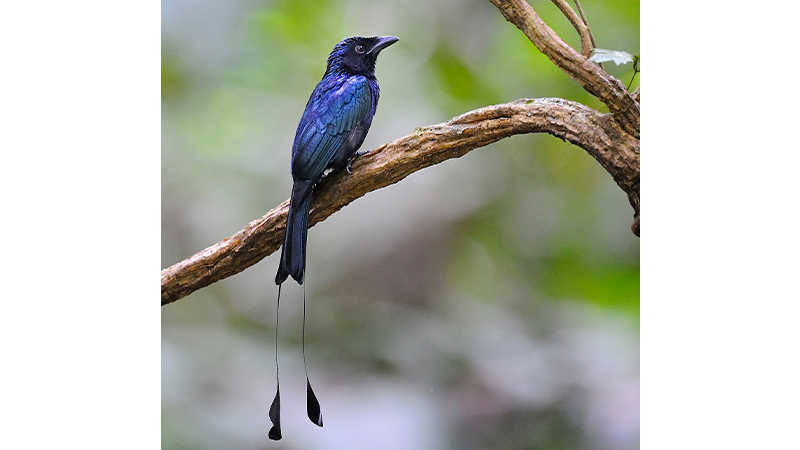
There are plenty of greater racket-tailed drongos in Singapore. (Their conservation status is “least concern”.) You can find them in forested areas particularly in the middle of the island: the Central Catchment Forest, Bukit Timah Nature Reserve, Dairy Farm Nature Park and Kent Ridge Park. If you see a bird with dark, glossy features and two distinctive extensions to its tail, a bit like streamers, that’s the one. (Oh, and if you see it hopping along a branch and throwing objects in the air and catching them again, it’s putting on a courtship display – possibly for you, but more likely for another drongo…)
By the way, the use of “drongo” in bird species comes from the indigenous language of Madagascar. As for Aussies using it to describe a fool, this is thought to have stemmed from a racehorse called Drongo who, in the 1920s, raced 37 times but never won. Over time, it developed into a nickname for someone who is generally hopeless.
Singapore’s Sasquatch
You all know Bukit Timah … but do you know the Bukit Timah Monkey Man?
Stories abound about big, hairy, human-like creatures that still roam the planet. In the US, there are semi-regular reports of sightings of Bigfoot or Sasquatch, while the Himalayas has the Yeti or Abominable Snowman; Australia has its Yowie, and Indonesia has the Orang Pendek.
The same goes for Singapore, where an urban legend exists around the BTMM, or Bukit Timah Monkey Man. Details are (unsurprisingly) sketchy, but some accounts attribute the first sighting to the early 1800s; others say Japanese troops spotted the creature during the WWII occupation. The occasional photographic “evidence” emerges too; most recently in December 2020, when some night hikers claimed to have seen the BTMM lurking behind a tree. (A 2012 YouTube video of a sighting is less convincing.)
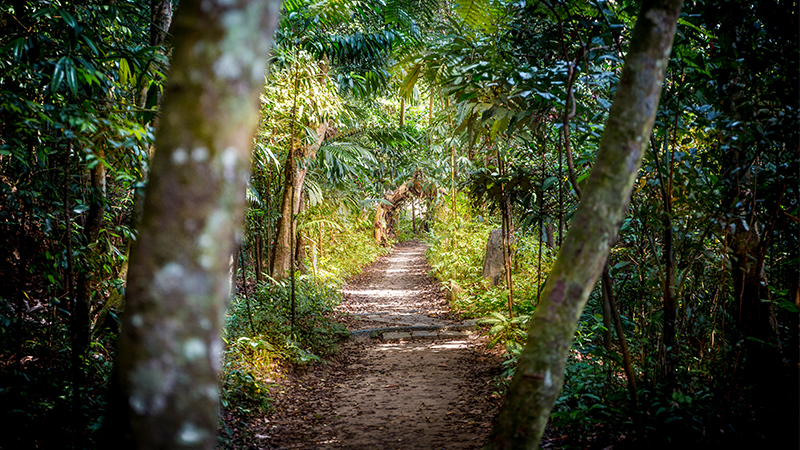
Unfortunately, unlike the Bigfoot and Yeti, who both tower above the average human, the BTMM is thought to be around the same height as a typical male. So, to replicate an appearance, it would really only take dropping a bit of cash at a costume rental place and then visiting Bukit Timah Nature Reserve for a quick photo session. (It would want to be quick, too – Singapore doesn’t lend itself to getting around in a fur suit for long …)
Still, the legend of the BTMM persists. There’s a short film on the subject – In Search of The Bukit Timah Monkey Man; and the creature has been discussed in books (Extraordinary Animals Revisited by Karl Shuker, for example) and even received a mention on an American TV show, Bones.
It’s something to ponder when you’re next on a solo hike on the Dairy Farm Loop and you hear the snap of a twig from the undergrowth….
Durians by numbers
July sees the peak of the durian season in Singapore, so if you’re a fan of the spiky, stinky delicacy, here’s a fact file!
- 100: Approximate number of durian varieties, including popular ones like D24, Mao Shan Wang and XO
- 1.5: Average weight of a durian, in kilograms
- 5: Number of “compartments” inside a durian where the flesh can be found
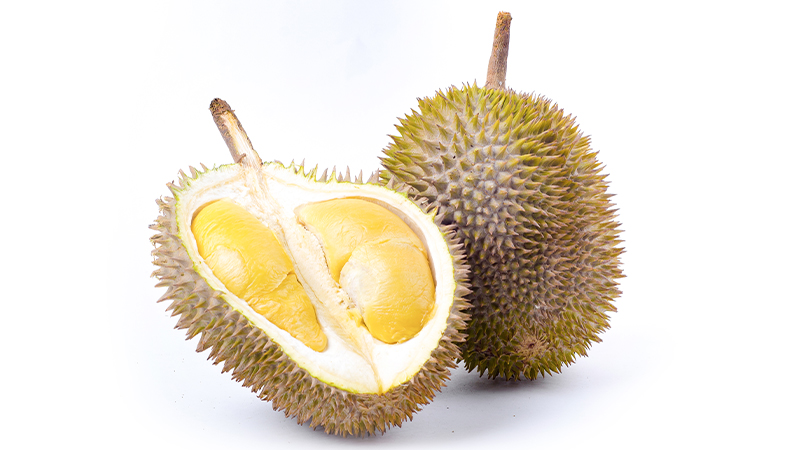
- 700,000: Tonnes of durian produced by Thailand per year, more than any other country
- 500: Number of years the word “durian” has been around; it comes from a Malay word duri meaning thorn.
- 1,350: The huge number of calories in a one-kilogram durian (thankfully, the fruit is also extremely high in vitamins and minerals)
- 50: The number of distinct odorous compounds (i.e., smells!) detected by German scientists in durians, including four previously unknown ones
Did you know? A 19th-century British naturalist described durian flesh as “a rich custard highly flavoured with almonds”. We have definitely heard less charitable descriptions!
Waiter, there’s a worm in my laksa!
If you’re reading this while hunched over a bowl of laksa, you may want to turn away… A few years ago, there was a hubbub in Singapore online forums after a diner found a tiny worm in her bowl of laksa and uploaded photos of the unwanted critter. While some were sympathetic, others shrugged it off, referring to the fact that worms and indeed maggots used to be added to laksa on purpose!
Apparently, in the 1950s, it was common practice for cooks to use earthworms during the preparation of the dish as a flavour enhancer; they’re said to have added a desired saltiness to the broth. And maggots were introduced in the process, too, because they were believed to “eat away bacteria” that might be present in the food.
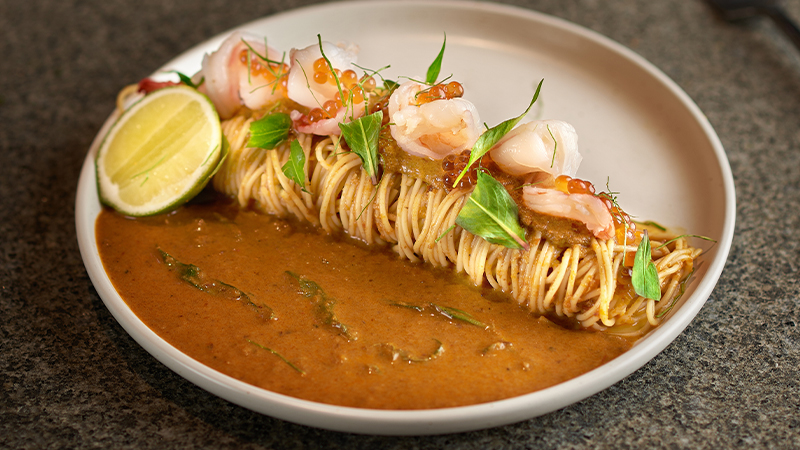
So, the next time you see what you think is a bean sprout in your bowl, it might warrant a second look, just to be sure.
Boat Quay views
Regular EL contributor Ceri Powell contacted us with a heads-up about a Singapore vantage point that we’ve not explored before, and we’re guessing many readers haven’t too. Thanks, Ceri!
“Members of the public are allowed into the Supreme Court building. You can take the lift to the Viewing Gallery on Level 8 and you’ll find the most amazing view of Boat Quay (pictured), the CBD and around to Marina Bay Sands and the Singapore Flyer. The panorama is framed by highly angled windows so it feels like a movie. It’s a hidden gem, with virtually no tourists or other visitors, ever!”
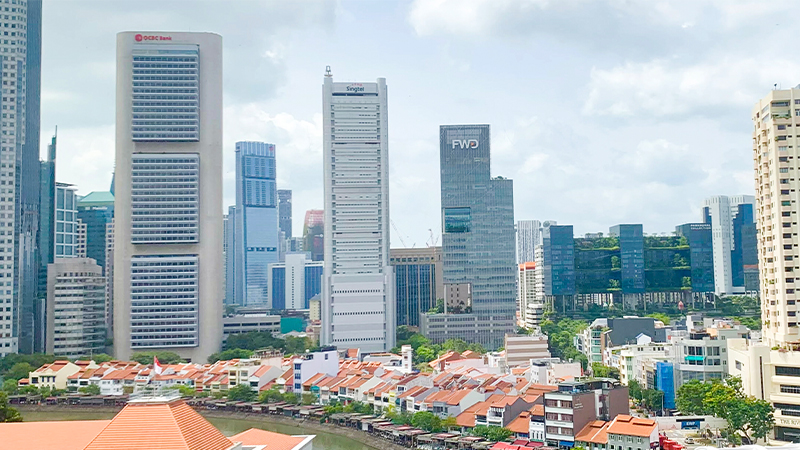
The Supreme Court building is at 1 Supreme Court Lane, near City Hall MRT. To book a free guided tour, visit judiciary.gov.sg/visit-us/tour-courts.
Just next door to the building is the Old Supreme Court, now part of the National Gallery. To see what it used to be like before the new version came along, you can download the “SG Old Supreme Court” mobile app for a virtual tour.
A Second World Heritage Site?
Speaking of the Old Supreme Court, it’s one of a cluster of buildings known as The Padang Civic Ensemble that was added to Singapore’s “Tentative List” for UNESCO World Heritage Sites. This is the first step in the potential nomination of the location as a World Heritage Site in the future. Currently, only the Botanic Gardens holds that status in Singapore (which it received in 2015).
The Padang Civic Ensemble is made up of the Padang itself, plus the Victoria Theatre and Concert Hall, the Old Supreme Court and City Hall, and the Former Parliament House and Annex (now Arts House).
10 things about Kusu
Did you know that the Chinese temple on Kusu Island is celebrating its 100th birthday in 2023? Here are some other things to know about this small dot that makes up part of Singapore’s Southern Islands.
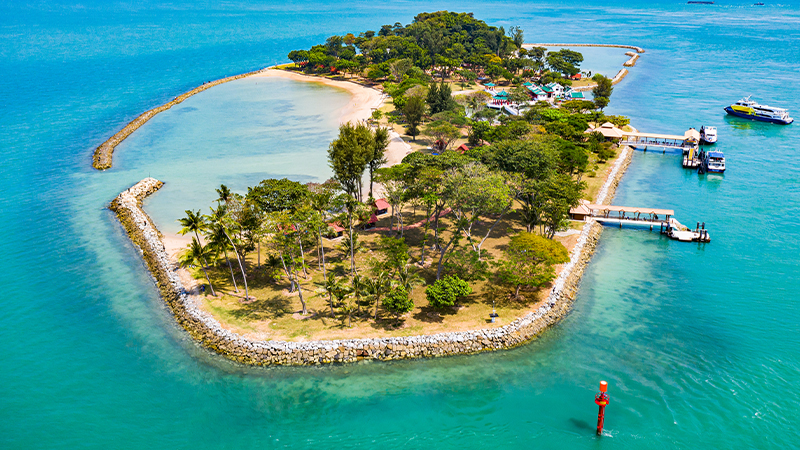
- “Kusu” means “turtle” in Hokkien; the Malay name for the island is Pulau Tembakul. In the 18th and 19th centuries, it was referred to as “Governor’s Island” and “Goa Island” at different times.
- In 1822, a few years after Stamford Raffles arrived in Singapore, a signal station and mast were set up on Kusu as a reference point for ships entering the new port.
- While it’s now a single island, in the past it was just two bumpy bits of reef joined by sand at low tide. Modern land reclamation turned it into the 85,000-square-metre island we know today (roughly the size of 12 football pitches).
- There are lots of myths and legends associated with the island; one tells the story of a Malay and a Chinese fisherman whose boat capsized in the vicinity, only for them to be carried ashore by a turtle. Despite their different cultural backgrounds, they lived out their lives on the island peacefully.
- While the island was inhabited in the past (in particular, by Orang Laut people who mostly work in the ferry industry today), there have been no permanent residents on Kusu since the late 1970s.
- Apart from enjoying beach picnics and checking out the island’s small tortoise sanctuary, people visit Kusu for its two key religious sites: the Da Bo Gong Temple (or Tua Pek Kong Temple – “Grand Uncle” in Hokkien); and the collection of three Malay kramats or shrines (which require a climb of 152 steps to reach!).
- On 17 April 2022, the Malay shrines were almost totally destroyed in a fire, thought to have started from a candle or oil lamp. They were reconstructed over a six-month period.
- Kusu is the site of a large annual pilgrimage, when as many as 100,000 devotees visit during the ninth lunar month to worship the local deities. A temporary hawker centre is set up to accommodate the crowds.
- One popular spot in the pilgrimage is the giant pink lotuss shaped wishing well that you can toss coins into after making a wish. There used to be bells inside the lotus that you could try to hit as a bonus!
- To get to Kusu, take the ferry from Marina South Pier (around 45 minutes). It stops off at St John’s Island either on the way there or on the return.
Meet the mousedeer
Singapore is home to a small handful of different ungulates – or hoofed animals. Perhaps best known is the wild boar, whose population is said to be on the rise. Less prominent by far is the mousedeer.
There are two species of mousedeer in Singapore. The lesser mousedeer (Tragulus kanchil) is often referred to as the kancil, and is said by some to be the world’s smallest hoofed animal – it weighs as little as 2kg when fully grown. One 2017 estimate suggested there were as few as 20 in Singapore, where they live in the Central Catchment Area. Meanwhile, the greater mousedeer (Tragulus napu) was thought to have disappeared entirely, only to be spotted again on Pulau Ubin in recent times, and confirmed by scientists to have made an “unlikely comeback”.
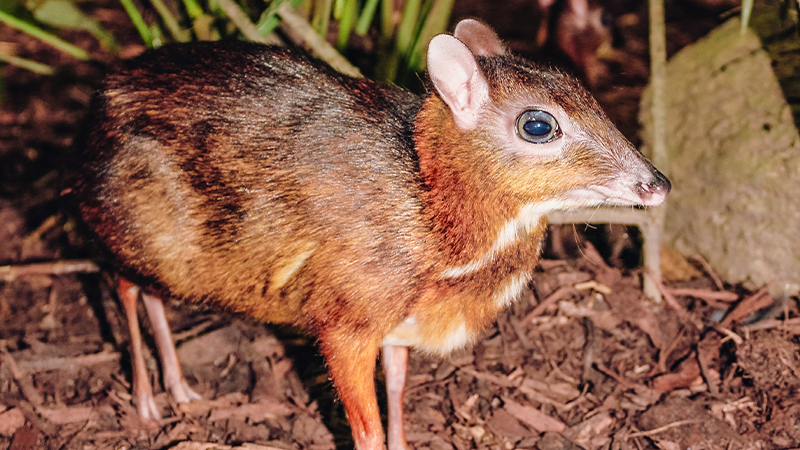
One thing is certain: with a face that looks a little like a cross between a deer, a rodent and a squirrel, this is definitely a cute critter! (Less cute are the oversized tusk-like canine teeth in the males, which are used for “slashing” at rivals during mating periods…)
There is a famous mousedeer character who is a recurring character in Malaysian and Indonesia folk tales. Known as Sang Kanchil, he’s clever and quick-witted, and uses his cunning to get the better of big scary crocodiles and tigers. For this reason, politicians have been known to use the mousedeer as an analogy for Singapore – something with a small size but the nimbleness to overcome obstacles.
Culture – Peranakan Museum
After a four-year revamp, Singapore’s Peranakan Museum reopened in 2023, with nine galleries across three floors, and each floor dedicated to a particular theme around an aspect of Peranakan identity.
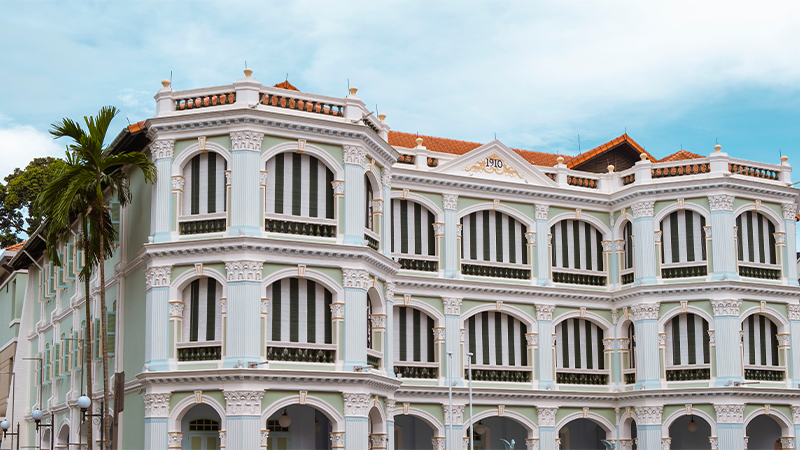
Along with physical displays, there are interviews and stories showcasing living cultures within the broader Peranakan group, including those of Arab Peranakans, Chinese Peranakans, Chitty Melakans (or Peranakan Indians) and Jawi Peranakans.
Here’s a glimpse of what to see!
Level: 1
Gallery name: ORIGINS
Theme: Exploring the origins of Peranakan identity, tracing how this hybrid identity emerged, and encouraging visitors to ask, “What is Peranakan?”
Sample display: Hand-painted photograph of a Batavian born Peranakan woman named Lie Pa-toe Nio.
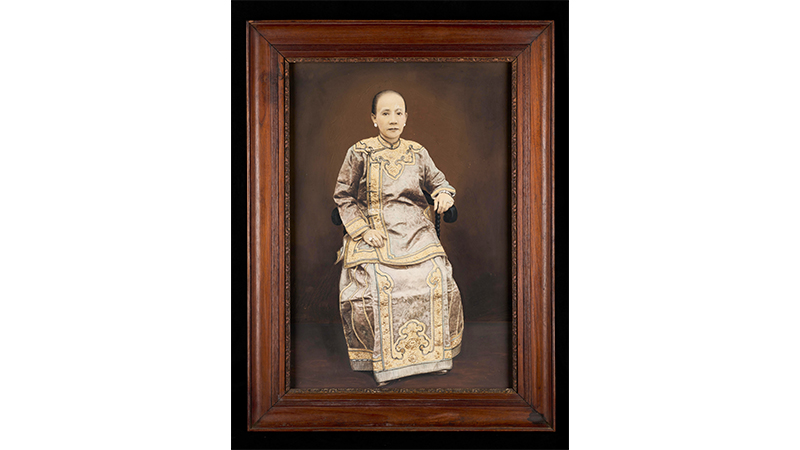
Level: 2
Gallery name: HOME
Theme: Objects from various family homes in Singapore and the region, touching on customs, lifestyles, furnishings, food, faith, language and art.
Sample display: Radiogram (combination radio/record player) with Plessey autochanger and two 78rpm records. Records were colloquially referred to as piring hitam or “black dishes”!

Level: 3
Gallery name: STYLE
Theme: A glimpse into fashion, glamour and personal adornment, through batik textiles, needlework, jewellery and a variety of dress styles – including the kebaya.
Sample display: A Chitty Melaka addigai necklace of the early 20th century, adapted from South Indian examples.
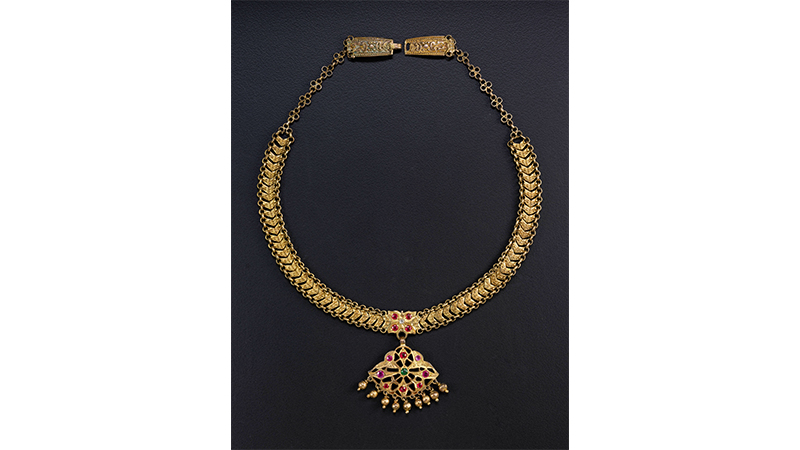
Did You Know?
- The impressive museum building was once home to Tao Nan School, which opened on North Bridge Road in 1906 before moving into the purposebuilt school on Armenian Street in 1912. There, it became the first Chinese school to change its teaching language from Hokkien to Mandarin. After 70 years, in 1982, the school moved to Marine Parade (where it still operates today).
- The building was gazetted as a National Monument on 27 February 1998.
- Two well-known sculptures remain at the front of the museum after the revamp: one shows a grandfather who is being tugged along by hand by his excited granddaughter; the other is the so-called “ACM cat”, a cat lying on the museum steps, apparently commemorating a real cat that used to frequent the area in the late 1990s.
The Peranakan Museum is a department of the Asian Civilisations Museum, operating under the National Heritage Board. IG @peranakanmuseum
5 things about carrot cake
No, not the one with the cream cheese frosting … we’re talking about the popular hawker stall variety: chai tow kway.
#1 Chai tow kway is unrelated to the other carrot cake – it doesn’t even have carrot in it. (A Singapore street food guide published in 2010 is called There’s no Carrot in Carrot Cake.) “Chai tow” in Teochew dialect can translate as radish, which is the main ingredient of the dish, but also as carrot – hence the confusion.
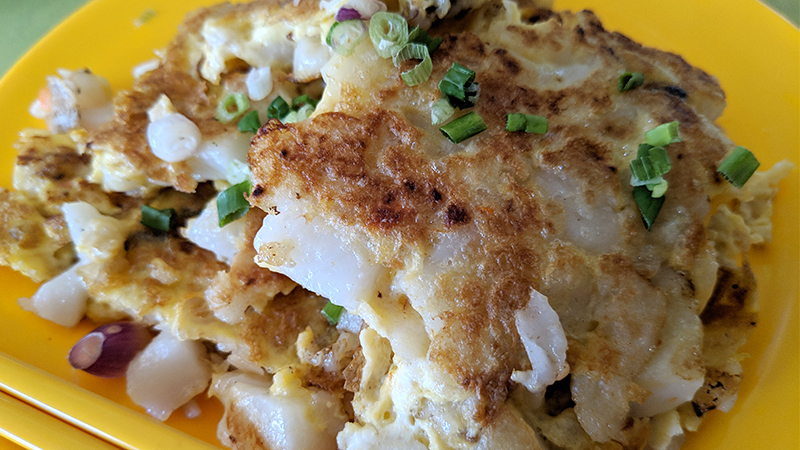
#2 Chai tow kway is made by frying pieces of steamed radish cake (made with radish and rice flour) with garlic, eggs and preserved radish (chai poh).
#3 The dish comes in “white” and “black” varieties. White is the original fried version, while black has the addition of sweet dark soy sauce. Every hawker cooks carrot cake differently; we especially like the ones with lots of charry bits!
#4 There are no “rules” around when and how to eat carrot cake. It’s a particular favourite at breakfast, but also gets ordered for lunch and dinner, and to share or as a meal on its own.
#5 Favourite stalls include Ghim Moh Carrot Cake, Fu Ming Cooked Food and Bukit Merah View Carrot Cake. Expect to pay around $3.
Transport – tiny thoroughfares
There is a Short Street in Singapore – it’s not far from the Tekka Centre, across Rochor Canal Road. It’s possibly called that because it’s short (around 300m) but it might also be named for a banker called Septimus Short.
Either way, it’s not Singapore’s shortest street. That honour perhaps goes to the 80-metre Finlayson Green, at the south end of Raffles Place. It takes its name from a 19th-century chairman of the Singapore Chamber of Commerce.
We say “perhaps” because if you include the many small offshoots from bigger roads, you could argue the shortest in Singapore is Tua Kong Green, a 25m branch of Jalan Tua Kong in Siglap.
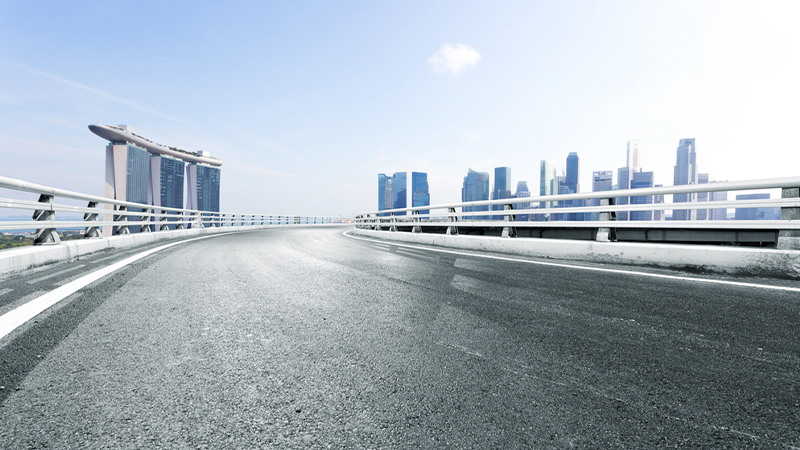
Then there’s Jalan Ulu Seletar, next to Masjid Ahmad Ibrahim, a mosque in Seletar. It’s currently only five metres long! It’s actually a very old road that was once much longer, but most of it is currently cut off from use, leaving pretty much just enough room to park a car.
Bukit Timah Road and Yio Chu Kang Road are among the longest roads in Singapore, but they’re both trumped by the expressways (the longest of which is the PIE, at 42.8km).
Singapore’s network of paved roads, if placed end to end, would reach China.
Rifle Range Nature Park
Eight things to know about Rifle Range Nature Park, which opened in 2022.
- It’s located on the site of the disused Sin Seng Quarry, a granite quarry that was once 55 metres deep.
- The name comes from Rifle Range Road, once the access road to the Bukit Timah Rifle Range, later the Singapore Gun Club. The Club relocated in 2001 to Choa Chu Kang.
- There used to be a kampong here too, evident from the cultivated fruit crops that still exist.
- Why “Nature Park” and not “Nature Reserve”? Nature parks in Singapore act as green buffers for public activities, protecting the nature reserves, which are areas of rich biodiversity and native flora and fauna.
- The Colugo Deck, reached by a half-kilometre hike, is a clifftop deck overlooking the Quarry Wetland, with a design inspired by the Sunda Collugo (or flying lemur) in flight.
- This is the first net-positive-energy nature park in Singapore, with energy harvested from solar panels at the site.
- Five species of kingfisher inhabit the park, along with wetland birds such as the Yellow Bittern. You can spot them from bird hides like the one pictured below.
- While the various trails in Rifle Range Nature Park are relatively short, the Gaharu Trail leads to MacRitchie Reservoir for a much longer outing.
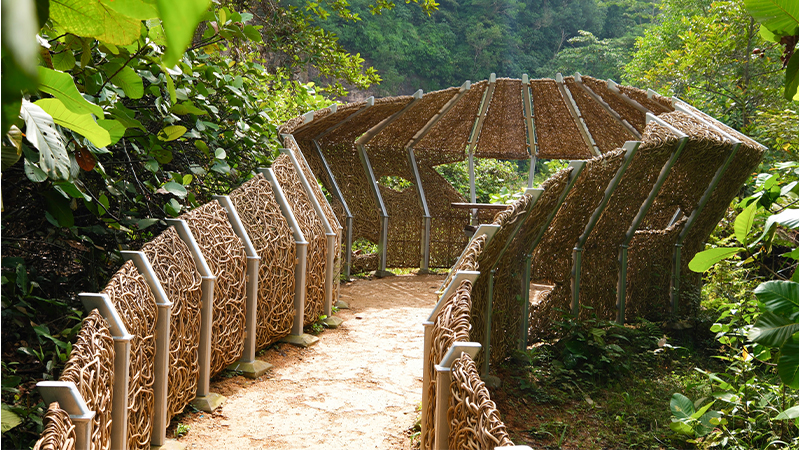
To get there, take exit A from Beauty World MRT and follow the Rambai Boardwalk. There’s a carpark on Rifle Range Road.
Records – a big bunch of Bichons
Singapore’s PetExpo in November 2022 saw a record crowd of 33,000 people and 10,000 pets come through the doors. Speaking of records, it was also the scene of a new entry in the Singapore Book of Records, for the Largest Gathering of Bichon Frise – 105 Bichon Frise dogs brought together at one time.
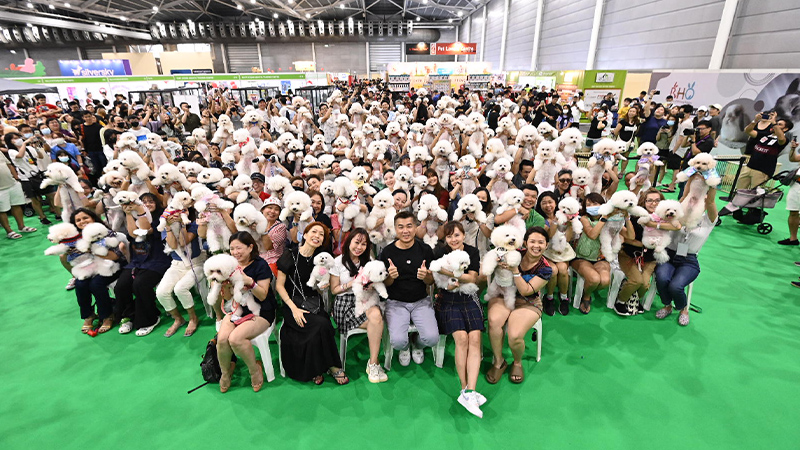
Raffles’ Banded Langurs
If you were to gather all the Raffles’ banded langurs in Singapore together at one time, you’d sadly have a much smaller group than the Bichons mentioned above! But there’s some good news for this rare monkey, as you’ll discover in our fact file, below.
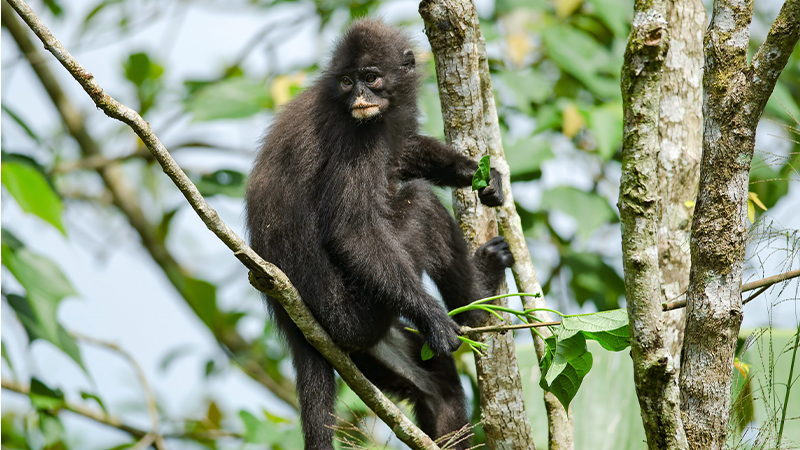
- The Raffles’ banded langur is native to Singapore, and is found here and across the border in Johor and Pahang. Also known as the banded leaf monkey or banded surili, it’s named after Sir Stamford Raffles, who included an identification of the animal among his research materials on Singapore.
- The monkey grows up to 60cm long, with another 60cm or so of tail, and weighs between 6 and 8kg. While its fur is dark, with some distinct white colouring on the chest and thighs, the babies are predominantly white.
- The monkey is mostly found in the Nee Soon Swamp Forest in the Central Catchment, between Upper Peirce Reservoir and Upper Serangoon Reservoir.
- Despite being protected from 1947, numbers are tiny – in fact, it’s critically endangered. However, while numbers dropped as low as 12 at one point, this grew to around 40 a decade ago, and then 60 in 2019. The current count is 66 by one estimate, and 70 by another. Heading in the right direction!
- Authorities hope that the Eco-Link@BKE, the large bridge of native vegetation that crosses the BKE at one point, will help the animals move from area to area, and perhaps repopulate Bukit Timah Nature Reserve (where they haven’t been sighted since 1987).
- The Raffles’ banded langur is fussy. It eats more than two dozen plant species (leaves, fruit and seeds), but will apparently travel long distances to find its favourite food. Okay, we’ve been known do the same.
- The monkey’s call has been described by a mammologist as “a harsh rattle followed by a loud chak-chak-chak-chak”.
- While the Raffles’ banded langur is one of only three primates in Singapore (with the long-tailed macaque and the Sunda slow loris), in 2020, a fourth species was spotted – two dusky leaf monkeys, who are thought to have swum across from Johor.
Food favourites – curry puffs
We’ve all tried these cheap and tasty snacks found across Singapore. Find out more about them here!
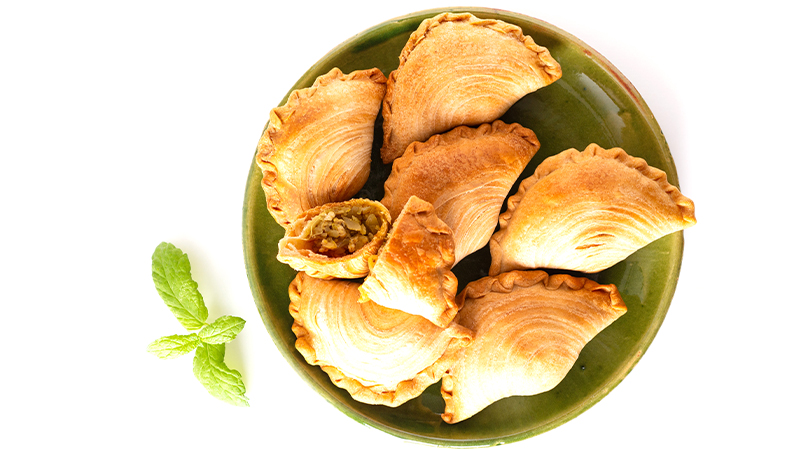
- What is a curry puff? It’s a small pie consisting of a pastry shell (usually in triangle or semicircle shape) with a filling – chicken and potato curry is the best known – then baked or deep-fried.
- In Malay, they’re called epok epok, though many foodies will point out that they’re not really the same thing, differing in pastry style, fillings and more.
- They perhaps have different origins too. Epok epok may have developed from the empanadas that Portuguese settlers in the Malay Peninsula enjoyed. The curry puff, on the other hand, was probably inspired by Cornish pasties, which Brits in the 19th century longed for; Indian chefs of the day then gave it a samosa spin, with the addition of curry.
- While chicken and potatoes is a traditional filling, other common ingredients include sardine, egg and beef.
- Curry puff variations are often denoted by a spot of food colouring on one side.
- There are more exotic fillings too. Durian, red bean, yam and even custard appear in “curry” puffs from time to time. Last month, the popular chain Old Chang Kee was offering a special kids’ edition called a Cheesy Corn’O.
- Speaking of Old Chang Kee, it started in 1956 and today has dozens of outlets all over Singapore, as well as outposts in Indonesia, Australia and the UK.
- Maxwell Road vendor J2 Famous Crispy Curry Puff is a Michelin-recognised stall selling curry puffs in Singapore.
Location, location!
Not too many Hollywood or international films use Singapore as a backdrop. Crazy Rich Asians (2018) is an exception, of course: it includes a wedding at Chijmes, meals at a hawker centre, plus Sentosa beaches, Raffles Hotel, MBS and more.
Less-well known – and perhaps understandably, if you read the mediocre reviews – is Hitman: Agent 47. This 2015 action thriller is based on the Hitman video game series and was originally set to have Paul Walker in the lead role before his untimely death; Rupert Friend played the role instead.
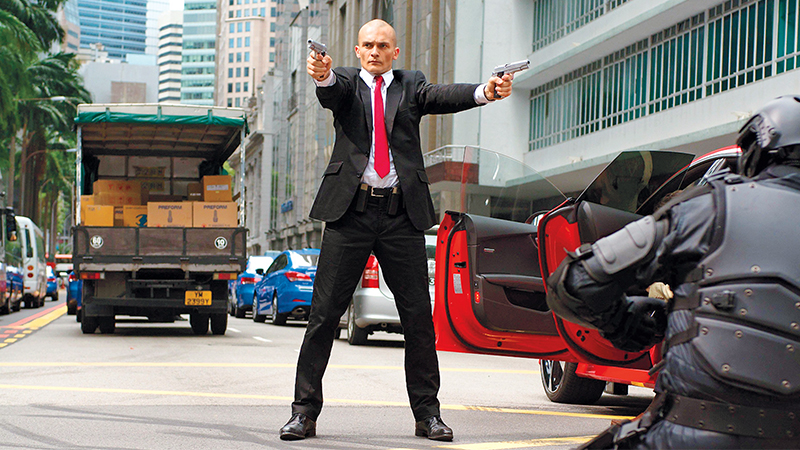
Around half of Hitman was filmed here – the rest in Berlin – and the Singapore setting is clear even from the movie poster; it shows the ArtScience Museum and other landmarks. One of the extras in the cast is referred to as “Gardens by the Bay man”.
More dramatically, Robinson Road in the CBD is used as the scene of a shoot-out – the area was shut down for four days for filming. One notable sequence shows the road jam-packed with blue ComfortDelGro cabs! You can also get a glimpse of the old MPH bookstore that traded at 63 Robinson Road until it closed a few years ago.
Other locations that appear include Changi Airport, Chinatown, Marina Barrage and Parkroyal at Pickering. The latter is where the cast stayed, including British lead Hannah Ware. She later reflected on her Singapore experience: “One thing I found hard was the humidity. I’ve never been somewhere so humid! But the food was really, really good, and everyone was just so nice and polite. It’s just a lovely place to film. It’s beautiful, in its own way – really stunning.”
The Rickshaw Puller
5 facts about this striking sculpture in Chinatown.
#1 The 2-metre bronze sculpture is the work of Lim Leong Seng (born 1950) who has produced more than 30 public sculptures.
#2 It’s called “Heading Home (Rickshaw)”, and depicts a traditional manpowered taxi service known as a rickshaw. Rickshaws were introduced from Japan (jinrikisha means “hand-drawn carriage”) in around 1880 and soon became commonplace. By 1920, there were 30,000 licensed rickshaw-pullers in Singapore.
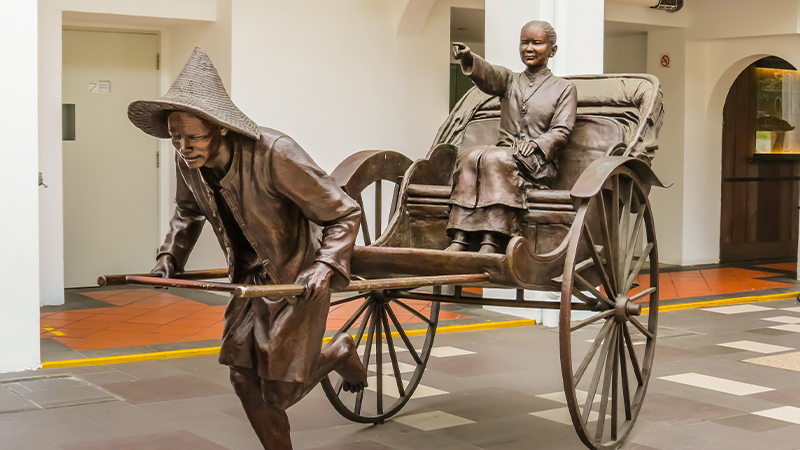
#3 Rickshaw-pulling was a demanding job – physically brutal with plenty of risk of injury. In 1912, The Straits Times described it as “the deadliest occupation in the East and the most degrading for human beings to pursue”.
#4 The passenger in the carriage is thought to be a wealthy Peranakan lady. She’s either pointing the direction home or demanding the driver go faster!
#5 The sculpture is on Nankin Street, near China Square Central. The street is named after the Chinese city of Nanking (now Nanjing) and used to be a prominent food alley over a century ago; today, it’s a pedestrian mall.
Singapore icons – The Merlion
Singapore’s famous Merlion statue has been shooting water into Marina Bay for half a century. Here’s a fact file!
#1 The Merlion was installed in an official ceremony overseen by Prime Minister Lee Kuan Yew on 15 September 1972.
#2 The 8.6-metre, 70-ton statue was built over the course of 10 months by an award-winning local sculptor named Lim Nang Seng.
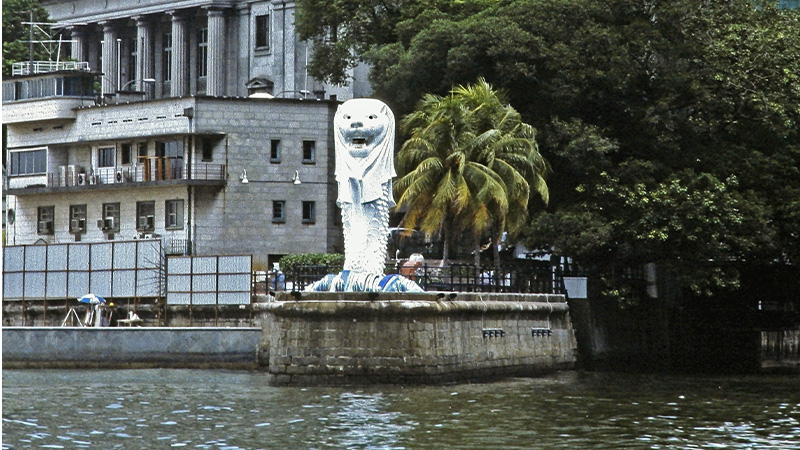
#3 As the history on Singapore goes, the Merlion’s location at the time was right at the mouth of the Singapore River, just north of the Fullerton Hotel and beyond Anderson Bridge. (The small photo at right dates to 1994, and shows the Singapore icon in that original spot.)
#4 In 1997, construction of the new Esplanade Bridge blocked the Merlion’s view of Marina Bay. Initially, there was talk of raising the creature to a higher pedestal to compensate, but eventually the decision was made to relocate the statue. In 2002, it was carefully moved via cranes and a barge to its current spot, 130 metres to the southeast. Lee Kuan Yew – who by then was Senior Minister – returned to officiate a welcome ceremony for the new location.
#5 The Merlion was designed by Alec Fraser-Brunner as the logo for the Singapore Tourism Board in the early 1960s. Fraser-Brunner was a British ichthyologist (i.e., a fish expert!) who was a member of the city’s Souvenir Committee. He also worked in Singapore as curator of the Van Kleef Aquarium – see opposite.
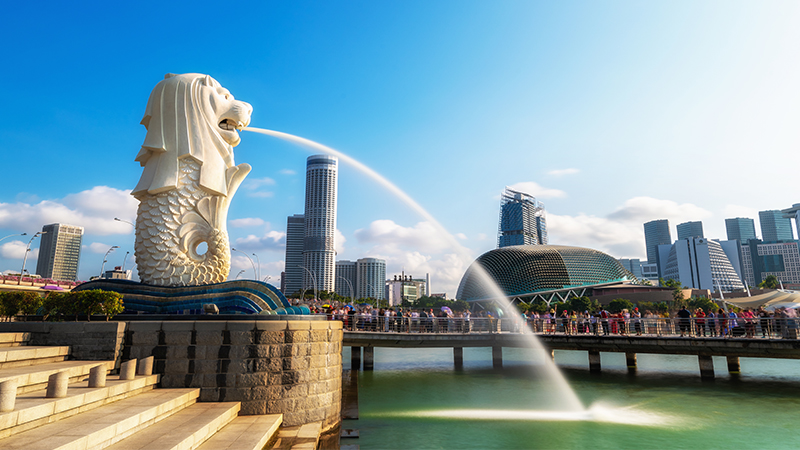
#6 What exactly is a Merlion? It’s a mythical creature with the head of a lion and the body of fish; the prefix “mer-“ means “the sea”, and reflects Singapore’s beginnings as a fishing village called Temasek, while the lion component represents Singapore’s original name “Singapura”, meaning “lion city”.
#7 In 2006, scaffolding went up around the Merlion while it was cleaned and mended for wear and tear. The scaffolding was illustrated to look like shower curtains, so the Merlion appeared to be sticking its head out from above the curtains.
#8 On the afternoon of February 2009, lightning struck the Merlion and broke some fragments from it, leading to further maintenance.
#9 There are currently six merlions in Singapore, including a Merlion “cub” close to the main statue, and another on Mount Faber. There used to be a seventh: the 37-metre Sentosa Merlion. It was built in 1995, and designed and sculpted by Australian artist James Martin, with features including octagon-shaped scales to represent the Taoist bagua symbol. There were two observation decks – one in the creature’s mouth and one at the top of its head. The site closed in 2019.
#10 Singapore’s Merlion makes plenty of appearances in popular culture, from films (Crazy Rich Asians and others) to video games (Animal Crossing and Mario Kart Tour).
Introducing the civet!
EL’s editor-in-chief recently had a close encounter with a civet who was climbing around in her garden in broad daylight; the large and quite friendly animal made repeat visits on other days too. It prompted us to find out more about them. Here are ten things we learnt:
#1 Civets aren’t cats!
#2 They’re actually more closely related to mongooses (we’ve seen them referred to as “a cross between a mongoose, a dog and a racoon”).
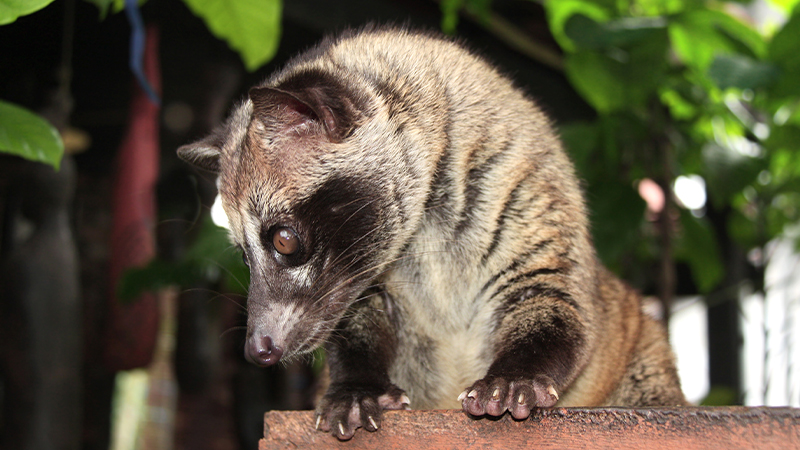
#3 There are around 12 varieties of civet, four of which can be found here. The Common Palm Civet is native to Singapore.
#4 Spotting a civet up close and in the middle of the day is rare; you’re more likely to see them at night, most commonly in Siglap, Bukit Timah, Portsdown and the Southern Ridges.
#5 Known in Malay as “musang”, civets are sometimes referred to in English as “toddy cats”. This comes from their habit of climbing coconut trees that had been tapped for their sap and drinking the fermented sap, known as “toddy”.
#6 A civet’s diet includes pretty much anything they can find (they’re omnivores), but they’re particularly fond of fruit such as mangos and bananas. They tend to swallow seeds whole and then defecate them, so they play an important role in dispersing seeds in forests.
#7 Another favourite snack of civets is coffee cherries, though, again, they don’t eat the beans. This gave some bright spark the idea of sifting through civet faeces to find the semi-digested beans and making a cup of coffee out of them. Apparently, the effect of the digestive enzymes on the beans gives them extra flavour and aroma. The resulting coffee, known as kopi luwak, is among the most expensive in the world.
#8 Not that we’ve given it a go, but if you smell the secretions from a civet’s anal scent gland, it’s said to have a similar aroma to pandan. In fact, the smell of pandan is one sign that a civet may be around.
#9 Speaking of a civet’s glandular secretions, these have been used in perfumery for over a thousand years. It sounds eww, but apparently when it’s diluted, the smell is “floral” and “velvety”. Happily for the animals, today a synthetic version of the substance called civetone is primarily used instead. For instance, Chanel replaced the real stuff with the lab-produced stuff back in 1998.
#10 The civet gets a mention in Shakespeare (As You Like It, Act 2, Scene 3). One character remarks, “The courtier’s hands are perfumed with civet,” only for the other to proclaim, “civet is of baser birth than tar, the very uncleanly flux of a cat”.
If you’ve found a civet in your house, or one that appears to be injured, call NParks’ Animal Response Centre at 1800 476 1600.
Have you tried youtiao?
If not, here’s a fact file!
- Youtiao is a light, fluffy, deep-fried stick of dough most commonly served at breakfast. It’s usually made as two joined strips that can easily be pulled apart when cooked.
- It originated in China in the 12th century – apparently as a type of protest food. The twin strips of dough were said to represent two leaders of the Song Dynasty who had executed a popular general on a trumped-up charge. Dumping the pair of strips into boiling oil was akin to throwing the nefarious leaders into the oil!
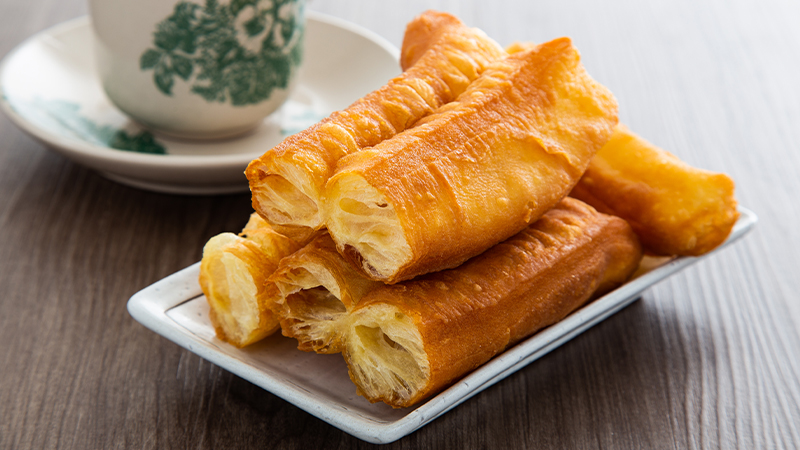
- In Singapore, youtiao is often referred to as you char kway.
- There are plenty of ways to eat youtiao – most commonly, it’s chopped up and added to congee, a bit like adding croutons to soup. A popular Singapore style of eating them is with a cup of coffee; you take a bite of youtiao, then dunk the remaining stick into the coffee so it can soak up the liquid.
- Xi De Li are perhaps the best known youtiao makers in Singapore; they started in the 1920s, and today the fourth generation of the family are in charge. They produce up to 10,000 youtiao every day!
Nature on a note
Which denomination of Singapore currency features a picture of a famous tree on one side, and a hard-to-spot marine animal on the other?
If you’re unsure, we get it – not many of us look at actual money very often these days, right? Things were already going in a cashless direction, and then the pandemic hurried the process along.
The answer is the five dollar note. This note has a “Garden City” theme – which explains the green colour – and on its reverse side is a picture of a Tembusu tree. The Tembusu is a large evergreen tree (Fagraea fragrans), native to Southeast Asia, with bitter-tasting red berries that fruit bats love.
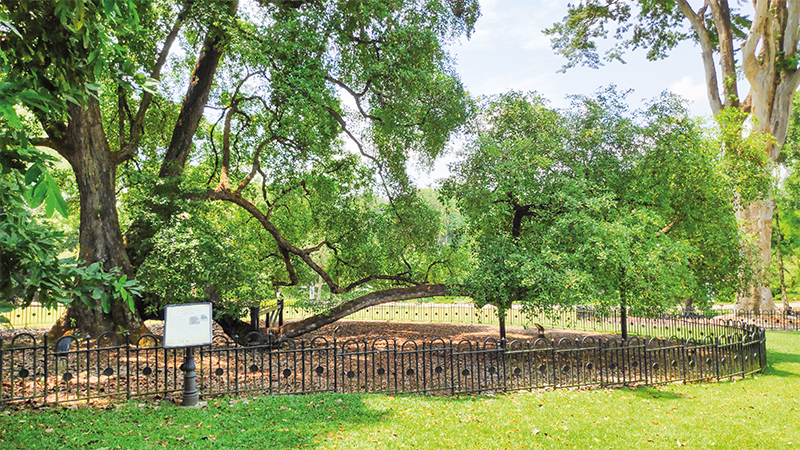
The tree pictured on the $5 note isn’t just any Tembusu, though. It’s the iconic 180-year-old specimen that still stands in the Botanic Gardens today (above). You can find it in a special fenced zone at Lawn E, next to Swan Lake. The tree is 32 metres high with a distinctly long side branch growing very close to the ground (and clearly shown in the banknote).
On the other side of the $5 is another representative from nature – though it’s far harder to spot! It’s a cowrie – as in, the marine snail with the pretty shell. There’s a different type of cowrie on each dollar note; the $5 features a gold-ringed cowrie. Still can’t find it? It’s just above the portrait of the first president of Singapore, Yusof bin Ishak, and to the right. (Yes, the pale blobby thing!)
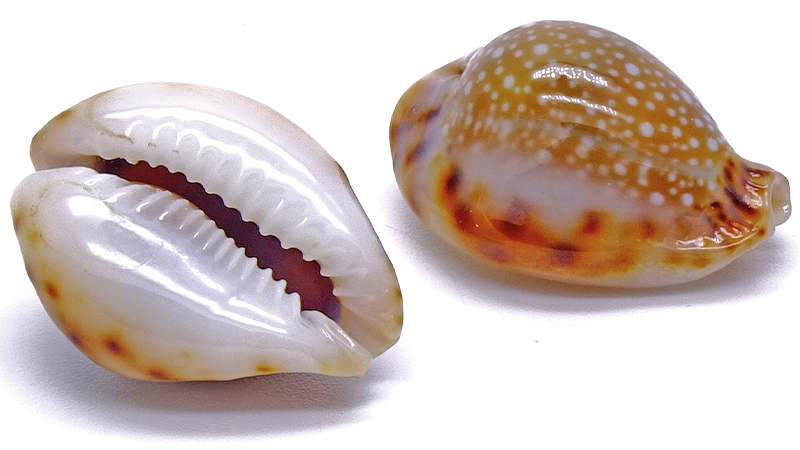
It makes sense to have a shell on a dollar note – after all, they’re one of the oldest forms of currency in the world. In fact, the cowrie that appears on the Singapore $10 note is the “money cowrie”!
Exploring – remarkable roads
Singapore has an official register of Heritage Trees: currently, 260 specific trees on the island are protected – they include the famous Tembusu mentioned above. But did you know there is an associated list of Heritage Roads? Despite the fame of Orchard, it doesn’t make the cut. Rather, the five roads on the list have been gazetted for being significantly scenic and tree-lined. They are:
#1 Arcadia Road
This peaceful avenue lined with Rain Trees runs off Adam Road in Bukit Timah. The leafy kilometre-long thoroughfare passes the black-and-whites of Adam Park Estate on the left, and then a few condos – as you drive along, it’s hard to imagine that the PIE is only 50 metres to the right, roaring with traffic!
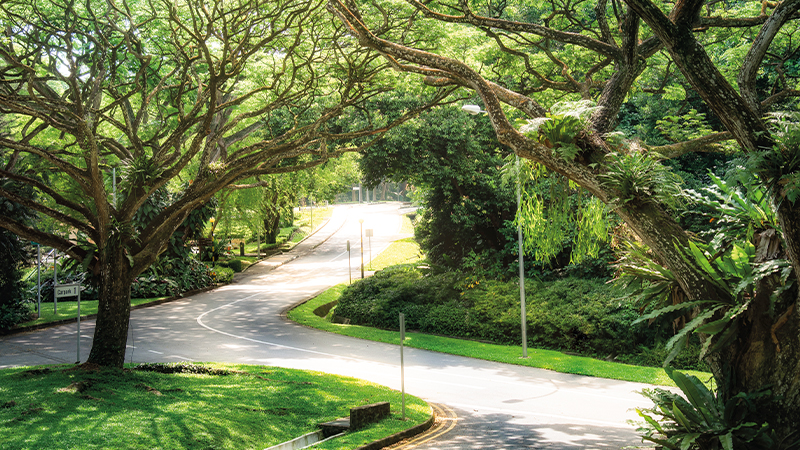
#2 Mount Pleasant Road
Just east of Arcadia is this very pretty road, again lined by colonial black-and-white houses, and flanked in this instance by Saga trees. Follow the road from the PIE and 1.5km later you’ll emerge just behind the Singapore Polo Club and Thomson Road.
#3 Mandai Road
If you’re heading along Mandai, chances are you’re on your way to the Zoo! This is one of Singapore’s oldest carriageways – well over a century and a half old, in fact. It was built to link the farms and villages between Woodlands and Upper Thomson.
#4 South Buona Vista Road
Named after the Italian words for “good view” – though today any sight of the sea is hidden by jungle – this road linking the AYE with the West Coast Highway is well known for its hairpin turns. These slopes were the site of the Battle of Pasir Panjang in 1942.
#5 Lim Chu Kang Road
This road was constructed over a century ago to service rubber, gambier and pepper plantations in the northwest. You’ll still see rubber trees today, along with angsana and mahogany. It’s also the road leading to the island’s main cemeteries.
Other roads have had their names thrown about as contenders for heritage status. Maybe you live near one of them? They include: Goodwood Hill, Lornie Road, Loyang Avenue, Nassim Road, Punggol Road, Redhill Close, Upper Thomson Road, Yishun Avenue 5 and Yuan Ching Road.
Icons – things about Slings
No cocktail is more closely associated with the Lion City than the iconic Singapore Sling. Here’s a fact file on the fruity, boozy, pinkish-red drink.
#1 Though there were drinks called “slings” as early as the 19th century, the Singapore Sling was likely invented in 1915 by Ngiam Tong Boon, a bartender at Raffles Hotel.
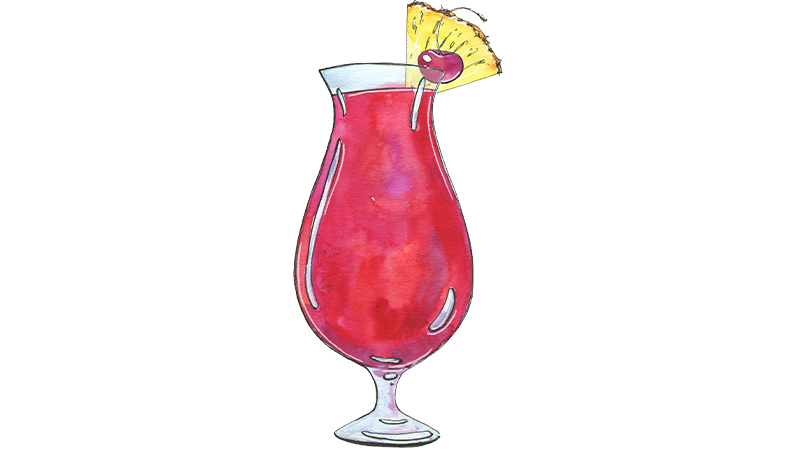
#2 Ngiam createed the colourful cocktail to appeal to the eyes – and taste buds – of colonial ladies; it also may have been a way of disguising an alcoholic beverage to make it look like a “socially acceptable” drink for women at the time.
#3 Singapore Slings were originally made with fresh pineapple juice from Sarawak pineapples, which gave them an extrafoamy head.
#4 While the Long Bar at Raffles is considered the “home” of the Singapore Sling, other bars such as Smoke & Mirrors, The Spiffy Dapper, Nutmeg & Clove, Southbridge and Bitters & Love have offered the drink (or a variation of it) at one time or another. The Fullerton Sling is another popular take on the classic.
#5 Hunter S Thompson was a big fan of the drink, which appears in his 1971 novel Fear and Loathing in Las Vegas (and the Johnny Depp film adaptation). The only difference is that the characters, in typically debauched style, drink their Singapore Slings “with mezcal on the side and beer chasers”.
Did you know?
Singapore Sling is also the name of …
- an Icelandic rock band – they formed in 2000 and had a song appear on Long Way Around, the travel/motorcycle documentary by Ewan McGregor and Charley Boorman;
- a Greek underground black and white horror film released in 1990 (there was an Australian TV movie released with the same name in 1993);
- quite a few racehorses around the world, including a South African import who raced successfully in Asia, winning the Hong Kong Classic Cup in 2018. Singapore’s basketball team, the Singapore Slingers, compete in the ASEAN Basketball League.
The recipe
If you’re keen to replicate the original Singapore Sling at home, here’s how:
- 30ml gin
- 15ml cherry brandy
- 7.5ml Bénédictine
- 7.5ml curaçao
- 120ml fresh pineapple juice
- 15ml fresh lime juice
- 10ml grenadine
- Dash of bitters
Pour everything but the bitters into a cocktail shaker then add ice and shake. Strain into a tall glass filled with ice and garnish with bitters, a maraschino cherry and a slice of pineapple.
Exploring – Little India stalwarts
For the past three years, the National Heritage Board (NHB) has been setting up a series of “mini-museums” in different Singapore shopfronts to highlight the heritage of various businesses and trades. The project is called Street Corner Heritage Galleries; in 2020, Balestier was the focus, followed by Kampong Glam in 2021. Now, it’s Little India’s turn.
Businessowners have plied their trade in Little India for over a century, selling garlands, gold, saris and spices. A number of stores that have become household names are featured in Street Corner Heritage Galleries, including Jothi Flower Shop, Haniffa Textiles and jewellery store Ani Mani.
Also included are three renowned Little India restaurants. Here are a few facts about them!
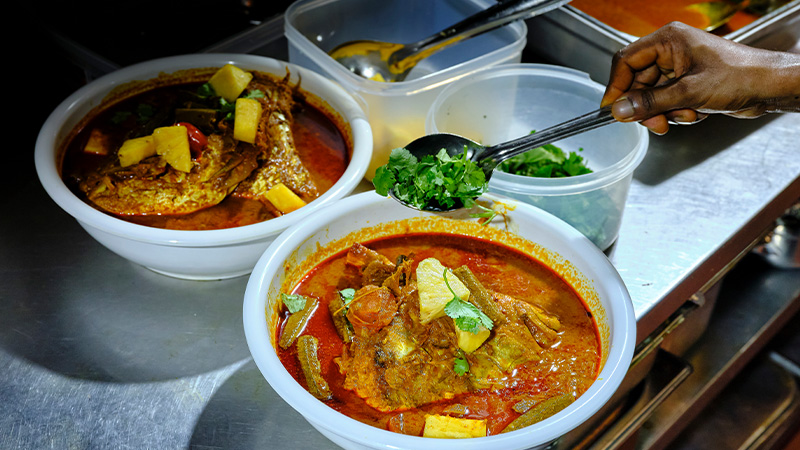
Ananda Bhavan
- Among Singapore’s oldest Indian vegetarian restaurants, Ananda Bhavan was founded in the 1920s by brothers from India.
- In the early years, the family lived above the restaurant, with different members taking on roles such as cleaning tables and handling accounts.
- Ananda Bhavan has been vegetarian from the start, serving rice and vegetable dishes on banana leaves – an affordable meal for labourers in earlier times.
- The restaurant was one of the first in Little India to introduce a self-service model, where customers order food at a cashier counter.
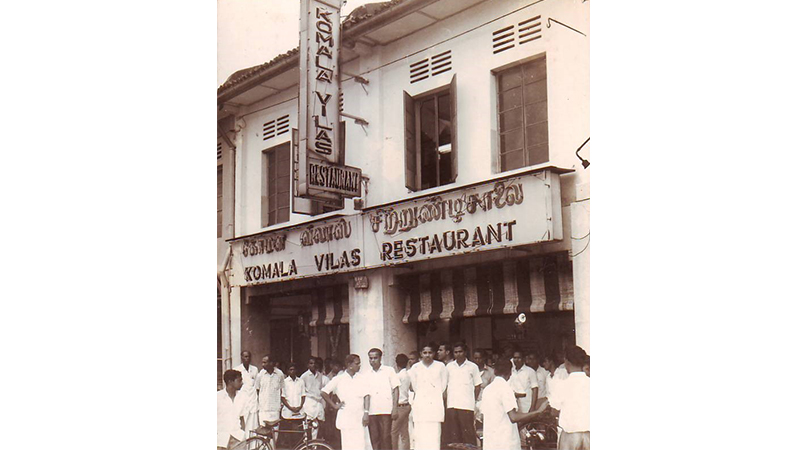
Komala Vilas
- Komala Vilas was established in 1947 by Murugiah Rajoo, who took over an older restaurant premises after the owners returned to India. He named his restaurant Komala after the wife of the former owner.
- Murugiah’s brother Sinnakannua was known as “the lieutenant” for keeping the business running smoothly.
- Children and grandchildren learnt the trade as they grew up, then more staff were hired as the restaurant flourished.
- Komala Vilas was among the first eateries in Little India to employ women in a customer-facing role as cashiers, and to offer an air-conditioned dining area on the second floor.
Banana Leaf Apolo
- Banana Leaf Apolo was founded in 1974 by S. Chellappan, who started in the F&B business by operating a small thosai stall.
- The restaurant is apparently named after the Apollo 11 space mission (with a unique spelling adjustment!). Chellappan wanted his establishment to take off like the NASA rocket itself.
- The most famous dish here is the fish head curry, which became a signature thanks to a secret blend of spices and the use of pineapple.
- Today, there are five branches of the restaurant, managed by Chellappan’s son.
Find out more at go.gov.sg/schglittleindia.
Nature – new arrivals at the Zoo
There must have been something in the water in 2021, because Singapore’s four wildlife parks – Jurong Bird Park, Night Safari, River Wonders and Singapore Zoo – welcomed 900 newborn animals, almost twice as many as the previous year! Around 160 species were represented in the figures, 44 of which are officially listed as threatened. Here’s a look at some of the new arrivals from that year.
Sunda Slow Loris: The perfect Christmas present came to Night Safari, in the form of a baby loris, born on 25 December. Native to Southeast Asia, the Sunda is endangered as a result of the illegal pet trade. Trivia: Lorises likely take their name from an old Dutch word meaning “fool” or “simpleton”.
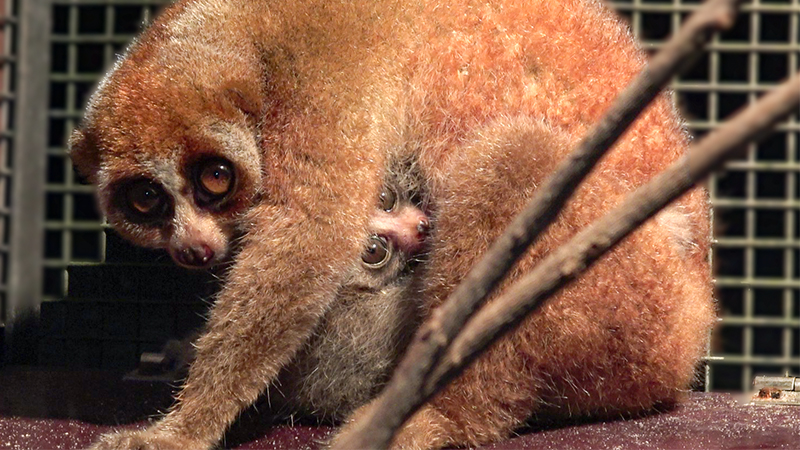
Southeast Asian Box Turtle: This endangered turtle, native to Singapore, received a boost in 2021 when three hatchlings arrived on the scene. The turtle has a distinctive yellow-striped head.
Grevy’s Zebra: The world’s largest wild equid (the family of horses and related animals), this is also the most threatened of the three species of zebra. Two foals, Izara and Tari, were born at the Zoo i 2021. Trivia: The zebra is named after Jules Grévy, a 19th-century French president.
Straw-headed Bulbul: This songbird is critically endangered (up-listed from endangered in 2018) – probably because of being traded for its beautifully melodic voice. So, the arrival of three chicks at Jurong Bird Park was great news.
Golden Mantella: Endemic to Madagascar – and among that country’s most threatened amphibian – this small frog has beautiful yellow/red skin that warns predators of its poisonous nature. Seventy babies were born here in 2021.
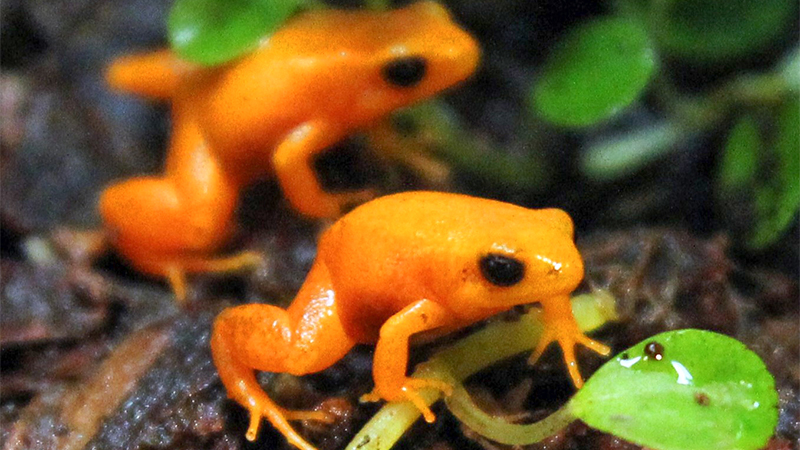
Giant Panda: The biggest baby news from 2021 was the birth of panda cub Le Le on 14 August. The name derives from the ancient Chinese word for Singapore, Shi Le Po, a transliteration of the Malay term “selat”, meaning “straits”. Statistics and photos: Mandai Wildlife Group
Exploring – The Rail Corridor
Expat Living’s Judit Gál shares one of her favourite long walks on the island, from the Woodlands Checkpoint to Tanjong Pagar.
There aren’t many countries you can cross on foot in a day, but Singpore is one of them! An easy but long hike of about 25km, the Rail Corridor passes through forested and residential areas following the former Malaysian Railway line, which ceased operation in 2011. It’s a walk down memory lane for those who had the chance to take the train when it was up and running, and a little slice of Singapore’s history for those who didn’t.
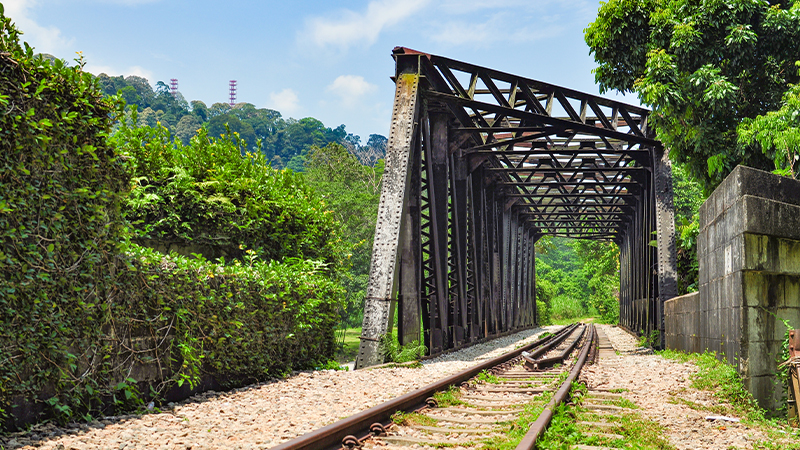
There are shops along the way so you don’t have to carry much – the silver lining of urban hiking. But do take water, sunscreen lotion and a raincoat with you. GPS comes in very handy as some parts of the corridor can be closed for upgrading works and you sometimes need to navigate amongst blocks of flats. Remember to record the walk – it looks really cool on Strava!
Find out more at railcorridor.nparks.gov.sg/visit-rail-corridor.
Trivia – A Singapore Quiz
Time to test the grey matter with a few SG-themed questions. See how you go!
- Nelson Mandela, Kate Middleton, Elton John, Jane Goodall and Joseph Schooling have all had what named after them in Singapore?
- Which year saw the fall of Singapore?
- Name the large Indonesian island, beginning with “S”, to the west of Singapore.
- In 1998, what protective feature was introduced as a compulsory feature in all new Singapore residential developments?
- What’s the name of the official residence of Singapore’s President?
- Which country provided the first frozen meat and dairy shipment to the Cold Storage depot in 1905?
- Which Singlish word means “competitive” or having a fear of missing out?
- Name the only other Asian country that is smaller than Singapore in area.
- Which street became well known as a nightly gathering spot for transvestites in the 1950s,1960s and 1970s?
- Which island was known in Malay as Pulau Ujong?
Answers below!
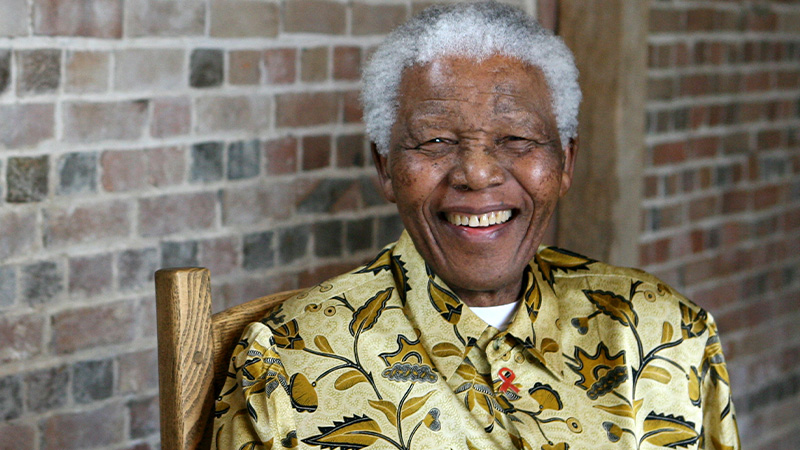
1. An orchid 2. 1942 3. Sumatra 4. Bomb shelter 5. The Istana 6. Australia 7. Kiasu 8. Maldives 9. Bugis Street 10. Singapore (the mainland)
Food – craving kaya?
In late 2021, the Monetary Authority of Singapore (MAS) released a commemorative coindepicting Singapore’s hawker culture. The two versions of the coin – in silver, and in nickel-plated zinc – featured a hawker centre scene of people preparing and eating various famous local foods. Among the pictured dishes were big-hitters like Hokkien mee, roti prata and nasi lemak; front and centre, though, was a simple plate of kaya toast.
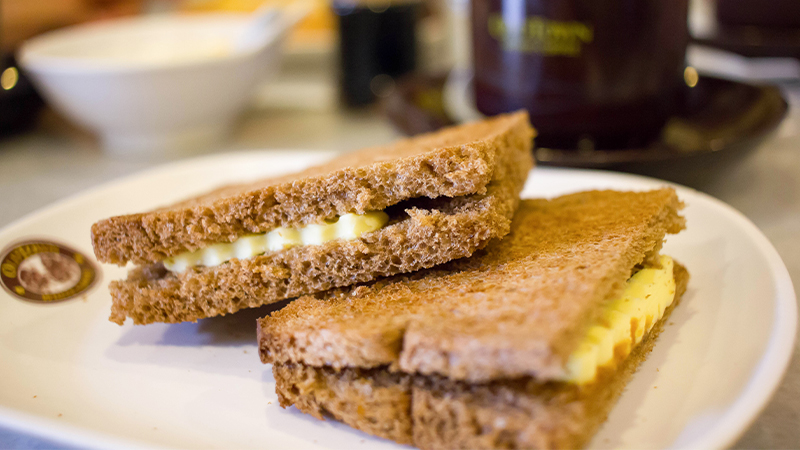
What is kaya? It’s a jam made from coconut, eggs and sugar that was initially created by Hainanese immigrants to replicate the Western-style fruit jams loved by Brits. The word kaya means “rich”, and a rich spread it is, too – sweet and creamy, with a colour that varies from brown to green (resulting from the use of pandan leaf as a flavouring).
How do you eat it? The most common way is in the popular breakfast combo of half-boiled eggs, kaya toast and coffee. The idea is to break the runny eggs into a bowl, and season them to taste with soy sauce. The toast comes sandwiched together with a couple of generous slabs of cold butter and plenty of gooey kaya. Or, you can try it in a fancier, more modern version, such as French kaya toast, or even served on crackers.
Where to try it? Specialist chains such as Killiney Kopitiam, Ya Kun Kaya Toast, and Toast Box, or standalone kopitiams including Good Morning Nanyang Café and Tong Ah Eating House.
Exploring – Masjid Petempatan Melayu Sembawang
EL’s Judit discovers a little known corner of Singapore’s north coast.
If you’re cycling or walking around Sembawang Park, it’s worth taking a detour to a well-hidden little mosque, Masjid Petempatan Melayu Sembawang. The two roads leading to the place (Jalan Mempurong and Jalan Selimang) already give an idea of what you can expect, as they’re lined by thick jungle on both sides.
Built in 1970 (though some websites say it was 1963), and surrounded by a beautiful lush garden, the place has a serene atmosphere that time has left unchanged. This is a place of religion, so remember to dress accordingly!
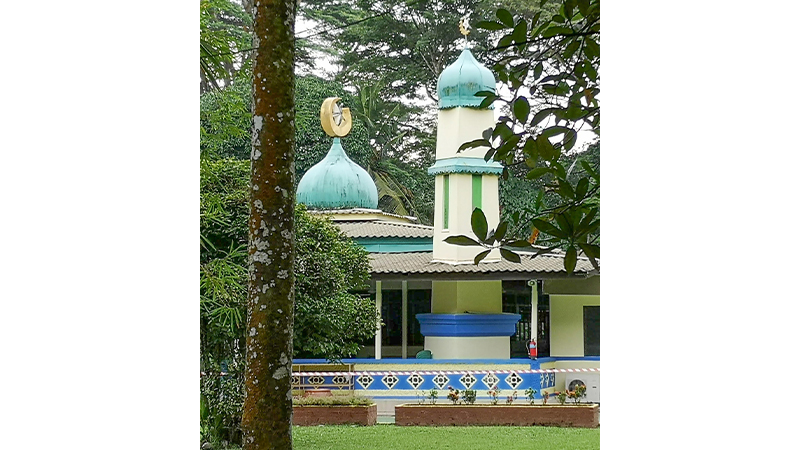
Did you know?
• The large rubber tree that stands adjacent to the mosque is thought to be over 100 years old. It may be the oldest surviving tree of its kind on the island.
• A crumbling old gateway can be found just beyond the mosque, on Jalan Selimang (see below); it once led to a grand seaside bungalow belonging to Chua Boon Peng, who headed up Cycle & Carriage from 1957 to 1985.
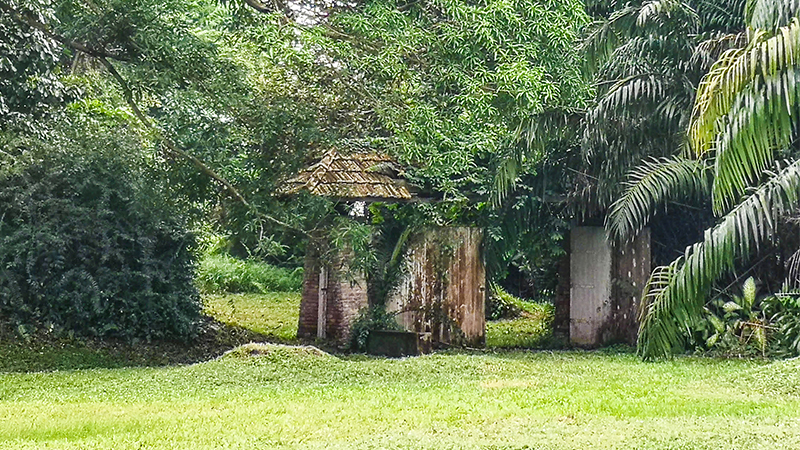
Animals – hawksbill hatchings
Singapore and its surrounds see regular, significant hatchings of hawksbill turtles. It’s not very common for this to happen on Sentosa, though. That’s what happened in 2021, when the island saw only its sixth hatching event over the past quarter of a century or so. The hawksbill turtle is critically endangered – and that’s no surprise, as humans have prized the animal for its shell and meat for 2,500 years. But the past century has been particularly unkind, with biologists estimating the hawksbill population may have dropped by around 80 percent in that short period.
At around dawn on 1 November 2021, 85 hawksbill turtles emerged from a nest that had been found on the beach back in September, and were safely released into the sea.
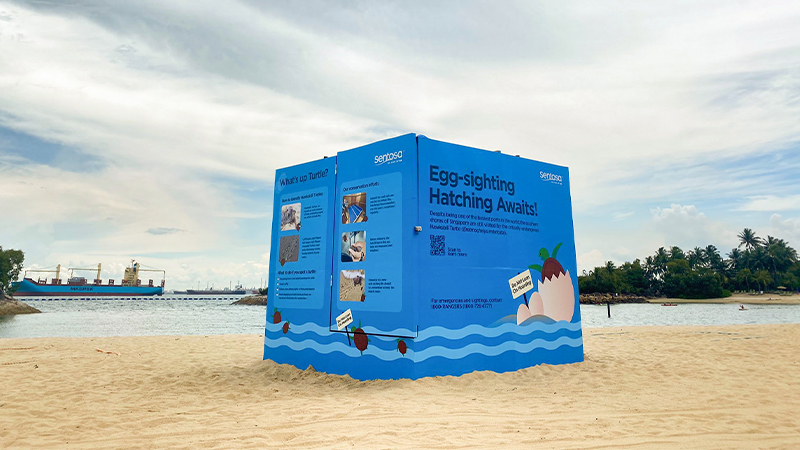
Their plight was helped by the Environment Management Team of the SDC (Sentosa Development Corporation), who built a temporary home for the nest to keep it safe from monitor lizards, crabs, humans and other disturbances.
Good luck, little turtles!
Tips from the SDC on protecting Singapore’s turtles
- Be quiet and keep your distance
- Don’t make loud noises or shine a torch; if a turtle is scared it will stop laying eggs and return to the sea
- Don’t dig up the nest
- If you see turtle tracks on beaches, leave them as they are, as they can be used by researchers to gather information
- If you spot a turtle nest on Sentosa, call the SDC at 1800-SENTOSA
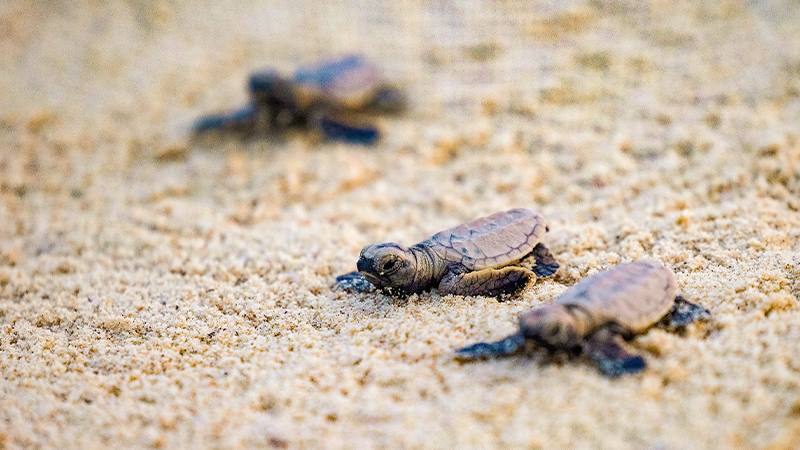
While you’re there
Sentosa is home to other native wildlife such as the common palm civet, colourful bee-eaters, green-crested lizards, as well as peafowls, monkeys and monitor lizards. There are various nature trails to explore, and you can also visit the new Geology Gallery to learn more about the island’s rock formations and flora and fauna.
Exploring – Jews of Singapore Museum
The Jews of Singapore Museum is at the Jacob Ballas Centre at Waterloo Street. The permanent exhibition traces the 200-year history of Jews in Singapore, showcasing their significant contribution to society and the economy.
The museum touches on three themes: the timelines of Jewish arrivals from 1820 to today; profiles of Jewish community leaders; and festivals, culture and religion. You can learn more about all of these through photographs, videos and audio recordings.
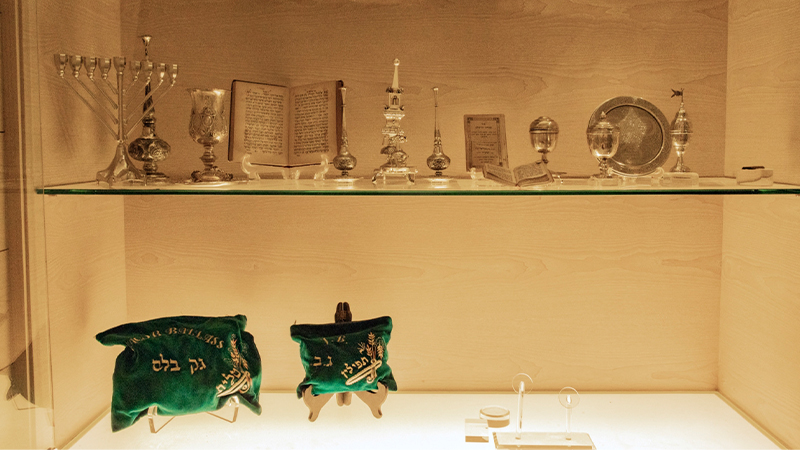
Prominent people and places
Members of the Jewish community who have made their mark on Singapore:
- David Marshall – First Chief Minister
- Sir Manasseh Meyer – Businessman and philanthropist
- Jacob Ballas – Stockbroker and philanthropist
- Joseph Grimberg – Supreme Court Judge
- Harry Elias – Senior Counsel
- Frank Benjamin – Entrepreneur
- Victor Sassoon – Entrepreneur
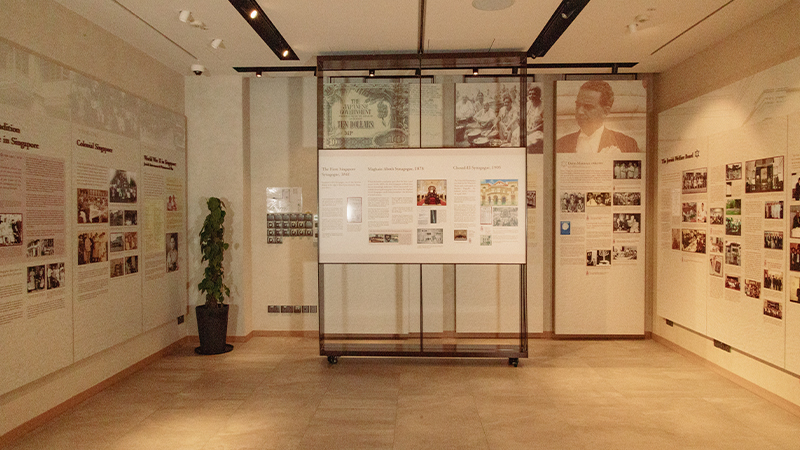
The legacy of the Jewish community in roads, institutions and buildings:
- Synagogue Street
- Frankel Avenue
- Meyer Road
- Nassim Road
- Elias Road
- Jacob Ballas Children’s Garden
- Ellison Building
Did you know? In 1922, Albert Einstein travelled to Singapore a week before he won the Nobel Prize in Physics to lobby the Singapore Jews to contribute to the Hebrew University.
The Museum is free and open to the public by appointment. For more, visit singaporejews.com/museum.
Animals – meet the Malayan colugo
Along with all those macaques trying to steal your picnic treats at MacRitchie Reservoir, there are some interesting creatures that call Singapore home. Here we take a look 10 facts about one of them, the Malayan colugo.
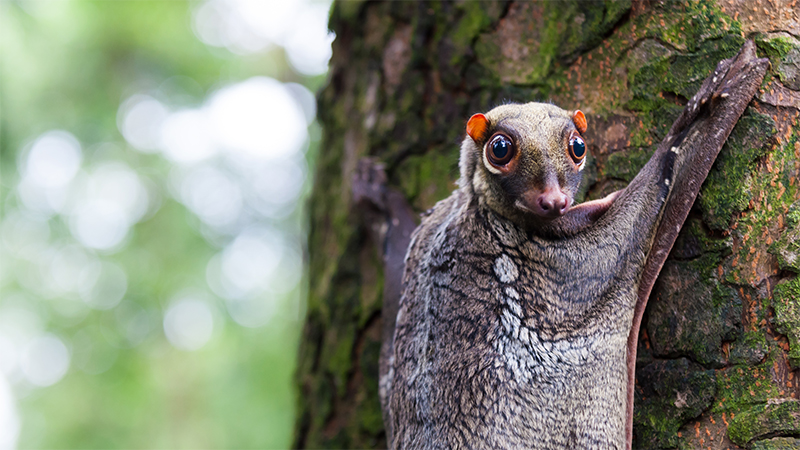
- Malayan colugo is just one name you’ll hear this animal given. It’s also commonly referred to as the Sunda colugo, Malayan flying lemur, Sunda flying lemur, flying cat, cobego and kubong.
- What exactly is a colugo? Well, it’s not a lemur, and it can’t fly – so a few of those names we just mentioned aren’t too accurate! Officially, a colugo is an arboreal (tree-dwelling) gliding mammal that is native to Southeast Asia.
- The flying reference comes from the fur-covered membrane that stretches between the colugo’s limbs and fingers, which works like a cape (think Batman…) and allows the creature to glide from tree to tree. How far? One individual has been recorded travelling 150 metres in a single glide.
- While they’re elegant in the air, the Malayan colugo is an awkward-looking tree climber, moving up and down the trunk with a stop-start hopping motion. And on the ground they’re even less mobile – in fact, they go out of their way to avoid the jungle floor.
- The animal’s diet includes leaves, buds, flowers, shoots, fruit and sap.
- In Singapore, while they’re relatively common, they can be tricky to spot as they’re almost wholly nocturnal. Take a quiet early morning stroll on the trails and boardwalks at Lower Peirce Reservoir, and you’ve got a decent chance. Colugos have also been seen in more built-up areas – even in the Botanic Gardens.
- The Malayan colugo is also found in Malaysia, Thailand, Cambodia, Laos, Indonesia and other parts of Southeast Asia.
- It has amazing stereoscopic vision, allowing it to easily see which branch it’ll grab onto at the end of a glide, even in very dim lighting.
- While they look like the most mellow of animals, Malayan colugos can apparently make a racket, especially when two males are fighting. Their call has been described as a very loud “ripping” sound that can be heard from a considerable distance.
- Nobody knows exactly how many of these creatures live in Singapore; in 1994, they were listed as being vulnerable, based on an estimated population of just 200 animals; today, it’s generally thought this number is in the low thousands instead.
Museums – Reflections at Bukit Chandu
Originally opened in 2002, and then again in 2021 after a three-year closure for a makeover, Reflections at Bukit Chandu (RBC) tells the story of the Battle of Pasir Panjang (12-15 February 1942), when heavily outnumbered soldiers from the Malay Regiment fought valiantly against a much bigger force of 13,000 Japanese troops.
RBC is located on Pepys Road in Kent Ridge Park; it’s housed in a bungalow that was built in 1930 for senior British staff of an opium packing plant further down the hill. Right nearby is “Point 226”, the military position that marks the heroic last stand of the Regiment.
There are, of course, all kinds of military-themed artefacts to explore, from rifles and machine-guns to bullets and helmets. What’s also interesting, though, are the everyday objects that archaeologists have retrieved from the site. Here are three of them:
#1 This small bottle made of handblown glass dates to the early or mid-20th century. It’s most likely a Chinese medicine vial, perhaps used by a domestic helper.
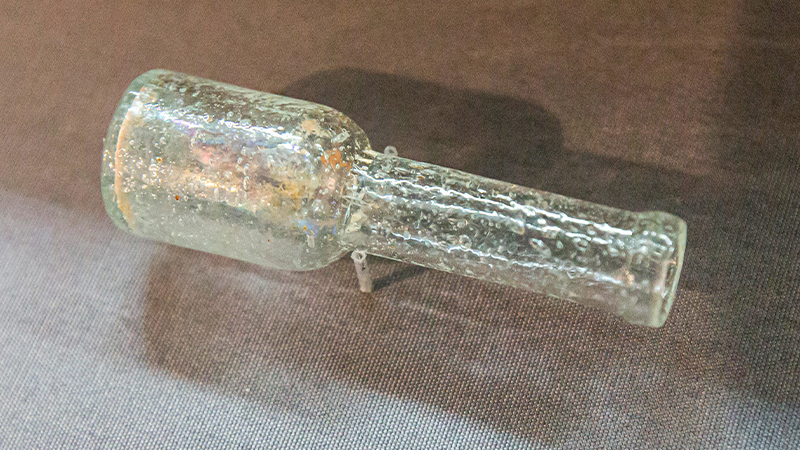
#2 Made of tin, this mess cup was owned by the Regiment’s Lieutenant Ibrahim Sidek; he was executed by the Japanese on 28 February 1942.
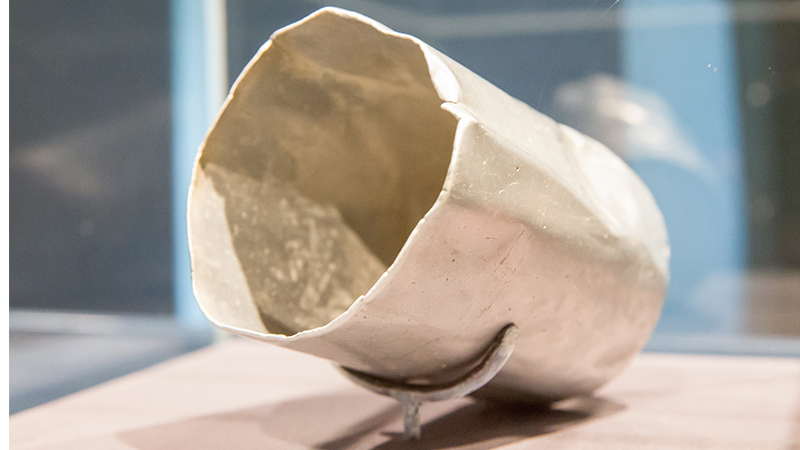
#3 A more recent discovery is this silver and glass talisman with a scroll inscribed with a Thai writing script. It perhaps belonged to a labourer working in Singapore around 40 years ago.
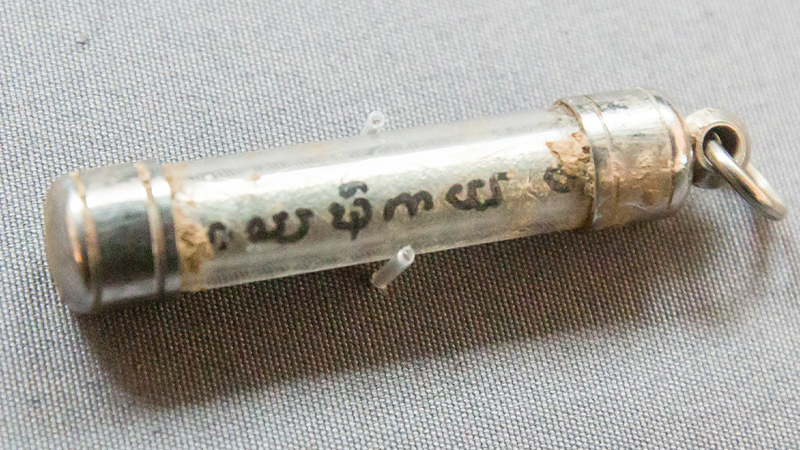
Find out more at heritage.sg/reflectionsatbukitchandu.
Nature – check out the chiku
Singapore is a goldmine for fans of tropical fruit. Go to any food centre and you’ll find an amazing array of fruit that you can enjoy either fresh on a stick, or in juices, ice creams and more. We’ve tried most of them, from rambutan and mangosteen, to durian and dragon fruit, but we admittedly know less about chiku (also “ciku” and “chikoo”). If you’re in the dark, too, here are 10 fast facts!
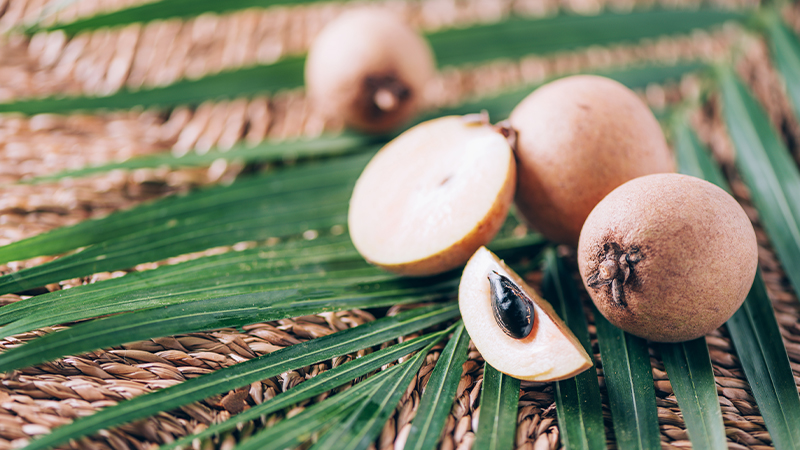
- Native to Central and South America, chiku came to Singapore via the Philippines, where it was introduced during Spanish colonisation.
- It’s commonly known in many Englishspeaking countries as sapodilla.
- The fruit is round or egg-shaped, and up to 10 centimetres in diameter. It has a thin, brownish-grey skin and a light brown-orange flesh with large black seeds.
- The taste of chiku has been described as “caramel-like” – or “pear sprinkled with sugar”!
- In an official tree-planting campaign of the 1970s and 1980s, chiku was one of the fruit trees chosen to be planted around housing estates in Singapore. Lee Kuan Yew planted a chiku tree at Spottiswoode Park Road on 3 November 1985.
- In the first half of the 20th century, an area of the East Coast had its streets renamed after tropical fruit. Chiku Road is still there today – it’s a short dead-end street running off Joo Chiat Place.
- Chiku trees are known to attract bats, so you’ll often see the fruit wrapped in newspaper as it hangs from the branches
- Known as chicle, the sap from the chiku tree and other similar tree varieties was once used as the base for making chewing gum.
- The plant is said to have medicinal qualities, with the bark used in the Philippines to treat fever and diarrhoea, and the flowers in Indonesia in a body ointment for women after childbirth.
- The dark and durable wood of the chiku tree can be used to make furniture.
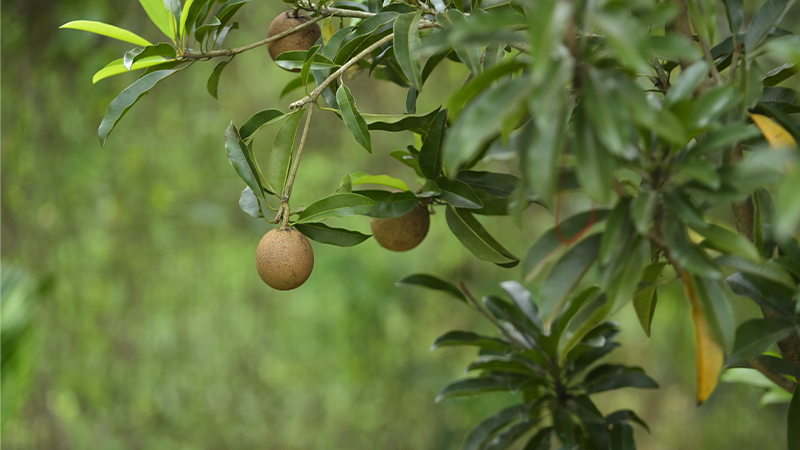
Want to get Expat Living magazine? You can buy the latest issue or subscribe so you never miss a copy!
For more about Singapore, see our Things To Do section.
Don't miss out on the latest events, news and
competitions by signing up to our newsletter!
"*" indicates required fields