
Training for Hyrox in Singapore? DR ALAN CHEUNG, Senior Consultant Orthopaedic Surgeon at International Orthopaedic Clinic, has nine Hyrox races under his belt. Here, he shares his top Hyrox training tips to help you stay injury free, from warming up to managing rest and nutrition, plus when to seek help for an injury.
Hyrox training in Singapore – hear from an ortho surgeon
This November, I will be taking part in my 10th Hyrox race (Singapore Men’s Pro Doubles). For those not caught up in this global phenomenon, Hyrox is an indoor fitness race that combines eight one-kilometre runs with eight functional exercise stations (Ski-Erg, Sled Push, Sled Pull, Burpee Broad Jumps, Rowing, Farmer’s Carry, Sandbag Lunges and Wall Balls) between each run. It’s exhausting but fun and addictive, and races take place all over the world. It’s a great opportunity to travel and race with friends and family overseas.
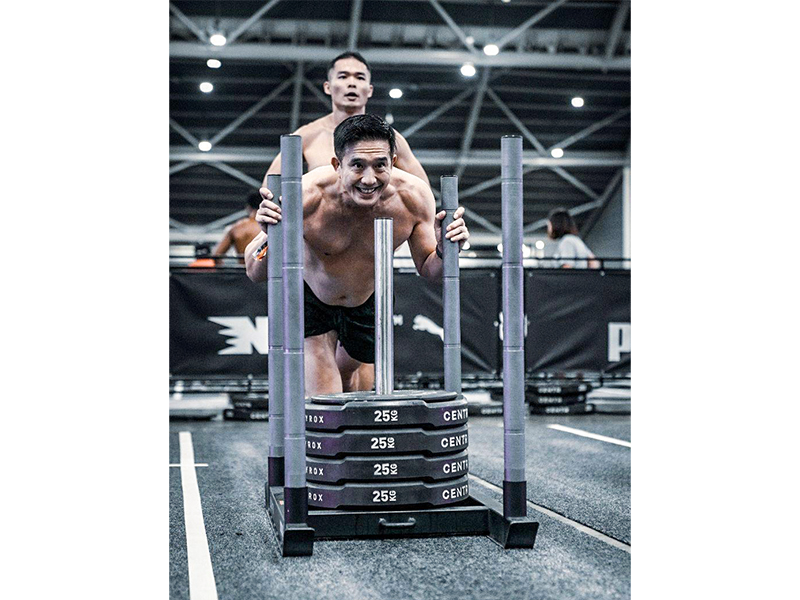
As a sports orthopaedic surgeon, I regularly see Hyrox athletes who have injured themselves through overtraining or poor technique. Here, I share my experiences, advice from professional trainers, and ten tips to help you stay injury free.
#1 Get professional guidance on Hyrox training
For a beginner, the first step is to find a professional coach and gym to train at. I train at ROAR Gym. Most gyms now offer a Hyrox-based programme – useful if you have no idea where to start. Try different gyms to see which one is right for you, and train with friends for motivation and support.
#2 Prioritise your running
My biggest mistake when I first started Hyrox training in Singapore three years ago was neglecting my running and only performing HIIT (high intensity interval training). Running is critical, as it can make up two-thirds of your Hyrox race. Weekly Zone 2 training (where heart rate is between 60 to 70 percent of your maximum heart rate) for 60 to 90 minutes at a time may not feel challenging, but it’s important for building aerobic endurance. Compromised running is an advanced form of training that involves running immediately after resistance training.

#3 Progress gradually
Lawrence Cartwright (Singapore’s Hyrox Men’s Pro Winner and owner of ROAR Gym) says, “It’s important to listen to the body and don’t overtrain! Have a full, rounded programme and gradually increase your training load and intensity.” A gradual increase in training (no more than 10 percent weekly increase in weights, reps or distance) is important to avoid overuse injuries. If you are an absolute beginner, it may take six to 12 months to train for your first race.
#4 Warm up before Hyrox training
Before you start training, I recommend a warm-up of 15 to 20 minutes involving gentle aerobic activity like light jogging, cycling or rowing, dynamic stretches for the upper and lower body and core, and race-specific exercises like light sled pushes and wall balls. Cool down can involve light cardio, deep static stretches and foam rolling.

#5 Master your technique
Mastering technique and specific movements during the stations is important to avoid injury, especially when fatigued. Each station puts a different demand on the body, so it’s worth seeking professional advice to learn the correct way to do things.
#6 Get strong
Strength training for Hyrox differs from a typical bodybuilding workout, as the stations are performed under fatigue. Exercises typically involve weighted squats (for sled pushes, lunges and wall balls), hinge-type exercises such as the trap-bar deadlift to build the posterior chain (muscles in your buttocks and legs) for sleds, farmer’s carries and sandbag lunges, and push or pull exercises such as lat pulldowns and overhead presses. Loaded carries and rotational or unilateral work are also important. At least two weekly sessions of strength training are ideal.
#7 Use the right gear
Before Hyrox, I often experienced pain in my peroneal (ankle) tendons and iliotibial band (on the outside of the knee) after running. Fortunately, my race partner Matt Herd, a podiatrist at My Foot Dr, assessed my running stride and found that my ankles were rolling inwards excessively. This was corrected with insoles, and I’ve been able to run without difficulty ever since. There are many running shoes out there; I prefer one with a thick, cushioned sole for shock absorption.

#8 Rest and recover
Recovery is just as critical to your performance as the workouts themselves. Aim to sleep seven to nine hours a night to allow proper recovery. Harry Busby (an ex-Royal Marine Commando and trainer at ROAR Gym) says, “Recovery is where adaptation to exercise occurs. The training breaks muscle down, and recovery allows the muscle to repair and get stronger.” Without rest, your muscles are slower to repair, and your tendons will gradually break down under cumulative stress. Dedicate at least one day a week to low-impact movement like swimming, light cycling or mobility work.
#9 Eat smart before and after Hyrox training
Fuel with complex carbohydrates before workouts, and prioritise protein and electrolytes post-training to restore muscle glycogen and repair muscle fibres. Avoid alcohol, particularly the night before training. Supplements such as creatine may help build muscle.
#10 Don’t ignore injuries
If you feel a joint or muscle niggle or ache that doesn’t go away with rest, or worse, a sharp pain, don’t ignore it. Seek specialist advice from a doctor who understands your sport. Otherwise, a small problem can become a big one requiring surgery.
About the doctor
Dr Alan Cheung is a British- and Australian-trained orthopaedic surgeon with over 20 years’ experience. He specialises in sports injuries, adult joint reconstruction and minimally invasive robotic surgery.
International Orthopaedic Clinic
#05-24 Mount Elizabeth Novena Specialist Centre, 38 Irrawaddy Road
6253 7111 | WhatsApp 8828 7111 | [email protected] | ioc-ortho.com
This article on Hyrox Singapore, Hyrox training tips and International Orthopaedic Clinic first appeared in the October 2026 Expat Living magazine. You can buy the latest issue or an annual subscription or read the digital version free now.
Don't miss out on the latest events, news and
competitions by signing up to our newsletter!
"*" indicates required fields