
Sleep apnoea, hearing loss and enlarged adenoids are three of the most common ear, nose and throat (ENT) conditions. Here, three ENT specialists in Singapore share the signs to look for and how these conditions can be treated.
#1 Sleep apnoea
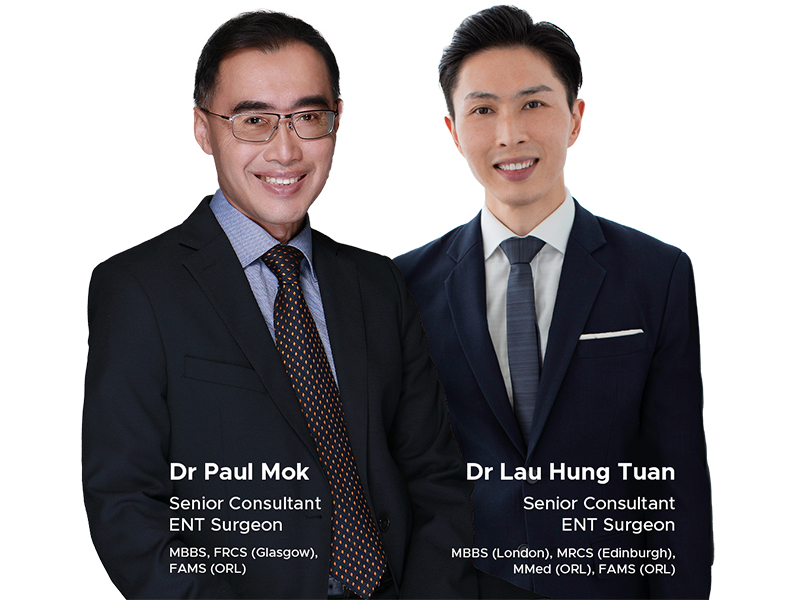
Sleep apnoea is an incredibly common ear, nose and throat (ENT) condition, yet many people may not realise they have it. According to DR PAUL MOK and DR LAU HUNG TUAN from My ENT Specialist, recognising the signs early can make a big difference to not just your sleep quality but overall health.
“Obstructive sleep apnoea belongs to a category of disorders called sleep disordered breathing,” says Dr Mok. “On one end of the spectrum, you have simple snoring which annoys their bed partner but poses no health risk to the patient. On the other end of the spectrum, you have obstructive sleep apnoea which is associated with potential cardio-metabolic morbidity.”

Patients with obstructive sleep apnoea (OSA) experience obstruction of their upper airway – the nose, soft palate, pharynx or tongue base – when they sleep, causing oxygen levels to drop. “This is associated with blood pressure and pulse rate fluctuations, which in the long run can cause hypertension as well as cardiac arrhythmias. The risk of diabetes also increases. This can lead to coronary artery disease, heart attacks and strokes. Poor memory, daytime sleepiness, dementia and early death are also linked with OSA.”
What to look out for
“In a local study, it is estimated that 30 percent of our population have moderate to severe OSA,” says Dr Lau. Yet, because sleep apnoea occurs during sleep, many people may not realise they have it until a partner or family member notices the symptoms. The most common ones include loud snoring, choking during sleep, periods of apnoea (when a patient stops breathing), frequent visits to the toilet at night, interrupted sleep, waking up unrefreshed, and daytime somnolence.
“If you already have pre-existing hypertension, diabetes, heart rhythm abnormalities and have poor sleep quality, it is highly recommended you be evaluated for co-existing OSA,” adds Dr Lau. At My ENT Specialist, diagnosis is straightforward. “First, we thoroughly review the above symptoms and related cardio-metabolic morbidity. Next, we perform an awake supine naso-endoscopy to identify areas of potential obstruction, before conducting a sleep study to document the presence of OSA and categorise its severity. We then discuss management options with the patient.”
Treatment options and new advances
According to Dr Mok, treatment depends on the severity of the condition and the patient’s individual needs. “The first-line treatment for OSA is usually continuous positive airway pressure therapy (CPAP). I recommend a one-month trial of CPAP followed by a consultation to evaluate the effectiveness and compliance to the treatment. We can also recommend mandibular advancement devices (MAD) for patients with mild to moderate OSA.”
However, these options may not suit everyone. “There are patients who cannot tolerate CPAP or MAD. They may benefit from surgery and would typically undergo a drug-induced sleep endoscopy as part of pre-surgical planning. Surgery encompasses nasal surgery, palate and pharyngeal surgery, hypoglossal nerve stimulation and skeletal framework surgery. It is customised to the patient and different combinations of surgery may be necessary to achieve surgical objectives and ensure a good outcome.”
A newer and particularly innovative treatment for OSA is hypoglossal nerve stimulation therapy (or HNST). It involves small devices implanted in the neck and chest.
“Tongue base collapse is common during sleep because the tongue muscles relax, prolapse backwards and obstruct the upper airway, especially when lying on the back. This is particularly challenging to treat because of the potential morbidity associated with its treatment,” explains Dr Lau. “The advent of hypoglossal nerve stimulation gives us an effective way to advance the tongue with minimal patient morbidity. In nerve stimulation surgery, the patient’s breathing is synchronised with a stimulation impulse to the tongue which stabilises its position to keep the airway open during sleep.”
According to these ENT specialists in Singapore, HNST is suitable for adult patients with OSA not exceeding 100 episodes per hour and a BMI under 40 who haven’t had success with CPAP or previous upper airway surgery.
Final thoughts
Both doctors emphasise the importance of early evaluation. “If you or your friends and family suspect they might have OSA, you should not delay evaluation and treatment because of the potential health consequences associated with it. There is a range of treatments available which our ENT doctors will walk
About these ENT specialists in Singapore
My ENT Specialist provides comprehensive care for ear, nose and throat conditions. The clinic was founded by Senior Consultant ENT Surgeons Dr Paul Mok and Dr Lau Hung Tuan, and the team has more than 20 years of specialist experience.
My ENT Specialist
• #09-24 Mount Elizabeth Novena Specialist Centre, 38 Irrawaddy Road
• #10-04 Connexion, Farrer Park Hospital, 1 Farrer Park Station Road
6397 5280 | myentspecialist.sg
#2 Hearing loss
Hearing loss is a condition that occurs when one or both ears are not working properly. It can present right from birth or later in life, at any stage. And it’s not just a condition of older people. Even children who previously had normal hearing can develop hearing loss.
In fact, a frightening number of younger people – specifically, 12- to-35-year-olds – are at risk of developing permanent hearing loss from listening to music and gaming devices at high volumes for prolonged periods of time, says DR REBECCA HEYWOOD, a British ENT specialist surgeon in Singapore, with special expertise in managing complex ear and hearing conditions in adults and children.

In addition to loud noise exposure, some common causes of acquired hearing loss in adults and children include:
- build-up of ear wax;
- ageing;
- infection of the outer or middle ear;
- fluid behind the ear drum (known as “ear glue”); and certain medications that are harmful to the inner ear.
For many people, hearing loss develops quite slowly, making it difficult to distinguish any obvious change in hearing capabilities. For example, someone with mild to moderate hearing loss may not notice that the everyday sounds around them have dulled.
“By the time hearing loss becomes severe, only very loud sounds can be heard and those affected may not even know that people are talking to them at all at a normal conversational level,” says ENT specialist in Singapore, Dr Heywood.
How hearing loss can hurt you
Because hearing loss is an “invisible” condition, it’s all too often disregarded. However, untreated hearing loss can have detrimental effects on all aspects of an individual’s life.
“Life is all about communication, and people with hearing loss have difficulty communicating. Having hearing loss can be extremely lonely and isolating,” says Dr Heywood. “For someone with mild to moderate hearing loss, dinner with family or friends can create feelings of exclusion and loneliness, even while surrounded by loved ones.”
Additionally, people with hearing loss often feel embarrassed about asking others to repeat themselves constantly. Sometimes, they pretend to understand, but miss what’s being said completely. This, of course, poses challenges at school and in the workplace, and everywhere in between. It can take a major toll on personal relationships, leading to social isolation and lack of self-esteem, and even anxiety and depression.
What’s more, Dr Heywood says hearing loss has recently been linked to various health conditions. Older people with hearing loss, in particular, have an increased risk of falls, hospitalisation and death, especially due to cardiovascular causes.
Also concerning is the link between hearing loss and memory problems, including an increased risk of dementia. In fact, hearing loss in midlife – not just in old age – has been found to be the largest modifiable risk factor for dementia.
Signs of hearing loss: What to look for at every life stage
With such challenges posed by hearing loss, it’s important to know the red flags to look for at every phase of life.
Babies and toddlers
Parents of babies with hearing loss may notice that their baby doesn’t startle to loud sounds, or won’t turn toward their voice or environmental sounds, or start to babble. Toddlers with hearing loss may have delayed or even absent speech and language development, depending on the degree of their hearing loss.
Children
Kids with hearing loss may:
- not respond when spoken to, particularly if they’re not close to the speaker;
- look at peoples’ faces more when they are being spoken to;
- ask for things to be repeated;
- start turning the TV volume louder; and
- fall behind in school. Parents and teachers may notice that the clarity of the child’s speech has deteriorated, and teachers may complain that the child doesn’t pay attention in class.
Adults
The first thing adults may notice is that they can hear people talking but can’t quite understand what they are saying. This is only made worse with background noise. Family members may notice that an adult with hearing loss needs to turn the TV louder and ask people to repeat things frequently.
Treatment options for hearing loss
Luckily, you don’t have to live with hearing loss. “No matter how bad the hearing loss is, there are treatment options available,” says Dr Heywood. “With the help of an experienced ENT specialist or audiologist, your quality of life can be transformed.”
Inner ear hearing loss can often be managed with a hearing aid. And, thanks to recent advances, there are now smaller, more aesthetically pleasing options with all kinds of technological capabilities to improve sound quality, says Dr Heywood.
Hearing aids, however, won’t prove beneficial in cases where the patient’s speech clarity is too depreciated. This is when patients can benefit from cochlear implants – electronic devices that surgeons implant into the inner ear to transmit sound signals directly to the cochlear (auditory) nerve leading to the brain. Patients can even stream music and phone calls from their smartphones directly to the implants – and to hearing aids too.
The ENT Clinic
#03-41/42 Gleneagles Annexe, 6A Napier Road
6251 6332 | entclinic.sg
#3 Enlarged adenoids
Adenoids are a cluster of soft lymphoid tissue at the very back of the nasal passage. Together with the tonsils, adenoids play an important role in your child’s lymphatic system, explains DR EUAN MURUGASU, an ENT specialist in Singapore. He’s also a surgeon at Euan’s ENT Surgery and Clinic based at Mount Elizabeth Novena and treats all kinds of ENT conditions in children and adults – from ear infections, hearing loss and tonsillitis to nose bleeds and sleep disordered breathing.
Adenoids, he says, are important in the very early years. That’s because they ward off infection by trapping harmful bacteria that your child breathes in through his mouth or nose. But, as children grow older and their bodies develop other ways to fight infection, their adenoids begin to shrink and almost completely disappear by the teen years.
The problem with enlarged adenoids
While adenoids serve a positive purpose as germ fighters, ENT specialist Dr Murugasu says that they can become problematic if they become enlarged or swollen and obstruct the child’s airway. Sometimes, this happens as a result of allergies, inflammation or infection. In fact, he says that, in the US, adenoids are sometimes referred to as the “sewer” of the nose, as bacteria may infect and colonise the tissues.
Luckily, there are signs you can look for that can indicate that enlarged adenoids may be affecting your child’s airway. You may notice that your child is experiencing:
- trouble breathing through the nose;
- mouth breathing, which can lead to a dry mouth and lips;
- noisy breathing;
- bad breath;
- snoring;
- obstructive sleep apnoea;
- frequent or chronic nose and sinus infections; and
- ear infections, middle ear fluid and hearing loss.
Of course, these symptoms do not always mean that a child has enlarged adenoids. But, if you notice that your child is presenting with any of these symptoms, it’s a good idea see your family doctor or paediatrician. They can then refer you to an ENT specialist for further diagnosis and treatment.
“At your visit, an ENT doctor will ask about and check your child’s ears, nose and throat, and feel the neck along the jaw. To get a really close look, the doctor might order x-rays or look into the nasal passage with a tiny telescope, called a naso-endoscopy,” says Dr Murugasu.

Treatment for enlarged adenoids
For a suspected allergy, doctors can prescribe nasal steroids to reduce the swelling. However, if the problem persists, your child may need surgery to remove the adenoids.
The surgical removal of enlarged adenoids is called an adenoidectomy. It is one of the most common ENT procedures performed on children, along with tonsil removal. These days, doctors can perform adenoidectomies as minimally invasive procedures, says Dr Murugasu. In his practice, he prefers the coblation technique. It uses gentle low-temperature radiofrequency technology to remove the targeted tissue with minimal damage to the surrounding tissue, as compared to the more traditional surgical techniques. The coblation system uses an endoscopic wand to access the back of the throat without requiring any incisions.
In most cases, the procedure is quick, and the child can usually go home on the same day, given that there are no complications.
Euan’s ENT Surgery & Clinic
#14-12 Mount Elizabeth Medical Centre, 3 Mount Elizabeth
6694 4282 | euansent.com
This article on sleep apnoea, hearing loss, enlarged adenoids and ENT specialists in Singapore first appeared in Expat Living magazine. You can buy the latest issue or an annual subscription or read the digital version free now.
Interested in knowing about editorial options? Email us at [email protected].
Don't miss out on the latest events, news and
competitions by signing up to our newsletter!
"*" indicates required fields