Want to do some Singapore tours but not sure where to start? On a recent guided walking tour of Chinatown with Tricia Lui of DoIt Tours, Expat Living reader RHIANNON OLIVER learnt about the history of the shophouses and had a look at some interesting street art. She also heard stories about the people behind some of the area’s iconic buildings and establishments.

I met Tricia along with a small group of expats outside the Urban Redevelopment Authority’s Singapore City Gallery. It’s just a few minutes’ walk from Maxwell or Tanjong Pagar MRT. We were about to set off on a guided walking tour of conserved buildings in Chinatown, an activity I’d always thought of as something for tourists rather than a way to explore my own city.
If you haven’t been, the gallery is worth a visit on its own. It’s packed with interactive models, exhibits and displays showing how Singapore has changed over time. Best of all, it’s free!

New life for old buildings
Tricia kicked off the tour by explaining Singapore’s approach to preserving heritage. This is easily remembered as the “three R” principles: sensitive restoration, maximum retention and careful repair.
As we walked through the gallery, she highlighted the differences between Singapore’s iconic shophouses, and how their architecture has changed over the years. The simple, early designs date back to the 1840s and had minimalistic décor. By the 1930s, a bolder Art Deco style was fashionable – easily identifiable by their geometric patterns and clean arches. Each era has its own design characteristics, which are easy to spot when you know what to look for.
Next, we crossed the road to the former St Andrew’s Mission Hospital. It’s been there since 1923 and has now been repurposed as a lifestyle and wellness venue, Kada. We rode the original lift (almost a hundred years old and still working!) up to the rooftop to a trendy alfresco eating area. Foodies can head here to check out Proud Potato Peeler, a fusion of Middle Eastern and Mediterranean flavours. There’s also Alani, a Mediterranean bakery-café and sister concept of Proud Potato Peeler. But make sure to book in advance!
A short walk up Erskine Road took us to The Scarlet (now The Erskine by The Scarlet). The row of shophouses from 1868 initially served as shared living quarters for poor immigrants and was even adapted to house horse-drawn carriages, with coachmen sleeping alongside their horses. The site was later transformed into a boutique hotel, complemented by the adjacent 1924 Art Deco building. Now you can find a range of shops, bars and eateries.

Stories behind the streets
We continued our Chinatown tour on South Bridge Road. The former Eu Yan Sang building is today a co-working space called The Great Room. This well-known Chinese medicine shop was founded in 1873 by Eu Kong, who left Southern China to seek his fortune in Malaya. The row of four conserved buildings dates back to 1910 and was commissioned by Eu Kong’s son, Eu Tong Sen. Interestingly, its designer Alfred Bidwell was the same architect who created Raffles Hotel and the Victoria Memorial Hall.
We stopped for a caffeine break at Mortar & Pestle, located on the fourth level of the building. It has a great view over Chinatown’s red-tiled roofs. What I loved most about Tricia’s style of guiding was how she brought every building to life with fascinating (and sometimes scandalous) stories about the people behind them. Over our coffees, she let us in on “locals-only” gossip. There were stories of polygamy, inheritance battles and brilliant business moves involving famous names. I found myself leaning forwards in my seat, eager to hear more!
With our gossip quota officially filled, we wandered towards Club Street to admire its murals. One that stood out to me was the Samsui Woman Mural, which recently stirred plenty of debate online. Painted by American artist Sean Dunston, it’s well worth a look if you’re nearby.
Clubs and societies
At the top of Club Street is the Chinese Weekly Entertainment Club, a private Chinese social club set up in the late 1800s. Members comprised mainly the wealthy Straits Chinese elites. It was the first club on Club Street and believed to be the reason for the street’s name. “Guest nights” were held where Europeans were invited and mingled with members over 10-course dinners and champagne.

Next to it stands the century-old Goh Loo Club, whose name translates to “my humble hut”. It was once an exclusive gathering place for prominent Chinese pioneer businessmen. Along the building’s side wall is a mural depicting several of the club’s late members, as well as General Tomoyuki Yamashita, who led the Japanese forces during the invasion of Malaya and the Battle of Singapore. In case you’re wondering about the connection, shortly after the fall of Singapore, Chinese community leaders who had not managed to flee were summoned to Goh Loo Club and ordered to pledge $50 million Straits dollars to support the Japanese war fund.
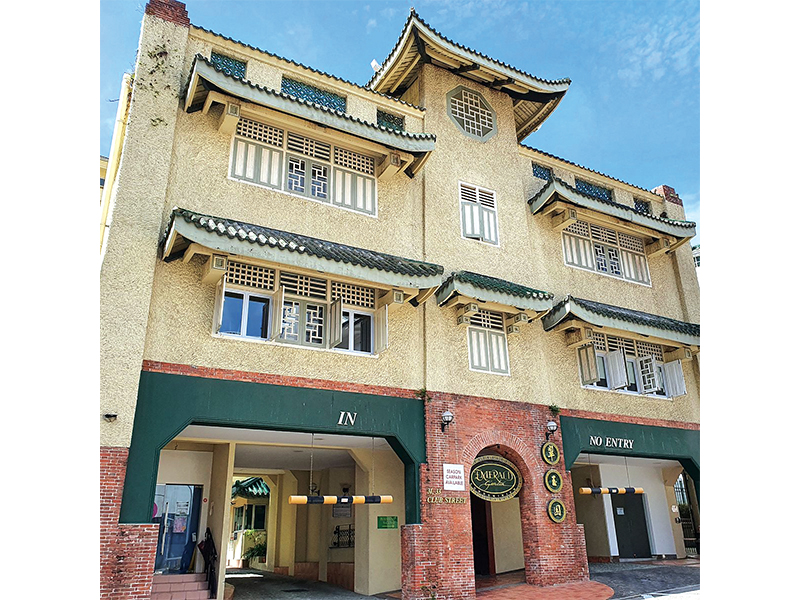
We also stopped by Emerald Garden Mansion, where Eu Tong Sen engaged architect Frank Brewer of Swan & Maclaren to design two Chinese Renaissance-style apartment blocks here. These conserved buildings now form the distinctive entrance to the modern Emerald Garden condominium.
Restoration and preservation of Chinatown
We continued to Mosque Street, whose eye-catching red-shuttered shophouses once housed Customs Officers during colonial times. By the early 2000s, they had become neglected. However, a new owner restored them in 2002, turning the upper floors into apartments and the lower ones into shop units.
We ended the guided walking tour of Chinatown outside The Majestic – formerly The Majestic Theatre, and before that, Tien Yien Moh Toi Theatre. Tricia told us Eu Tong Sen built it in 1927 after his wife had been turned away from another theatre. (Cue some of the group joking, “If he wants to, he will!”) It’s now a major Chinatown landmark. Look closely and you’ll notice the colourful mosaic front still shows ornate dragons and scenes from Cantonese opera.

I couldn’t believe how quickly the morning had passed and how much we had managed to squeeze in. I’ll definitely be signing up for another walking tour soon. The EL team is doing The Crazy Rich Asians tour with Tricia in March, too.
Find out more about this and Tricia’s other Singapore tours at doit.tours.
This article on Singapore tours first appeared in the January 2026 issue of Expat Living. You can buy the latest issue or an annual subscription, or read the digital version free now.
Want your company to be in this round-up, or interested in knowing about other editorial options? Email us at sales@expatliving.sg.
Don't miss out on the latest events, news and
competitions by signing up to our newsletter!
By signing up, you'll receive our weekly newsletter and offers which you can update or unsubscribe to anytime.